
The people's voice of reason


The people's voice of reason
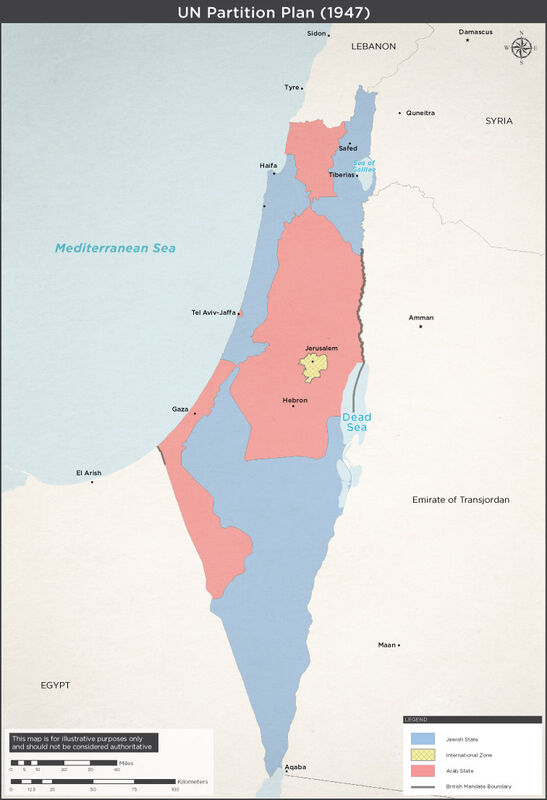
The UN's proposed division of Mandatory Palestine into separate Jewish and Arab states, with Jerusalem and the area around it designated as an internationally administered city.
On the evening of November 29, 1947, the United Nations General Assembly voted to adopt Resolution 181 (II), a landmark decision that proposed the partition of Mandatory Palestine into two independent states-one Jewish and one Arab-with Jerusalem designated as a special international zone due to its religious significance. The resolution passed with 33 votes in favor, 13 against, and 10 abstentions, reflecting deep global divisions over the future of the region.
The Partition Plan
The resolution was based on recommendations from the United Nations Special Committee on Palestine (UNSCOP), which had been tasked with resolving the escalating conflict between Jews and Arabs in the British-administered territory. The plan proposed:
• Jewish State: Approximately 56% of the territory, including the coastal plain, Galilee, and the Negev Desert.
• Arab State: About 43%, covering the West Bank, Gaza Strip, and parts of central Palestine.
• Jerusalem: A corpus separatum, or separate entity, under international administration, to protect access to holy sites for Jews, Christians, and Muslims.
The resolution also called for the termination of the British Mandate and a phased withdrawal of British forces, to be completed by August 1, 1948.
Immediate Fallout: Civil War in Palestine
While the Jewish leadership accepted the plan-viewing it as a legal foundation for the future state of Israel-the Arab leadership rejected it outright, arguing that it unfairly favored the Jewish minority, which comprised roughly one-third of the population but was allocated the majority of the land.
Within hours of the vote, violence erupted across Palestine, marking the beginning of the Palestinian civil war. Armed clashes between Jewish and Arab militias intensified, leading to widespread casualties and displacement. This internal conflict would escalate into the 1948 Arab-Israeli War following the declaration of the State of Israel in May 1948.
Legacy and Controversy
Resolution 181 remains one of the most consequential-and controversial-acts in UN history. It laid the groundwork for the establishment of Israel, but also deepened the Arab-Israeli divide, contributing to decades of conflict and displacement. The internationalization of Jerusalem, though never fully implemented, continues to be a sensitive issue in peace negotiations.



Reader Comments(0)