
The people's voice of reason


The people's voice of reason
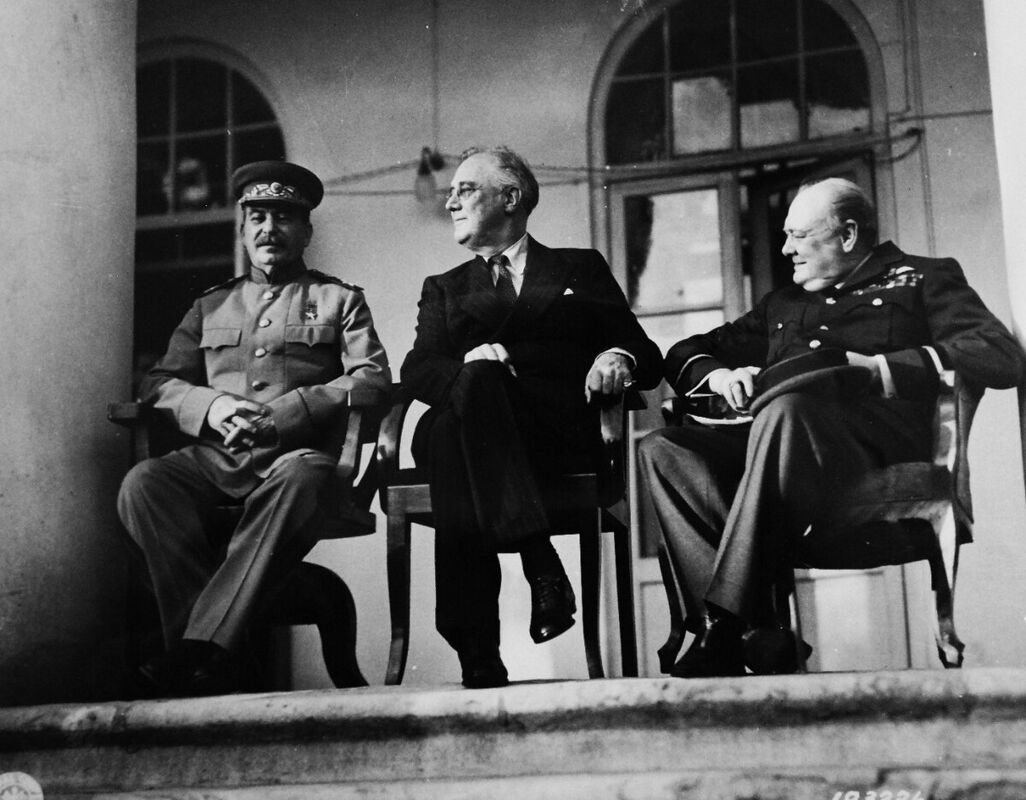
The Tehran Conference: Stalin, Roosevelt, and Churchill
On November 28, 1943, the Tehran Conference brought together U.S. President Franklin D. Roosevelt, British Prime Minister Winston Churchill, and Soviet Premier Joseph Stalin for the first time in person. Held in Tehran, Iran, this pivotal World War II summit shaped the Allied strategy for defeating Nazi Germany and laid the groundwork for the postwar world.
The First Meeting of the "Big Three"
The Tehran Conference, codenamed "Eureka," was the first time that all three of the leaders of the three major Allied powers-Roosevelt, Churchill, and Stalin-met face-to-face. The summit took place from November 28 to December 1, 1943, at the Soviet Embassy in Tehran, then under Allied occupation following the Anglo-Soviet invasion of Iran in 1941.
The meeting followed the Cairo Conference, where Roosevelt and Churchill had met with Chinese leader Chiang Kai-shek. But Tehran was different: it was the first time the Western Allies and the Soviet Union would coordinate their military and political visions in one room.
The Central Issue: Opening a Second Front
The most pressing topic on the agenda was the long-delayed Second Front in Western Europe. Stalin had been urging the U.S. and Britain to launch a major offensive against Nazi Germany in the west to relieve pressure on Soviet forces fighting on the Eastern Front.
At Tehran, Roosevelt and Churchill finally committed to Operation Overlord, the codename for the Allied invasion of Normandy, France, which would begin in June 1944. In return, Stalin pledged to launch a simultaneous Soviet offensive on the Eastern Front to coincide with the invasion, ensuring that German forces would be stretched thin on both sides.
This agreement marked a turning point in the war. It signaled a unified Allied strategy and set the stage for the liberation of Western Europe from Nazi control.
Postwar Planning and Political Tensions
While military coordination was the primary focus, the Tehran Conference also delved into postwar geopolitical arrangements. The leaders discussed the future of Germany, the fate of Eastern Europe, and the creation of a new international organization to maintain peace-what would later become the United Nations.
However, tensions were already evident. Stalin insisted on Soviet control over Eastern Poland and the Baltic states, citing security concerns. He also expressed disdain for the Polish government-in-exile in London, which the Western Allies supported. These disagreements foreshadowed the Cold War divisions that would emerge after the war.
Despite these differences, the leaders agreed on a Declaration of the Three Powers Regarding Iran, pledging to respect Iran's sovereignty and independence and to provide postwar economic assistance.
Security and Diplomacy in Tehran
The choice of Tehran as the meeting site was strategic. Iran provided a secure location accessible to all three leaders and served as a vital supply route for the Allies, especially for delivering American aid to the Soviet Union via the Persian Corridor.
Security was tight. The conference was held at the Soviet Embassy, and Roosevelt, who had originally planned to stay at the American legation, was persuaded to stay at the Soviet compound for safety. This gave Stalin a home-field advantage and allowed him to exert subtle influence over the proceedings.
Roosevelt, eager to build rapport with Stalin, went out of his way to charm the Soviet leader-sometimes at the expense of Churchill, who remained wary of Stalin's intentions. Churchill later expressed concern that Roosevelt was too accommodating, especially regarding Eastern Europe.
The Yugoslav Partisans and Turkey's Role
The conference also addressed the situation in the Balkans. The Allies agreed to support Josip Broz Tito's Yugoslav Partisans, who were proving more effective against Axis forces than the royalist Chetniks. This decision would have long-term consequences for Yugoslavia's postwar alignment.
Stalin also pressed for Turkey to join the war against Germany. While Turkey remained officially neutral at the time, the Allies hoped it might open a new front in the Balkans. However, Turkey would not declare war on Germany until 1945.
Legacy of the Tehran Conference
The Tehran Conference was a landmark in Allied cooperation. It solidified the military strategy that would lead to the defeat of Nazi Germany and initiated discussions that would shape the postwar world order.
Key outcomes included:
• Commitment to Operation Overlord, launching the D-Day invasion in June 1944
• Soviet agreement to join the war against Japan after Germany's defeat
• Support for Iranian independence and postwar aid
• Preliminary discussions on the United Nations
• Recognition of the need for postwar occupation and division of Germany
Yet, the conference also exposed the ideological rifts between East and West. While the Big Three presented a united front, their competing visions for Europe's future would soon lead to confrontation.
In retrospect, the Tehran Conference was both a triumph of wartime diplomacy and a harbinger of the Cold War. It demonstrated the Allies' ability to coordinate massive military operations, but also revealed the deep political fissures that would define the second half of the 20th century.







Reader Comments(0)