
The people's voice of reason


The people's voice of reason

Last week, the global trade policy landscape saw a mix of slowing down and reactivation. The U.S. administration, while maintaining its broader tariff agenda, indicated a pause or delay in the imposition of large semiconductor import tariffs, reflecting sensitivity to supply-chain disruption, consumer pricing and the U.S.–China trade truce. Meanwhile, Canada and India moved to reset bilateral trade negotiations, signalling a thaw in previously strained relations and a renewed push to expand trade and investment. At the same time, high‐level engagement between the U.S. and China underscored that major trade policy shifts continue to be intertwined with geopolitics and technology-driven supply chain, Freight Right Global Logistics reports..
China-US Ocean Freight Market:
CEA to USWC: Spot rates continued their rapid decline this week, now falling to the $1,350-$1,500/FEU range, with some carrier-specific lows touching $1,350. This marks the fifth or sixth consecutive weekly drop in November, driven by slow demand and an extremely short holiday week in the U.S.
CEA to USEC: USEC rates also fell, now averaging ~$1,900/FEU, shrinking the typical spread between West and East Coast from ~$800–$900 to just $600–$700. Both lanes are effectively at or near their “rock-bottom” levels for the year.
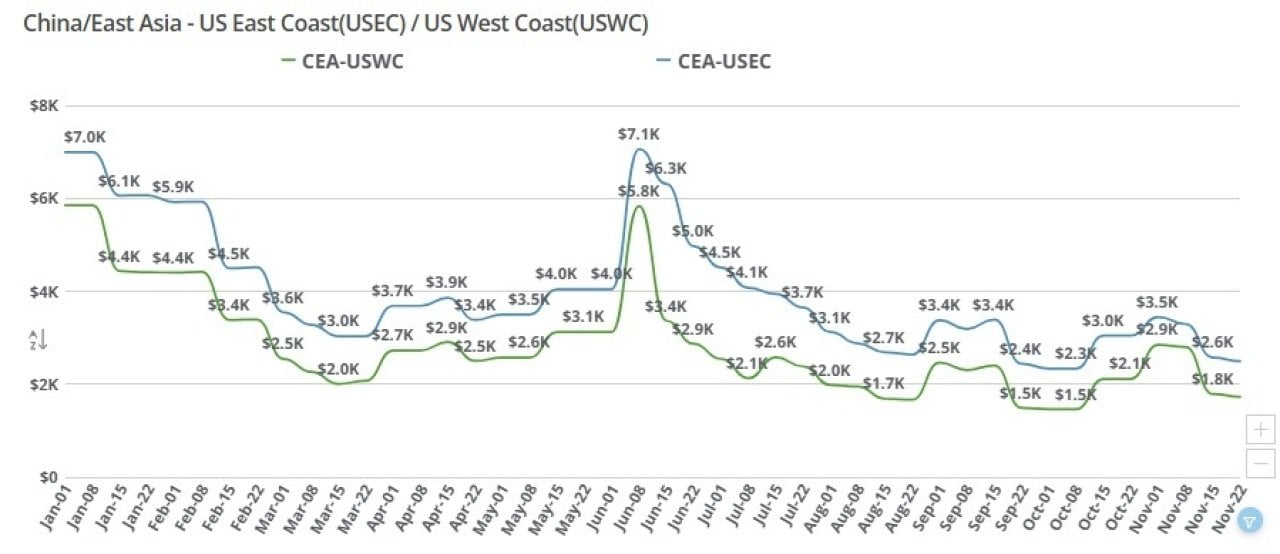
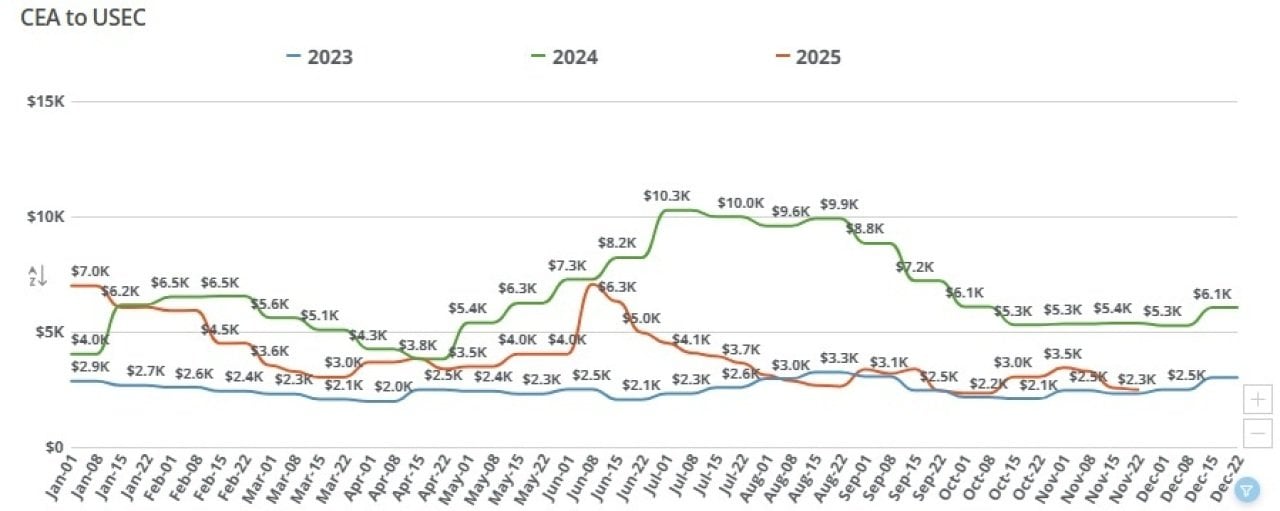
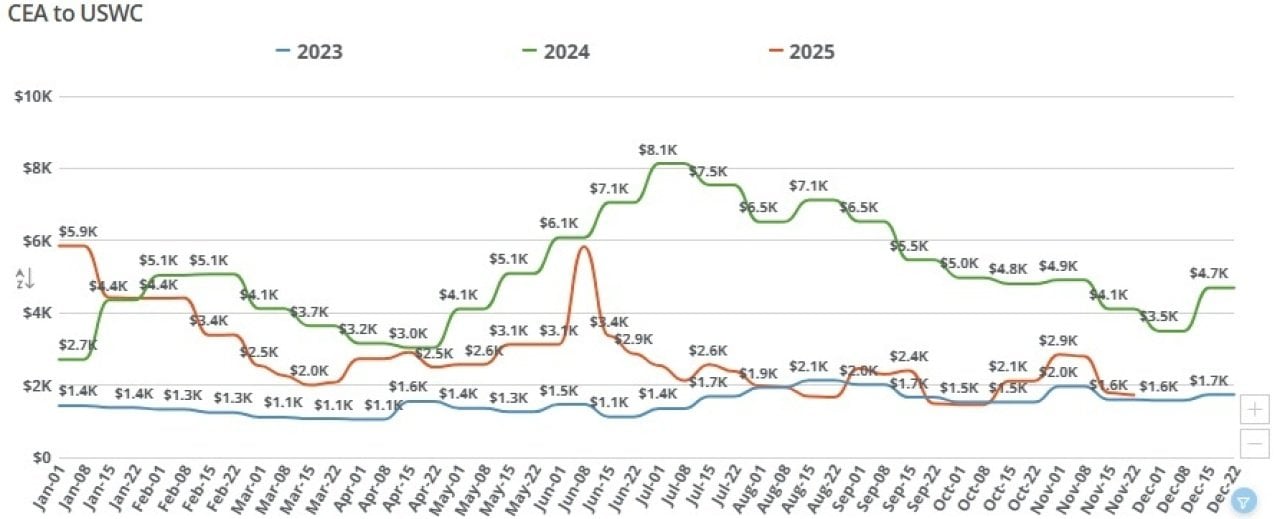
Read more about the state of the ocean freight spot market with Freight Right’s TrueFreight Index.
This Week Explained:
Looking Ahead:
December is likely to stay at rock-bottom levels. Rates are expected to remain flat or soften slightly heading into December. With multiple public holidays and business closures, carriers have no incentive to introduce GRI/PSS mid-month.
A January rate increase is expected ahead of Chinese New Year. Carriers are almost certain to push through GRIs or PSS by early or mid-January to capitalize on pre-CNY cargo. Current levels are unsustainably low, and carriers will not want to move CNY volumes at $1,300–$1,900.
The Post-CNY slowdown will return. Once CNY passes (Feb. 18 window), carriers expect a deep lull for several months. Any rate strength in January-February will likely be short-lived.
No market surprises are expected: The near-term outlook is stable, predictable, and soft. Rates will close the year at or near current levels unless an unexpected shock emerges.
CEA to USWC (China to U.S. West Coast): Rates continued to climb week-over-week as carriers push peak-season pricing ahead of December demand. Although the increases are moderate, capacity tightening and steady booking momentum are sustaining upward pressure.
CEA to USEC (China to U.S. East Coast): East Coast rates also moved higher this week, with all-water services seeing firmer pricing due to stronger demand, longer transit times, and continued blank-sailing strategies. The week-over-week uptick is in line with broader peak-season behavior.
This Week Explained:
Looking Ahead:
Rate strength is expected to persist through the end of December, with carriers signaling additional GRIs if demand remains firm.
Capacity constraints will likely remain tight, particularly on USEC services, as vessels sail fuller approaching the holiday cutoff period.
A short-term stabilization or slight softening may emerge in early January once holiday-driven demand tapers, though much will depend on carrier discipline with blank sailings.
Shippers should plan for elevated rates and limited premium space availability for the remainder of the month and secure bookings as early as possible.
This story was produced by Freight Right Global Logistics and reviewed and distributed by Stacker.








Reader Comments(0)