
The people's voice of reason


The people's voice of reason
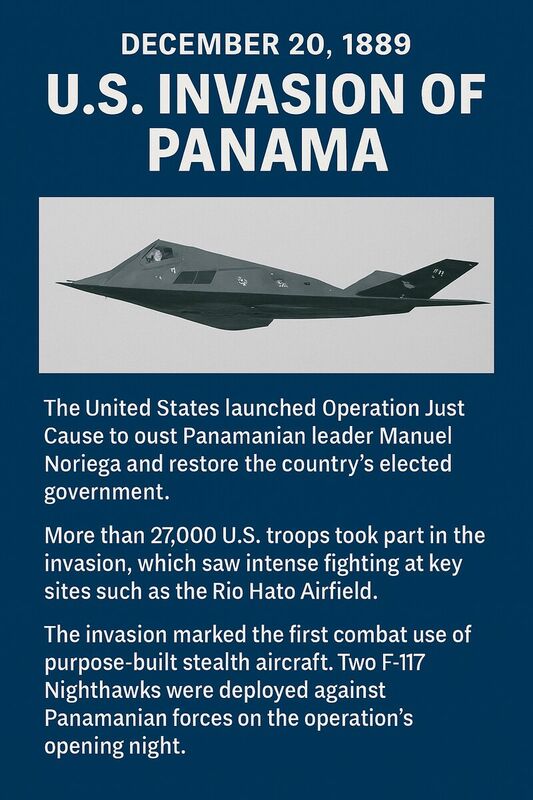
The invasion of Panama was the first use of stealth aircraft in combat
December 20, 1989 - In the early hours of December 20, 1989, the United States launched Operation Just Cause, a large‑scale military invasion of Panama aimed at removing strongman Manuel Noriega from power and restoring the country's elected government. The operation would become one of the most significant U.S. military actions of the late Cold War - and the first to feature the combat use of purpose‑built stealth aircraft.
More than 27,000 U.S. troops participated in the invasion, striking targets across Panama in a coordinated assault designed to neutralize the Panama Defense Forces and secure key infrastructure. One of the opening actions unfolded at Rio Hato Airfield, the largest Panamanian military base, where U.S. Army Rangers parachuted in under heavy fire to seize the installation and capture Noriega's nearby beach residence.
Stealth Aircraft Enter Combat for the First Time
Operation Just Cause marked the combat debut of the F‑117A Nighthawk, the world's first operational stealth attack aircraft. Two F‑117s were tasked with delivering 2,000‑pound precision bombs near Rio Hato in an effort to disorient Panamanian forces before the Rangers' arrival.
Although the bombs detonated slightly off target, the mission represented a historic milestone: the first time a purpose‑designed stealth aircraft had been used in live combat. The F‑117's participation in Panama paved the way for its more extensive use during the Gulf War just over a year later.
Ground Combat and Heavy Resistance
The assault on Rio Hato illustrated the intensity of the fighting. Rangers jumped from C‑130 aircraft at an unusually low altitude - just 490 feet - to avoid Panamanian anti‑aircraft fire. Eleven of the thirteen transport planes were hit by 23mm fire, and several Rangers were wounded before they even reached the ground.
Despite the resistance, U.S. forces secured the airfield, captured dozens of Panamanian troops, and established control of the surrounding area.
Objective: Remove Noriega
The invasion followed months of escalating tension between the United States and Noriega, who had been indicted on drug trafficking charges and accused of nullifying democratic elections. U.S. officials cited the need to protect American personnel, defend the Panama Canal treaties, and restore democratic governance.
Noriega fled and remained at large for several days before surrendering to U.S. forces in early January 1990.
Legacy of Operation Just Cause
Operation Just Cause lasted just over two weeks, ending with the installation of Panama's elected government. The invasion remains a subject of debate, but militarily it demonstrated the growing sophistication of U.S. joint operations - and introduced the world to the era of stealth warfare.
The F‑117's role in Panama, though limited, marked the beginning of a new chapter in aerial combat technology, one that would shape U.S. airpower for decades to come.





Reader Comments(0)