
The people's voice of reason


The people's voice of reason

The thrill of the open road is an unbeatable universal truth for every motorcycle rider. However, the associated cost of motorcycle insurance can be a real buzzkill. While protection is essential, riders do not want their motorcycle insurance eating into their new gear fund.
The good news regarding motorcycle insurance savings? The quickest and most effective way to ride safely and lower the cost of motorcycle insurance is not some secret handshake or shady online deal. It is a motorcycle safety course. It can be thought of as a two-for-one deal: a major upgrade in riding skills and a guaranteed shrinkage of the motorcycle insurance bill. It is a win-win situation, and Cheap Insurance provides the roadmap for how this savings opportunity occurs.
The reluctance of motorcycle insurance companies to offer discounts is well known, given their risk aversion. Therefore, the decision by these motorcycle insurance providers to reduce premiums following course completion requires examination. The foundation for this practice is simple: data.
A motorcycle operator who has successfully completed an approved safety course represents a statistically lower risk to the motorcycle insurance provider. The successful course completion demonstrates a commitment to proper riding techniques, accident avoidance, and a responsible attitude toward safety. Lower risk exposure results in fewer insurance claims, and this positive claims history translates directly into lower motorcycle insurance premiums for the policyholder.
While the exact percentage varies by state, individual insurer, and the specific motorcycle insurance policy, the typical discount for completing an approved motorcycle safety course is significant and immediate.
The graph below is based on research by CheapInsurance.com from the websites ridemss.com and trustedchoice.com.
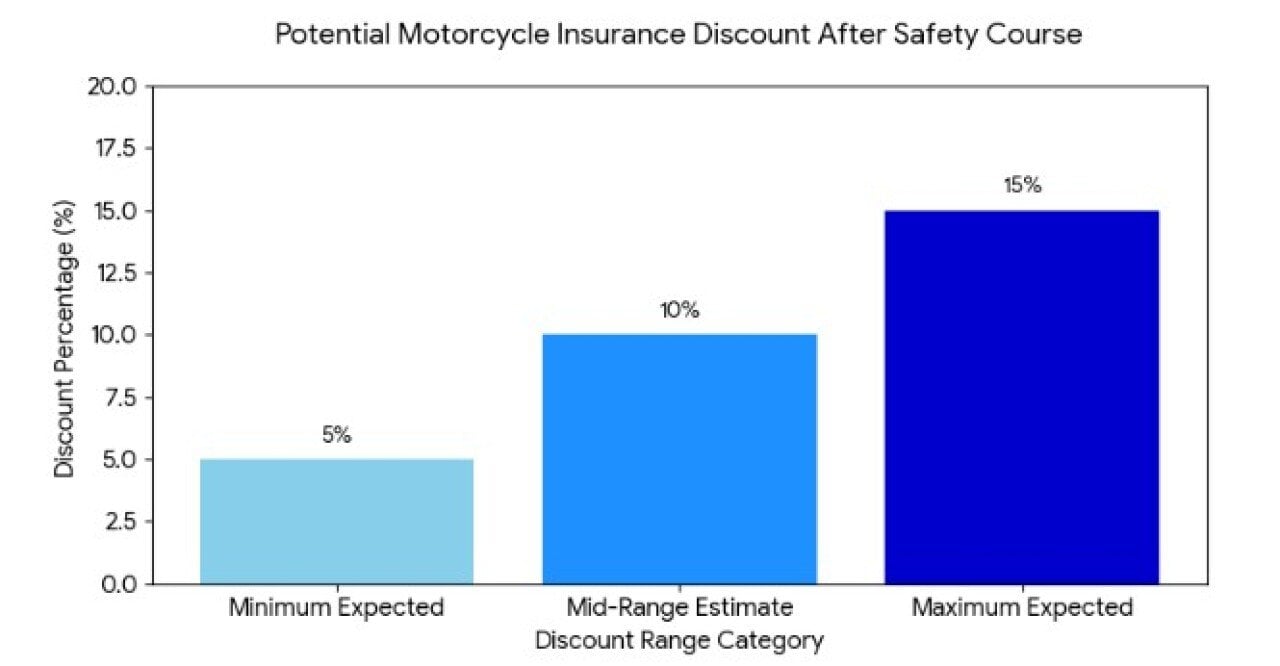
The financial savings associated with lower motorcycle insurance premiums are a compelling incentive. The true, priceless value of this investment, however, lies in the substantial improvement to the rider’s skills and confidence. Completing an approved motorcycle safety course is not merely about fulfilling a requirement for the motorcycle insurance provider. It is fundamentally about transforming an individual into a more proficient, safer, and highly confident operator. This reduced risk profile directly justifies the significant discount offered on motorcycle insurance coverage. The advanced training results in fewer incidents, reinforcing the value of the safety certification within the motorcycle insurance industry.
Most approved safety courses, such as the widely recognized Motorcycle Safety Foundation (MSF) Basic RiderCourse (BRC), are intensive, hands-on programs. These courses cover essential maneuvers that significantly reduce the likelihood of accidents, a factor highly valued by motorcycle insurance providers.
For newer riders, successful completion of the Basic RiderCourse often grants a license waiver in many states, streamlining the licensing process. For experienced veterans, an Advanced RiderCourse (ARC) or a refresher course can polish skills that may have grown rusty and help maintain the vital motorcycle insurance discount.
For riders prepared to secure their savings, the following is a quick action plan for obtaining the motorcycle insurance discount.
Step 1: Verify Motorcycle Insurance Requirements
Before registration, the insurance agent must always be contacted. Ask the agent the following critical questions regarding the motorcycle insurance policy:
Step 2: Locate a Certified Training Location
Riders should seek out providers certified by the state's Department of Motor Vehicles (DMV) or a nationally recognized organization, such as the MSF. These are the courses that motorcycle insurance companies recognize and trust. Local motorcycle dealerships, community colleges, or dedicated riding academies can be checked for availability.
Step 3: Complete the Course and Obtain the Card
Enrollment, attendance, and successful completion of the required classroom and riding portions are necessary. Upon passing, the rider receives a course completion card (often a brightly colored, durable card). This card is the necessary documentation for the motorcycle insurance discount and must be retained carefully.
Step 4: Inform the Motorcycle Insurance Agent
This is the final step. The insurance agent must be notified of the course completion, and a copy of the completion card must be sent to the agent (a digital photo or scan is usually acceptable). The agent will then apply the discount to the motorcycle insurance policy. Riders should expect to see the savings reflected on the next bill or as a partial refund on the current premium.
Many riders focus on saving money only when the annual motorcycle insurance renewal bill is received. There is no need for this delay. The safety course discount can often be applied midpolicy, offering immediate savings on motorcycle insurance.
The renewal clock is constantly ticking, and the sooner the safety course is completed, the sooner those savings on motorcycle insurance premiums begin. Furthermore, for a newer rider, taking the course early immediately establishes a lower-risk profile, potentially resulting in the most significant reduction in motorcycle insurance costs when initial rates are typically higher.
Investing a weekend in a safety course represents one of the smartest financial and safety-oriented decisions a rider can make. The rider gains essential skills that build confidence on the road and improve hazard avoidance. Crucially, the cost of motorcycle insurance is significantly reduced.
This story was produced by CheapInsurance.com and reviewed and distributed by Stacker.





Reader Comments(0)