
The people's voice of reason


The people's voice of reason
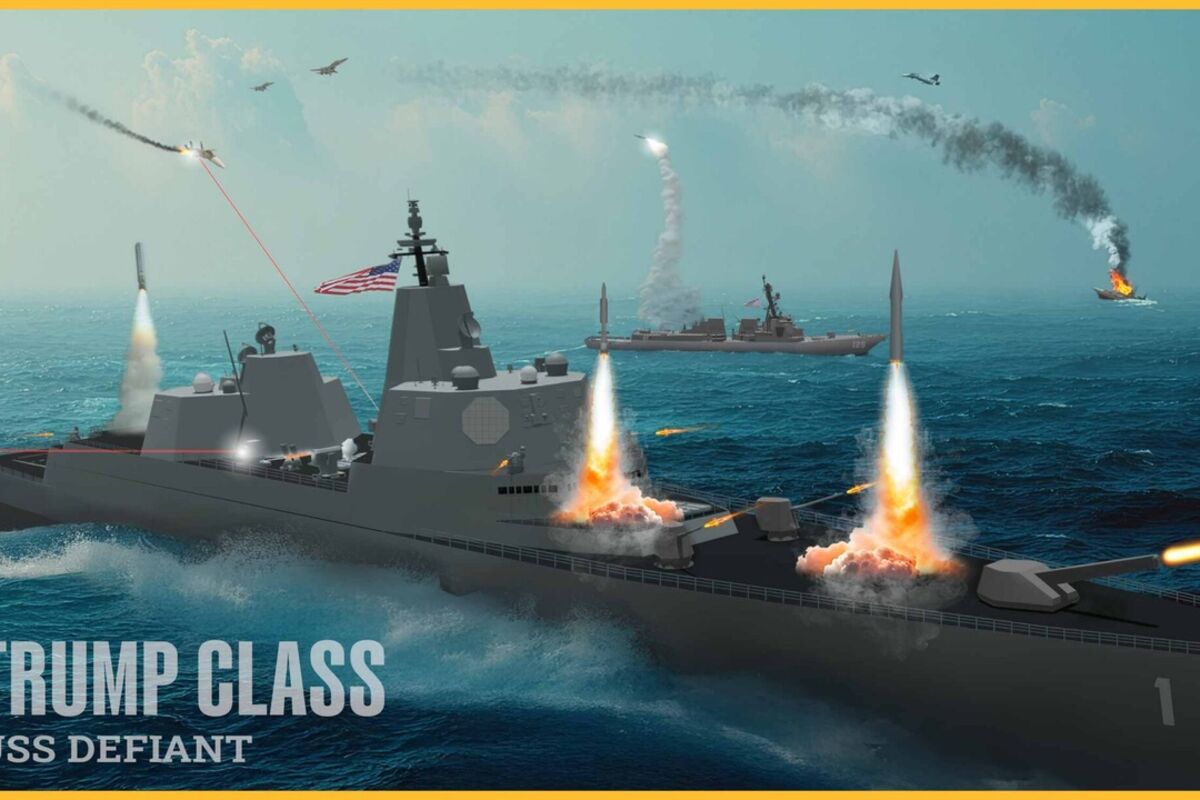
USS Defiant is the first Trump-class battleship
December 23, 2025 - WASHINGTON, D.C. - President Donald J. Trump (R), Secretary of the Navy John C. Phelan, and Secretary of War Pete Hegseth announced their intent to construct a new class of American-designed battleships.
Trump promised that the new ship will be the most lethal surface combatant ever constructed. The first ship in the new Trump class will be the USS Defiant (BBG 1). The Trump class battleships will be the flagships of Trump's new "Gold Fleet" proposal.
"As we forge the future of our Navy's Fleet, we need a larger surface combatant and the Trump-class Battleships meet that requirement," said Admiral Daryl Caudle – the 34th Chief of Naval Operations. "We will ensure continuous improvement, intellectually honest assessments about the requirement to effectively deter and win in the 2030s and beyond, and disciplined execution resulting in a Fleet unparalleled in lethality, adaptability and strength."
The USS Arleigh Burke (DDG51) destroyers first launched in 1989 are presently the backbone of the U.S. Navy's surface fleet. There are 74 Arleigh Burke's active (including the lead ship) and the Navy plans to build a total of 99. The new Trump class is triple the size of an Arleigh Burke (8,300 to 9700 long tons). The new battleship will have a displacement of 35,000 tonnes and be 840-880 feet long. The World War II era Iowa class battleships by comparison were 887 feet long and had a displacement of over 57,000 tonnes. The Zumwalt class destroyers are presently the heaviest U.S. surface combatants (not counting aircraft carriers) at 15,000 tonnes.
The Navy promised that the USS Defiant will have a speed of 30+ knots. The Iowa class BBs could do 34 knots.
The Defiant will not have 16 inch guns like the Iowas. Instead the Trump class will have an array of weaponry.
The new ship is described as having 128 MK 41 VLS cells. That means it carries 128 individual launch tubes. That is more than even a Ticonderoga class cruiser which carries 122 or the Burke class destroyers which typically carry 90 to 96 cells. A ship equipped with 128 cells is a missile carrier capable of sustaining prolonged operations or responding to large‑scale threats from incoming aircraft or cruiser missiles.
Each cell can hold a full‑size missile such as a Tomahawk cruise missile, an SM‑2 or SM‑6 air‑defense interceptor, or an ASROC anti‑submarine rocket. Some missiles, like the Evolved Sea Sparrow Missile (ESSM), can be "quad‑packed," meaning four can fit into a single cell. In practice, a 128‑cell VLS could carry well over 400 missiles depending on the loadout, giving the ship enormous flexibility to tailor its arsenal for air defense, ballistic‑missile defense, anti‑submarine warfare, or long‑range strike missions.
That arsenal would be impressive all by itself, but the new battleship also incorporates hypersonics in its arsenal.
The Trump class battleships have what is described as "12 cells CPS." This means that it has the U.S. Navy's Conventional Prompt Strike (CPS) hypersonic missile system. The 12 cells refers to a launcher or ship configuration that carries 12 CPS launch tubes. CPS is a boost‑glide hypersonic weapon designed to strike high‑value, time‑sensitive targets at extreme speed. The Navy plans to deploy CPS on the four Zumwalt‑class destroyers as well as on new Virginia‑class submarines, using large vertical launch canisters. These launchers are much larger than standard MK 41 VLS cells, so CPS is installed in dedicated hypersonic launch tubes, not normal VLS. A "12‑cell CPS" setup would therefore mean that the battleships would have 12 dedicated CPS hypersonic missile tubes with each tube holding one CPS All‑Up Round (AUR) - a two‑stage booster plus the Common Hypersonic Glide Body. This is similar to how the Army's LRHW "Dark Eagle" uses a mobile launcher with multiple CPS tubes, though the exact number varies by the platform. The hypersonics would give the Navy to ability to: conduct deep‑strike missions, penetrate advanced air defenses, hit time‑sensitive targets at hypersonic speed, as well as complement the VLS‑based weapons.
The Navy is also promising that the battleships will have a 32 MJ railgun with HVP. This is an electromagnetic railgun capable of firing projectiles using 32 megajoules (MJ) of muzzle energy, paired with Hypervelocity Projectiles (HVPs). This would be a next‑generation naval weapon that launches small, dense projectiles at hypersonic speeds using electricity instead of gunpowder or rockets. 32 megajoules is the energy used to launch the projectile. That's roughly equivalent to the explosive energy of about 11 pounds of C4. At this energy level, the railgun can fire projectiles at Mach 6–7.5 depending on the system. Railguns have been developed by companies like General Atomics and BAE Systems for the U.S. Navy and missile defense programs. The HVP - Hypervelocity Projectile – is a guided, fin-stabilized projectile originally designed for naval guns and railguns. When fired from a railgun, it becomes a pure kinetic interceptor - no explosives needed. At Mach 6+, even a small tungsten slug can destroy: cruise missiles, ballistic missiles, aircraft, ships, and/or hardened ground targets. The railgun provides the speed, and the HVP provides precision. Together, they create: Long-range strike capability (100–220 miles depending on system), missile defense potential (intercepting threats at a fraction of the cost of missiles, deep magazine (electricity replaces expensive missile stockpiles). The 32 MJ railgun could serve as a terminal defense layer stopping massed missile or drone attacks at low cost per shot.
The Navy is already testing the 60 kW HELIOS laser system on the Arleigh Burke destroyers. The new battleship would have two either 300-kilowat or 600-kilowatt lasers.
A pair of 600‑kilowatt naval lasers would represent a major leap in shipboard defensive power, far beyond today's 60 kW HELIOS systems that are already capable of shooting down drones. At this scale, each laser would have enough energy to burn through the airframes, seekers, and control surfaces of incoming cruise missiles, giving a ship a true hard‑kill layer that doesn't rely on expensive interceptors. Two such weapons would allow simultaneous engagements and full coverage across the ship's forward and aft arcs, dramatically improving survivability in saturation‑attack scenarios.
Beyond missile defense, 600 kW lasers would give a vessel the ability to destroy larger drones, damage manned aircraft, and disable enemy sensors or fire‑control systems at long range. This level of power also makes them effective against fast‑attack craft and swarm threats, replacing or supplementing close‑in systems like Phalanx with a virtually unlimited‑ammo option. Because lasers fire at the speed of light, they can rapidly shift between targets, making them ideal for defending against complex, multi‑vector attacks.
Two high‑energy lasers also open the door to limited offensive use. At 600 kW, a beam can burn through exposed shipboard equipment, blind or destroy radar arrays, and potentially disable propulsion or weapons on smaller vessels. Combined with traditional missiles and guns, a dual‑laser setup would turn a ship into a hybrid combatant capable of both kinetic and directed‑energy warfare. In short, two 600 kW lasers would transform a naval vessel from a defensive platform into a highly adaptable, next‑generation combat ship.
The new battleship also boasts two RAM launchers. A naval RAM launcher is the ship‑mounted firing system for the RIM‑116 Rolling Airframe Missile (RAM) - one of the most advanced short‑range, last‑ditch defense weapons used by the U.S. Navy and allied fleets. It is designed to protect ships from incoming anti‑ship missiles, drones, aircraft, and fast attack craft.
It is also going to be equipped with two five-inch naval guns capable of firing hypervelocity projectiles (HVPs) and four 30 mm guns, two smaller ODN lasers, and two counter UxS systems to detect, track, identify, and defeat unmanned threats in the air, on land, at sea, and underwater.
The battleships also have a flight deck that can handle helicopters, V-22s, and/or UAVs as necessary.
The Trump administration promises that the new class will be capable of operating in a traditional Integrated Air and Missile Defense role with a Carrier Strike Group or commanding its own Surface Action Group for Surface and Anti-Submarine Warfare efforts in addition to delivering long range hypersonic strategic fires and quarterbacking the operations of an entire fleet as the central command control node.
The Navy claims that the new battleship will be acquired using a Navy-led, industry-collaborative design team approach to accelerate design and construction and supported by over 1,000 suppliers in nearly every state in America.
In remarks reported by Naval News, President Trump said, "We're desperately in need of ships, and I have approved a plan for the Navy to begin construction of two large battleships... These will be 100 times the force and power. Each one of these will be the largest battleships built in the history of our country."
The Trump class will begin as two ships, but there are plans to build 24.
The Navy in recent years has struggled with actually building any ships. The littoral combat ships – the Freedom Class and Independence Class – were both plagued with problems. Some recent ships were decommissioned shortly after launch. The Constellation frigate class still has not been delivered; but Sec. Hegseth cancelled 18 of the 20 new ships due to delays in the problem plagued design. Unlike the LCSs – which were completely new designs - the Constellation was based on an existing frigate already in service with two navies. Problems and cost overruns with the Zumwalt class destroyer led to the class being reduced from a planned 32 to just 3 ships. Even in ship classes that are proven, delays are hampering efforts to keep up with the Chinese navy (the largest in the world). The Virginia class submarines (which are replacing the 1970s era Los Angeles class SSNs) are more than a year behind schedule. The USS Columbia is the lead ship in the ballistic missile submarine that the Navy intends to replace the aging Ohio class SSBNs (ca. 1975). The Navy began construction on Columbia back in 2020. Not only it is not complete, but the most recent projection is that she will not be launched until 2031.
(AI contributed to this report.)
To comment or to ask a question email: brandonmreporter@gmail.com








Reader Comments(0)