
The people's voice of reason


The people's voice of reason

Asthma is a chronic respiratory condition that affects millions of people of all ages. While there is no cure, modern asthma medications make it possible for most people to control symptoms, prevent flare ups, and live active lives. With so many asthma treatment options available, it can be difficult to understand how different medications work and which ones may be right for you. SaveHealth, a prescription discount/savings card website, shares the basics.
Asthma causes inflammation and narrowing of the airways, making it harder to breathe. Symptoms may include wheezing, coughing, chest tightness, and shortness of breath. These symptoms can vary in severity and frequency.
Asthma medications are generally used to:
Doctors usually recommend a combination of long-term control medications and quick relief medications.
Asthma medications are grouped by how they work and how they are used.
Main categories include:
Understanding these categories makes it easier to compare asthma medication options.
Below is a listicle style overview of major asthma medication types, along with commonly prescribed drugs in each group.
1. Inhaled corticosteroids
Inhaled corticosteroids are the cornerstone of long-term asthma control. They reduce airway inflammation and prevent symptoms when used daily.
Common inhaled corticosteroids include:
Savehealth.com can help people save money on asthma medications like Flovent, Pulmicort, and Qvar RediHaler.
2. Combination inhalers
Combination inhalers contain both an inhaled corticosteroid and a long acting bronchodilator. They provide inflammation control and airway relaxation in one device.
Common combination inhalers include:
Combination inhalers are often prescribed for moderate to severe asthma. Savehealth.com can help people save money on asthma medications like Dulera and Airsupra.
3. Leukotriene modifiers
Leukotriene modifiers are oral asthma medications that block inflammatory chemicals called leukotrienes. They are taken as tablets rather than inhaled.
Common leukotriene modifiers include:
These medications may be used alone for mild asthma or alongside inhalers for additional control. Savehealth.com can help people save money on asthma medications like montelukast and zafirlukast.
4. Biologic therapies for severe asthma
Biologic medications are advanced treatments used for people with severe asthma that is not well controlled with standard therapies. They target specific immune pathways involved in asthma inflammation.
Common biologic asthma medications include:
These medications are typically given by injection or infusion and are prescribed by specialists. They can significantly reduce asthma attacks and steroid use.
5. Oral anti inflammatory medications
Some asthma medications reduce inflammation through different oral mechanisms.
Examples include:
These medications are less commonly used but may benefit certain patients.
6. Rescue and quick relief medications
Quick relief medications provide fast symptom relief during an asthma attack. While short acting bronchodilators are common, newer options are emerging.
Airsupra is an example of a newer quick relief inhaler that also provides anti-inflammatory benefits. It contains both albuterol and budesonide as its active ingredients. It represents an evolution in how quick relief asthma medications are designed.
Rescue medications should always be available, even when asthma is well controlled.
7. Targeted add on therapies
Some medications are used as add ons when asthma remains uncontrolled.
Examples include:
These targeted therapies help personalize asthma treatment plans.
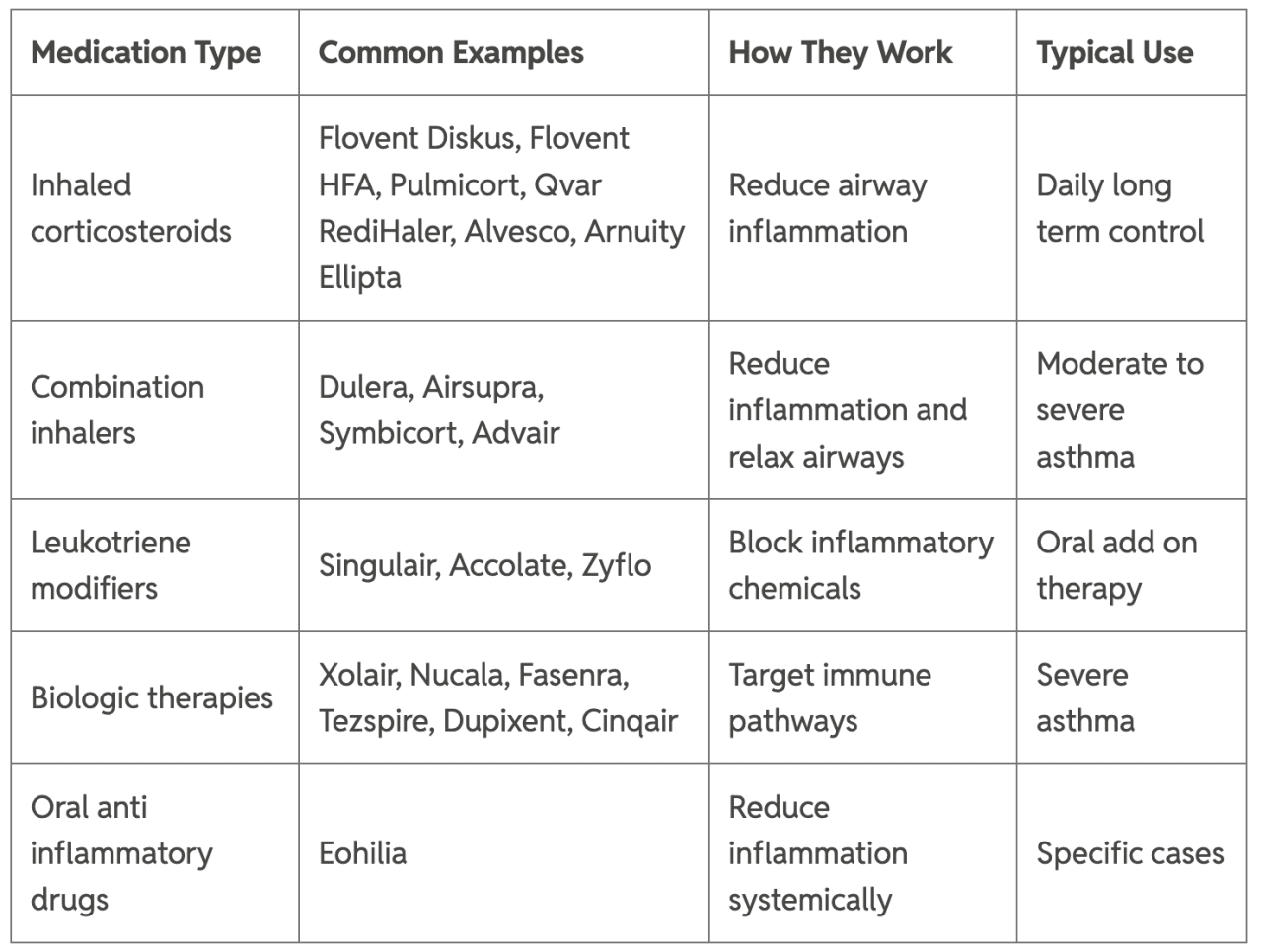
Like all medications, asthma drugs can cause side effects. Most people tolerate them well, especially inhaled therapies.
Common side effects may include:
Using inhalers correctly and following medical advice can reduce side effects. Doctors monitor treatment and adjust as needed.
Many people ask about the difference between inhalers and oral asthma medications.
Key differences include:
Both approaches can be effective when used appropriately.
Long term asthma control medications reduce airway inflammation over time. They do not provide immediate relief but help prevent symptoms and attacks.
Examples include:
Consistency is key for long term control.
Choosing asthma medication
There is no single best asthma medication for everyone. Doctors consider:
Many treatment plans involve step up or step down adjustments over time.
They include inhaled corticosteroids, combination inhalers, oral leukotriene modifiers, biologics, and quick relief medications.
Quick relief inhalers such as newer options like Airsupra are used during asthma attacks.
Side effects vary by medication type and are often mild when used correctly.
Asthma is a lifelong condition, but effective treatment makes it manageable for most people. From inhaled corticosteroids like Flovent Diskus, Flovent HFA, Fluticasone HFA, Fluticasone propionate Diskus, Pulmicort, Qvar RediHaler, Alvesco, and Arnuity Ellipta to combination inhalers such as Dulera and Airsupra, there are many reliable options.
Oral medications like montelukast, Singulair, Accolate, zafirlukast, Zileuton ER, and Zyflo provide additional control for some patients. Advanced biologic therapies including Xolair, Nucala, Fasenra, and Tezspire offer hope for people with severe asthma.
Affordability plays a major role in long term success. Savehealth.com can help people save money on asthma medications.
This story was produced by SaveHealth and reviewed and distributed by Stacker.





Reader Comments(0)