
The people's voice of reason


The people's voice of reason
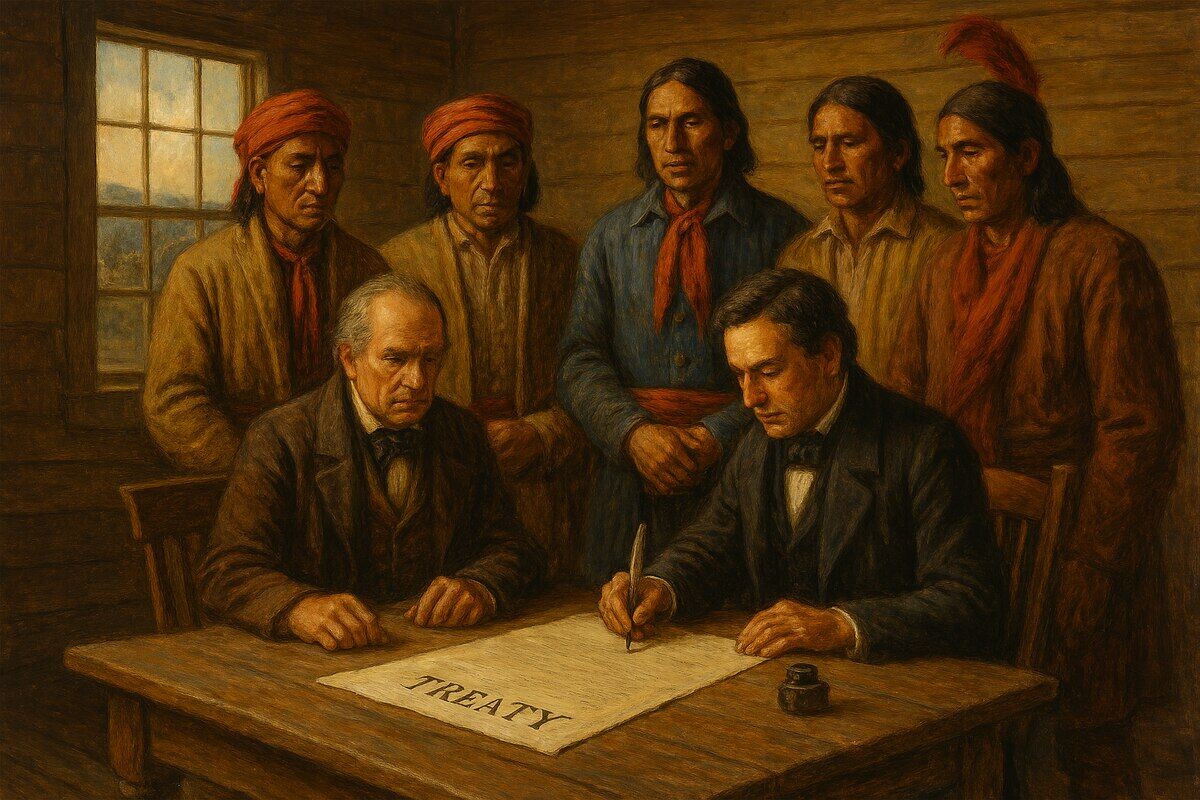
The Treaty of New Echota ceded all Cherokee lands east of the Mississippi River to the United States
December 29, 1835 - New Echota, Georgia - On a cold December day in 1835, in the Cherokee capital of New Echota, a small group of Cherokee men signed a document that would alter the fate of their nation forever. Known as the Treaty of New Echota, the agreement ceded all Cherokee lands east of the Mississippi River to the United States, setting the legal foundation for the forced removal that would later be remembered as the Trail of Tears. Though signed by only a minority faction of the Cherokee Nation, the treaty became one of the most consequential - and controversial - agreements in American history.
A Nation Under Pressure
By the 1830s, the Cherokee Nation had spent decades resisting pressure from the United States and the state of Georgia, both of which sought access to Cherokee lands. The discovery of gold in north Georgia in 1829 intensified the push for removal. Despite the Cherokee Nation's legal victories - including the landmark Worcester v. Georgia decision - the federal government continued to pursue a policy of relocation.
President Andrew Jackson's Indian Removal Act of 1830 accelerated these efforts. Federal agents and state officials increased pressure on the Cherokee to accept removal, even as Principal Chief John Ross and the majority of the Cherokee people remained firmly opposed.
The Treaty Party Steps Forward
Amid this turmoil, a small political faction within the Cherokee Nation - later known as the Treaty Party - concluded that removal was inevitable. Led by figures such as Major Ridge, John Ridge, and Elias Boudinot, the group believed that negotiating terms would at least secure compensation and a peaceful transition.
On December 29, 1835, U.S. commissioners General William Carroll and John F. Schermerhorn met with these men in New Echota. Without authorization from the Cherokee National Council and over the objections of Chief Ross, the Treaty Party signed the agreement.
Terms of the Treaty
The Treaty of New Echota included several major provisions:
- The Cherokee Nation ceded all lands east of the Mississippi River.
- In exchange, the United States promised $5 million, land in present-day Oklahoma, and assistance for relocation.
- The treaty guaranteed compensation for improvements on abandoned lands and support for establishing new homes in the West.
- It pledged protection for the Cherokee during the transition - a promise that would not be honored.
Although the treaty was signed by only a small minority, the U.S. Senate ratified it in May 1836, by a margin of just one vote.
A Controversial Ratification
The Cherokee National Council immediately denounced the treaty as fraudulent. More than 15,000 Cherokee citizens - nearly the entire nation - signed petitions protesting its legitimacy. Chief Ross traveled to Washington to plead the Cherokee case, but the federal government refused to reconsider.
Despite widespread opposition, the treaty became the legal justification for forced removal.
The Road to the Trail of Tears
By 1838, under President Martin Van Buren, federal troops and state militias began rounding up Cherokee families at bayonet point. Thousands were forced into stockades before beginning the long march westward.
The result was catastrophic: an estimated 4,000 Cherokee people died from disease, exposure, and starvation along the route. The Trail of Tears became one of the darkest chapters in American history - a direct consequence of the treaty signed at New Echota.
Legacy and Memory
Today, the Treaty of New Echota stands as a stark reminder of the consequences of coercive diplomacy and the fragility of minority representation. The site of New Echota is preserved as a historic landmark, where visitors can walk the same ground where the treaty was signed and reflect on the profound human cost that followed.
For the Cherokee Nation, the treaty remains a symbol of internal division, federal overreach, and the resilience of a people who survived displacement and rebuilt their nation in the West.







Reader Comments(0)