
The people's voice of reason


The people's voice of reason
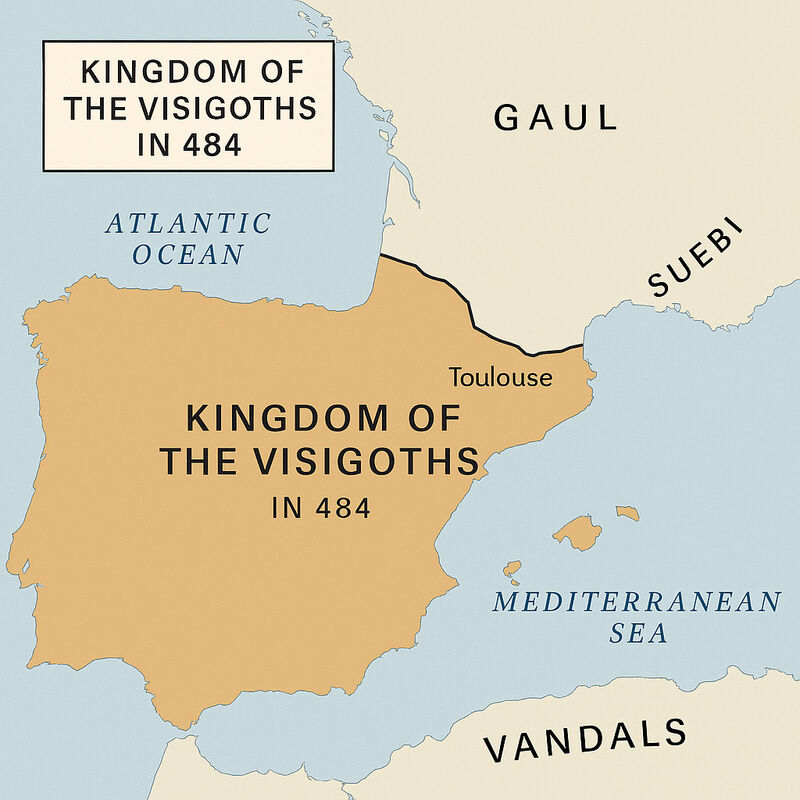
On December 28, 484, a young nobleman named Alaric II ascended the throne of the Visigoths, inheriting a kingdom that stretched across much of southern Gaul and the Iberian Peninsula. His rise marked a pivotal moment in the post‑Roman West - a world still reeling from the collapse of imperial authority, where new kingdoms were carving identities out of the ruins of empire.
A Kingdom in Transition
Alaric II succeeded his father, King Euric, one of the most powerful and assertive Visigothic rulers. Euric had expanded Visigothic control deep into Gaul and Spain, establishing a stable capital at Toulouse and building a legal and administrative structure that rivaled the fading Roman institutions around it.
When Euric died, the throne passed to Alaric II, likely in his late teens or early twenties. His accession on December 28 was not just a dynastic formality - it was a test of continuity for a kingdom that had grown rapidly and now needed consolidation.
A Young King with a Heavy Burden
Alaric II inherited a realm that was vast, diverse, and politically fragile. His territories included:
- Most of Hispania, except the rugged northwest
- Gallia Aquitania, a wealthy and Romanized region
- Much of Gallia Narbonensis, the Mediterranean corridor of Roman Gaul
These lands were populated not only by Goths but by millions of Roman provincials, bishops, and landowners who still thought of themselves as heirs to Roman civilization. Managing these competing identities would become one of the defining challenges of Alaric's reign.
Arian King, Catholic Subjects
Like his father, Alaric II was an Arian Christian, a theological position considered heretical by the Catholic majority in his kingdom. Yet unlike some earlier Gothic rulers, he adopted a more conciliatory approach.
According to Britannica, Alaric mitigated the persecution of Catholics and even authorized the Council of Agde in 506, a major Catholic synod within his territory. This willingness to coexist with Catholic institutions helped stabilize relations between Gothic elites and Roman clergy.
A Lawgiver in the Roman Tradition
One of Alaric's most enduring achievements came late in his reign: the Breviary of Alaric (Breviarum Alaricianum), issued in 506. This legal code distilled centuries of Roman law into a clear, accessible form for his Roman subjects.
It was a political masterstroke:
- It reassured Roman landowners that their legal traditions would endure
- It strengthened administrative unity across his diverse territories
- It signaled that the Visigothic kingdom saw itself not as a barbarian enclave, but as a legitimate successor to Rome
A Reign Cut Short
Despite these accomplishments, Alaric II's rule unfolded in a dangerous neighborhood. To the north, the rising Frankish king Clovis was consolidating power and converting to Catholicism - a move that won him support among Roman bishops and set him on a collision course with the Arian Visigoths.
The inevitable clash came in 507, when Clovis invaded Visigothic Gaul. Alaric II was killed at the Battle of Vouillé, a defeat that shattered Visigothic power in Gaul and forced the kingdom to retreat into Hispania.
Why His Accession Still Matters
Alaric II's rise on December 28, 484, represents more than a dynastic transition. It marks:
- The continuation of one of the most important successor states of the Western Roman Empire
- A moment when Gothic and Roman cultures intertwined in new political forms
- The beginning of a reign that sought compromise, legal order, and coexistence in a fractured world
His death would usher in instability, but his legal reforms and attempts at religious tolerance left a lasting imprint on the medieval West.







Reader Comments(0)