
The people's voice of reason


The people's voice of reason

Humans have been exploring space since 1957, when the Soviet Union launched Sputnik 1. At the height of the space race, government agencies conducted all space missions, but that’s no longer the case. Private space companies now launch satellites, operate entire “constellations” of privately owned satellites in orbit, shuttle NASA astronauts to and from the International Space Station — and are in the early stages of offering space tourism.
The development of the space industry is exciting from a technological and scientific standpoint. It could also make investors in space stocks a lot of money.
How fast is space exploration growing, and which space companies offer the best prospects for investors? The Motley Fool shares a detailed look at space launch statistics.
Key Points
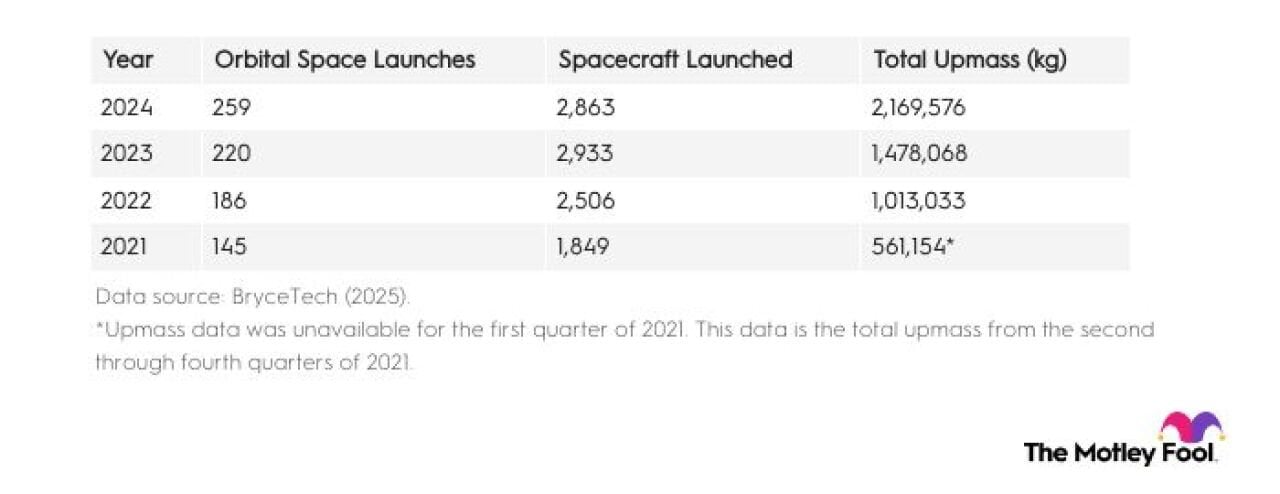
Multiple metrics are used to track space launches. Orbital space launches count spaceflights in which a craft reaches speeds permitting at least one orbit. Spacecraft launches include all vehicles passing either 50 miles’ altitude (the Federal Aviation Administration standard) or the Karman line, the international standard set at 62 miles above Earth’s surface. Total upmass, measured in kilograms, counts the payload carried into orbit on a spaceflight and excludes the mass of the vehicle that carries it.
Orbital space launches have rapidly increased:
These launches are carrying more payload, too. Total upmass more than quintupled from 2020 to 2025, reaching 3,020.5 tons. U.S. payloads accounted for 85% of the total, with Starlink satellites launched by SpaceX making up the majority of the U.S. payloads.
Increasingly, the answer to both questions is: SpaceX.
Western rocket stocks competing with the privately held (but perhaps soon-to-IPO) space giant include United Launch Alliance, a joint venture between Boeing and Lockheed Martin, Rocket Lab, and in Europe, Arianespace and its parent company ArianeGroup — both subsidiaries of aerospace giant Airbus.
Here’s how many space launches those companies conducted in 2025:
In under two decades, SpaceX has gone from a company on the brink of bankruptcy (in 2008, before the successful orbital launch of its Falcon 1 rocket) to the first private company to orbit a spacecraft (in 2010, with its Dragon space capsule) to arguably the biggest success story in the space industry.
A few SpaceX launch statistics may illustrate their growing market share: In 2014, SpaceX conducted six of the 12 successful U.S. space launches. A year later, it raised $1 billion in funding from early investors Fidelity and Google, began developing Starlink internet satellites, and conducted seven out of America’s nine total launches. In 2017, SpaceX’s global market share reached an impressive 45% of awarded commercial space contracts, making it the top commercial launch provider.
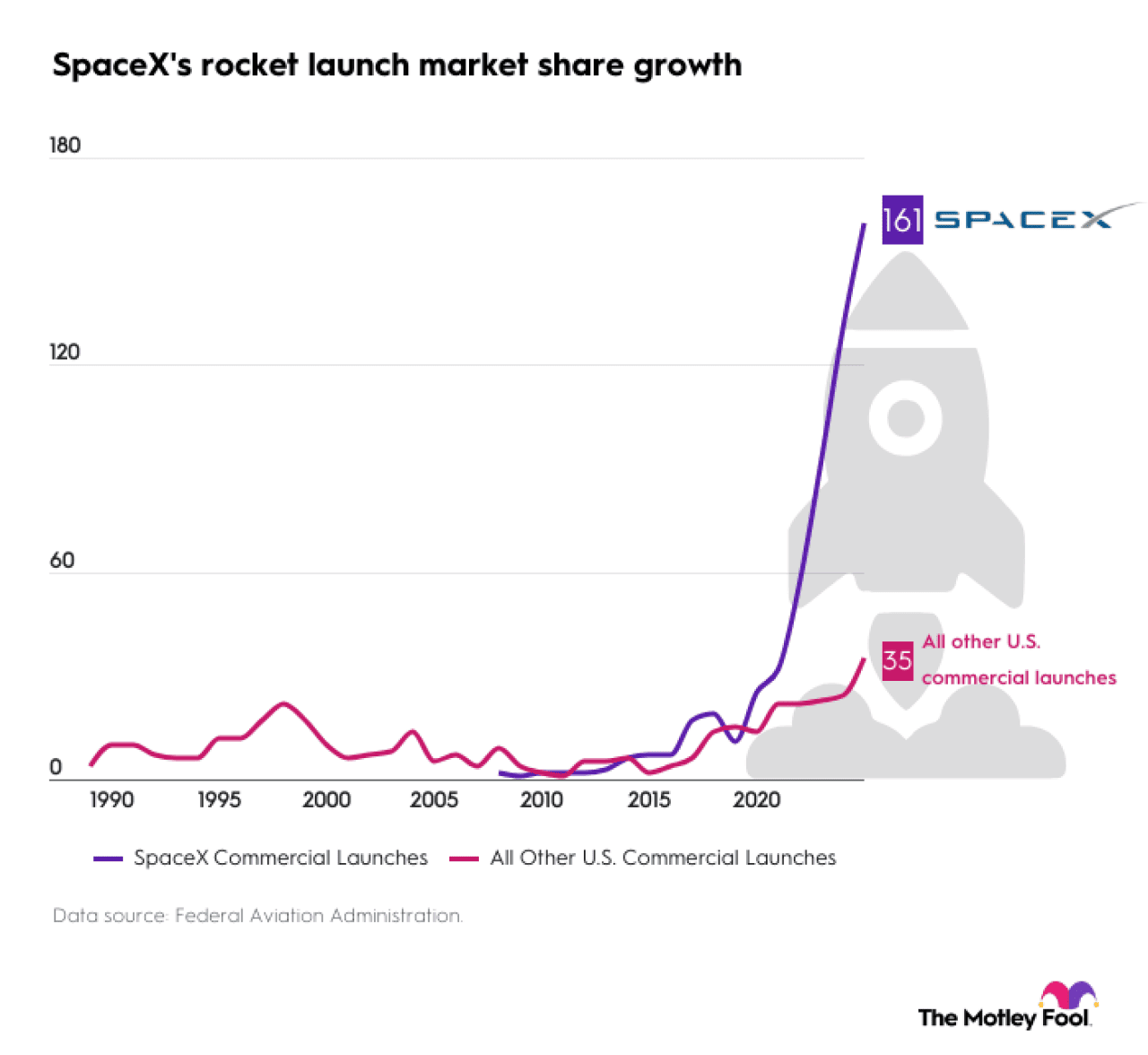
SpaceX’s dominance has continued to grow in the 2020s. It hit new launch records every year from 2020 to 2024, will set yet another record when 2025 wraps up, and is now responsible for roughly 80% of U.S. space launches.
SpaceX’s commercial launch pace and market share capture have been impressive, to say the least:
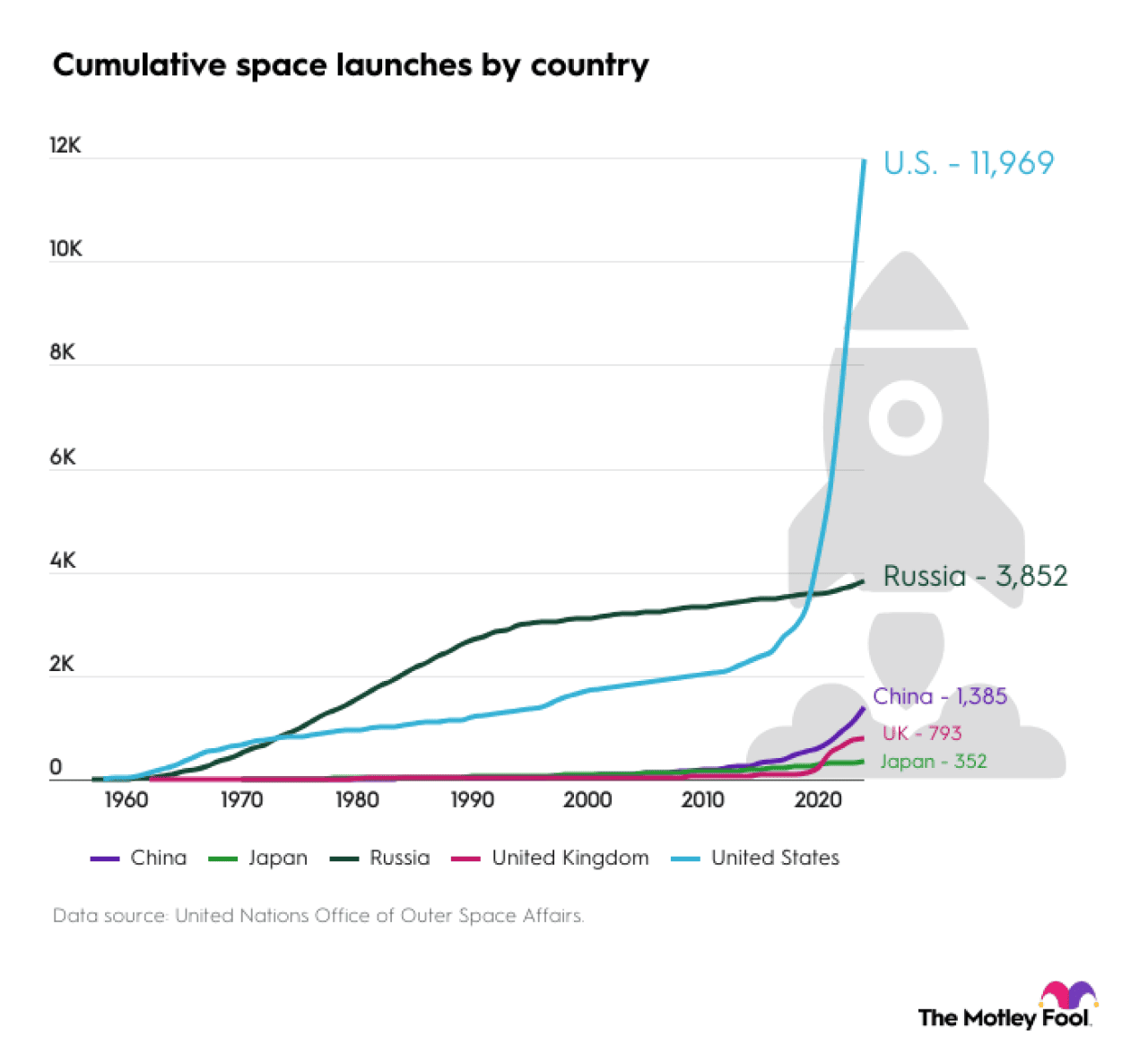
From 1957 until its dissolution in 1991, the USSR conducted 2,760 space launches, more than twice as many as the U.S. (1,221). Despite what the space launch numbers suggest, however, the United States clearly had the more successful space program, winning the race to land humans on the moon, and developing and flying reusable space shuttles 135 times. (The Soviets also developed a shuttle, the Buran, but it flew only once — uncrewed — in 1988).
In more recent years, and especially since the start of the Ukraine war, Russian launches have slowed considerably. It has ceded its second-place position in space to China, where launches are accelerating. Still, the U.S. remains far and away the leader in space exploration, launching 7,605 times from 2010 through 2023, versus 3,277 times for the rest of the world combined.
The increasing number of commercial space launches and the upward trend in upmass serve as unmistakable signs of space industry growth. Space is a high-risk, high-reward industry, however. Space launches are expensive, and space companies often operate at a loss for years while developing their businesses.
Luckily for investors, in the West at least, publicly traded space stocks such as Boeing, Lockheed, Rocket Lab, and — maybe soon — SpaceX continue to blaze the way to U.S. dominance in space.
Investors also benefit from the fact that many space names are fairly well-known and high-profile. It’s easy to identify potential prospects with names as famed as Boeing and Lockheed Martin, for example, both well-known defense contractors, and also space stalwarts. SpaceX, if it goes public, will be just as easy to identify and invest in.
Second-tier space players — if not exactly second-tier companies — include such well-known defense names as Northrop Grumman and L3Harris Technologies. Rocket Lab, too, probably belongs in this grouping — although one could argue Rocket Lab is moving up in visibility, while Northrop and L3Harris are perhaps becoming lower-profile.
Things get a bit more complicated as you enter the realm of "newspace" companies, space start-ups with names like AST SpaceMobile, BlackSky, Firefly Aerospace, and Planet Labs. Smaller in market capitalization and largely unprofitable, these are the kind of “get in on the ground floor” space companies offering the most potential for profit — and also the biggest risk of going broke.
Those who want to invest in a broad swath of space stocks, to diversify and limit their risk by owning both established space companies and a smattering of start-ups, might consider investing in space-focused exchange-traded funds (ETFs) instead. The ARK Space Exploration & Innovation ETF is probably the best-known ETF in this camp.
Instant diversification and exposure to a brand new industry in space? It’s hard to argue with that.
This story was produced by The Motley Fool and reviewed and distributed by Stacker.





Reader Comments(0)