
The people's voice of reason


The people's voice of reason
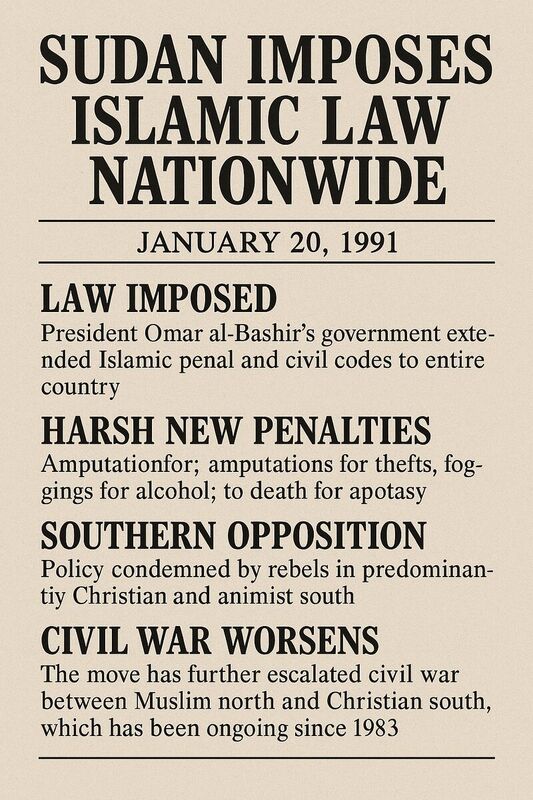
On January 20, 1991, Sudan's military‑Islamist government intensified its transformation of the country by imposing Islamic law nationwide, a move that dramatically worsened the already‑devastating civil war between the Muslim‑majority north and the largely Christian and animist south. The decision marked a turning point in Sudan's modern history, hardening political divisions, escalating violence, and deepening the authoritarian grip of President Omar al‑Bashir's regime.
The imposition of Sharia law was not a sudden development. It was the culmination of years of ideological maneuvering by the National Islamic Front, which had gained influence in the late 1980s and fully consolidated power after Bashir's 1989 coup. But the 1991 nationwide enforcement of Islamic criminal and civil codes represented the most sweeping and consequential step yet - one that reverberated across Sudan's political, social, and military landscape.
A Country Already in Crisis
By 1991, Sudan was eight years into the Second Sudanese Civil War, a conflict rooted in deep cultural, religious, and economic divides. The war had reignited in 1983 when then‑President Jaafar Nimeiry first introduced Sharia law in the north, sparking rebellion in the south. That decision helped fuel the rise of the Sudan People's Liberation Army (SPLA), which rejected the imposition of Islamic law and demanded greater autonomy.
When Bashir seized power in 1989, he inherited a fractured nation. Instead of seeking compromise, his government moved aggressively to reshape Sudan into a fundamentalist Islamic state. Human Rights Watch reported that by 1991 the regime was "strengthening its grip" and "moving purposefully in the direction of creating its version of a fundamentalist Islamic state".
The 1991 Islamic Penal Code
The centerpiece of the government's Islamization campaign was the 1991 Islamic penal code, a sweeping legal overhaul that replaced Sudan's existing criminal statutes with laws rooted in the government's interpretation of Sharia. The code introduced hudud punishments - fixed penalties drawn from Islamic jurisprudence - including:
- Amputation for certain categories of theft
- Flogging for alcohol consumption and other offenses
- Stoning for adultery
- Death for apostasy
Human Rights Watch noted that the code withdrew full legal rights from women and non‑Muslims, criminalized apostasy, and introduced punishments that violated international human rights standards. Amnesty International similarly reported that public floggings and amputations continued under the new law, and that courts imposed death sentences followed by crucifixion in western Sudan during 1991.
Although the government claimed the law would apply nationwide, implementation varied. Much of the south remained outside Khartoum's control, and SPLA‑held areas rejected the code entirely. Still, the symbolic and political impact of the nationwide declaration was unmistakable.
A Blow to Peace Efforts
The decision to impose Islamic law nationwide dealt a severe blow to any hope of political reconciliation. Southern leaders viewed the move as confirmation that the government intended to impose a religious identity on the entire country, regardless of its cultural diversity.
Human Rights Watch warned in 1991 that the penal code would "certainly inflame the war in the south and make political compromise in the north far more difficult". That prediction proved accurate. The SPLA intensified its military operations, and the government responded with increasingly harsh counterinsurgency tactics, including mass arrests, torture, and forced displacement.
Amnesty International documented widespread human rights abuses during this period, including arbitrary detention, torture, and extrajudicial executions in both government‑controlled and rebel‑held areas. The conflict grew more brutal, with civilians bearing the brunt of the violence.
Authoritarian Consolidation in Khartoum
The imposition of Islamic law also served a domestic political purpose: consolidating the regime's control. Bashir's government purged the judiciary, installed loyalists in key positions, and suppressed independent unions, political parties, and newspapers. Human Rights Watch reported that the government created state‑sponsored organizations - including a "Sudan Human Rights Organization" - to defend its record and silence dissent.
The new penal code became a tool for political repression. The criminalization of apostasy, for example, allowed the government to target political opponents under the guise of religious law. The state of emergency in place since 1989 ensured that military tribunals and security forces operated with near‑total impunity.
Impact on Sudan's Social Fabric
For many Sudanese, especially non‑Muslims and women, the 1991 law represented a profound shift in their daily lives. The penal code restricted women's legal rights, limited their ability to testify in court, and reinforced gender‑based discrimination. Non‑Muslims faced new barriers in civil and criminal proceedings, and the government's interpretation of Sharia became a tool for enforcing cultural conformity.
The law also deepened regional and ethnic divides. In the Nuba Mountains and other contested areas, government forces used the rhetoric of religious purification to justify harsh military campaigns. Amnesty International documented disappearances, extrajudicial killings, and widespread torture in these regions during 1991.
A Legacy That Shaped Sudan's Future
The nationwide imposition of Islamic law in 1991 did not end the civil war - it intensified it. The conflict continued for another 14 years, ultimately claiming an estimated two million lives before the 2005 Comprehensive Peace Agreement. That agreement granted the south autonomy and set the stage for South Sudan's independence in 2011.
But the legacy of the 1991 law endured. It entrenched authoritarian rule, deepened mistrust between Sudan's regions, and left a lasting imprint on the country's legal and political institutions.
Conclusion
January 20, 1991 stands as a pivotal moment in Sudan's modern history - a day when the government's ideological ambitions collided with the country's complex social fabric, fueling a conflict that would reshape the region for decades. The nationwide imposition of Islamic law hardened divisions, escalated violence, and cemented the authoritarian character of Bashir's regime. Its consequences were felt not only on the battlefield, but in the courts, homes, and daily lives of millions of Sudanese.







Reader Comments(0)