
The people's voice of reason


The people's voice of reason
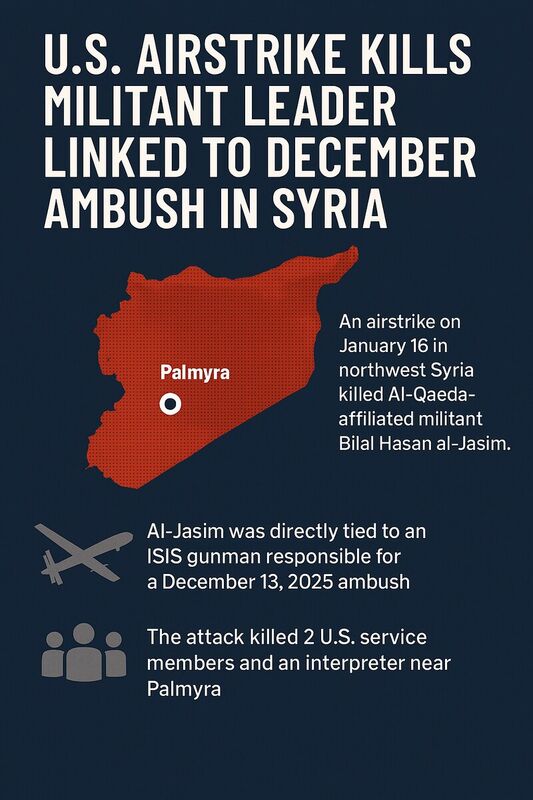
A senior militant leader directly linked to a December ambush that killed two American service members and an interpreter has been eliminated in a U.S. airstrike in northwest Syria, U.S. Central Command (CENTCOM) announced Saturday. The precision operation marks the latest escalation in Washington's campaign to dismantle extremist networks responsible for targeting American forces in the region.
The strike, conducted on Friday, Jan. 16, targeted Bilal Hasan al‑Jasim, an Al‑Qaeda‑affiliated operative whom U.S. officials say maintained a working relationship with the ISIS gunman behind the Dec. 13, 2025, attack near Palmyra. That ambush left three personnel dead - including two U.S. troops - and injured several others, triggering a sweeping American response across Syria.
Military officials described al‑Jasim as a seasoned militant figure who played a direct role in plotting terror operations and facilitating communication between extremist cells. CENTCOM said his removal represents a significant disruption to the network responsible for last month's deadly assault.
"The death of a terrorist operative linked to the deaths of three Americans demonstrates our resolve in pursuing terrorists who attack our forces," said Adm. Brad Cooper, commander of CENTCOM. "There is no safe place for those who conduct, plot, or inspire attacks on American citizens and our warfighters. We will find you."
A Targeted Strike Amid Rising Regional Tensions
The Jan. 16 operation unfolded against a backdrop of heightened instability across Syria, where remnants of ISIS, Al‑Qaeda affiliates, and other armed groups continue to operate in fragmented pockets. While ISIS no longer controls territory, U.S. officials warn that the group's decentralized cells remain capable of orchestrating lethal attacks - particularly against coalition forces and local partners.
Al‑Jasim's role, according to CENTCOM, extended beyond ideological alignment. He reportedly maintained operational ties with the ISIS militant who carried out the December ambush, providing support and coordination that enabled the attack. U.S. intelligence analysts believe he served as a connective node between extremist factions that often cooperate tactically despite differing affiliations.
His death, officials say, removes a key facilitator whose influence spanned multiple militant networks.
Operation Hawkeye Strike: A Broader Retaliatory Campaign
Friday's airstrike is the latest action in a broader U.S. retaliation campaign known as Operation Hawkeye Strike, launched in the immediate aftermath of the December killings. That operation involved a sweeping series of coordinated attacks on ISIS infrastructure across central and eastern Syria.
U.S. and partner forces struck more than 100 ISIS‑linked sites, including weapons depots, logistics hubs, and command nodes. More than 200 precision‑guided munitions were deployed in the opening wave alone, making it one of the most extensive U.S. operations in Syria in recent years.
Defense officials framed the campaign as both punitive and preventative - a message to extremist groups that attacks on American personnel will be met with overwhelming force.
The strike on al‑Jasim, while more targeted, fits squarely within that strategy.
A Year of Intensified Counterterror Pressure
Beyond the immediate response to the December ambush, the U.S. military has steadily increased pressure on ISIS and affiliated groups throughout the past year. CENTCOM reports that U.S. and coalition forces have captured more than 300 ISIS operatives and killed at least 20 others in ongoing missions aimed at degrading the group's ability to regroup or project power.
These operations include joint raids with the Syrian Democratic Forces (SDF), targeted airstrikes on high‑value individuals, and intelligence‑driven missions to disrupt weapons smuggling and financial networks.
While the U.S. maintains a relatively small footprint in Syria, officials argue that the presence is essential to preventing a resurgence of ISIS - a concern shared by regional partners who rely on American support to maintain stability.
Strategic Implications and Regional Fallout
The elimination of al‑Jasim is expected to reverberate across militant circles in northwest Syria, where shifting alliances and rivalries often shape the operational landscape. Analysts note that leaders who bridge multiple extremist factions are particularly difficult to replace, and their deaths can create temporary disarray within militant hierarchies.
However, the strike also underscores the persistent volatility of the region. Syria remains a battleground for competing interests - from ISIS remnants and Al‑Qaeda affiliates to Iranian‑backed militias and Russian forces. Each U.S. operation risks triggering retaliatory attacks or escalating tensions among the various actors operating in the country's fractured terrain.
The December ambush itself was a stark reminder of the dangers American personnel continue to face, even years after the territorial defeat of ISIS. U.S. officials have repeatedly emphasized that the mission in Syria is not a combat deployment but a counterterrorism effort designed to prevent extremist groups from rebuilding.
Still, the loss of two service members and an interpreter has renewed scrutiny of the mission's risks and raised questions about the evolving threat landscape.
A Message of Resolve
For CENTCOM, the strike on al‑Jasim serves as both a tactical victory and a symbolic message: attacks on American forces will not go unanswered.
Adm. Cooper's statement - blunt and unequivocal - reflects a broader posture of deterrence that U.S. officials hope will dissuade future attacks. Whether that message resonates with extremist groups remains to be seen, but the U.S. military appears committed to maintaining pressure.
As operations continue, American commanders insist that their focus remains on protecting U.S. personnel, supporting regional partners, and preventing extremist networks from regaining the ability to threaten the homeland.







Reader Comments(0)