
The people's voice of reason


The people's voice of reason
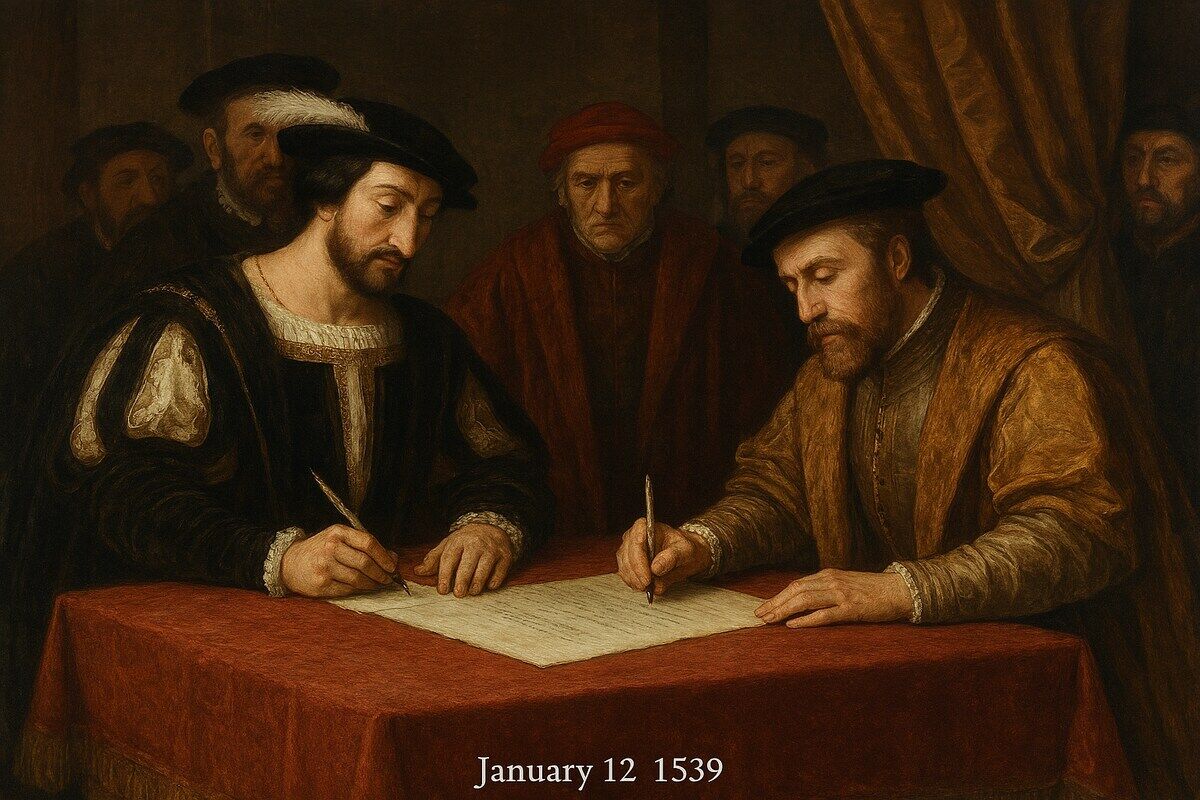
On January 12, 1539, two of Europe's most powerful rulers-King Francis I of France and Holy Roman Emperor Charles V-signed the Treaty of Toledo, a diplomatic accord intended to stabilize a continent exhausted by decades of rivalry, shifting alliances, and intermittent war. Though often overshadowed by the more dramatic battles of the Italian Wars, the treaty marked a pivotal moment in the long struggle between the Valois and Habsburg dynasties for dominance in Western Europe.
A Rivalry That Defined an Era
By the late 1530s, Francis I and Charles V had already clashed repeatedly over control of Italy, influence in the Low Countries, and the broader balance of power in Europe. Their rivalry was not merely political-it was personal. Each viewed himself as the rightful leader of Christendom, and each believed the other's ambitions threatened the stability of Europe.
The 1530s had seen a series of uneasy truces, broken promises, and renewed hostilities. France sought allies wherever it could find them, including the Ottoman Empire, while Charles V relied on the vast resources of his sprawling Habsburg domains. By 1538, both rulers were financially strained and politically fatigued, creating an opening for diplomacy.
The Road to Toledo
The Treaty of Nice in 1538 had brought a temporary truce, brokered by Pope Paul III, but it left many issues unresolved. The pope continued pressing for a more durable peace, hoping to unite Christian rulers against the rising threat of the Ottoman Empire.
Negotiations resumed in Toledo, where envoys for Francis I and Charles V worked to craft a more stable agreement. On January 12, 1539, the two monarchs formally ratified the treaty.
Terms of the Treaty
The Treaty of Toledo reaffirmed the earlier truce and committed both rulers to:
- Maintain peace between France and the Holy Roman Empire
- Respect each other's territorial claims, particularly in Italy and the Low Countries
- Avoid alliances with each other's enemies, a clause aimed especially at curbing France's cooperation with the Ottomans
- Support efforts toward a general Christian unity, reflecting papal pressure to redirect European energies toward external threats
While the treaty did not resolve the deeper geopolitical tensions between the two powers, it temporarily eased hostilities and allowed both monarchs to regroup.
A Peace That Could Not Hold
Despite its diplomatic promise, the Treaty of Toledo proved fragile. Mutual suspicion lingered, and neither ruler fully trusted the other's intentions. Within a few years, the peace unraveled, and the Italian Wars resumed with renewed intensity.
Still, the treaty remains significant as a rare moment when two bitter rivals attempted to stabilize Europe through negotiation rather than force. It also reflected the growing influence of the papacy in mediating secular conflicts and the increasing complexity of European diplomacy in the early modern era.
Legacy
The Treaty of Toledo did not end the Valois–Habsburg rivalry, but it marked an important pause in one of Europe's most consequential power struggles. For a brief moment in 1539, Francis I and Charles V set aside their ambitions in the hope of preserving peace-an effort that, though short‑lived, underscored the shifting political landscape of 16th‑century Europe.



Reader Comments(0)