
The people's voice of reason


The people's voice of reason

Just like a fancy camera doesn't make you a photographer, just having access to powerful AI tools doesn't mean you're getting real value out of them. It's what you do with the tools—how you structure the workflow, train the agent, and plug it into your systems—that determines whether it's a novelty or a strategic advantage.
Zapier spoke with business leaders about how they're using AI agents to build autonomous workflow solutions at scale. Here are five real-world examples.
An AI agent is an entity that can take in information from its environment, make decisions based on that input, and act on its own to achieve a goal.
AI agents can understand and interact with their circumstances. They'll run once you give them an objective or a stimulus to trigger their behavior—you don't need to keep prompting them. This makes them great for complex and unpredictable tasks. And even though they don't have complete accuracy, they can detect their mistakes and figure out ways to solve them as they move forward.
1. Analyze customer sentiment
Artūras Lazejeva, chief technology officer at Whatagraph, needed an AI solution to address his team's biggest problem. Customer feedback was pouring in across multiple communication channels, but combing through all that for actionable insights and getting it to the right teams? That was slow, painful, and way too manual.
So Lazejeva built an AI agent called CommsQA. Lazejeva explains how it works: "Our CommsQA bot connects to all our communication channels, plus our product and billing data. It then uses large language models (LLMs) to analyze sentiment, identify recurring themes, and categorize the feedback. It can even flag or prioritize items based on customer revenue."
But it doesn't stop there. "All of this information feeds directly into Slack," Lazejeva continues. "We receive a daily digest of the overall product feedback, top requests, pain points, and critical issues, which means we can address critical items much faster than before."
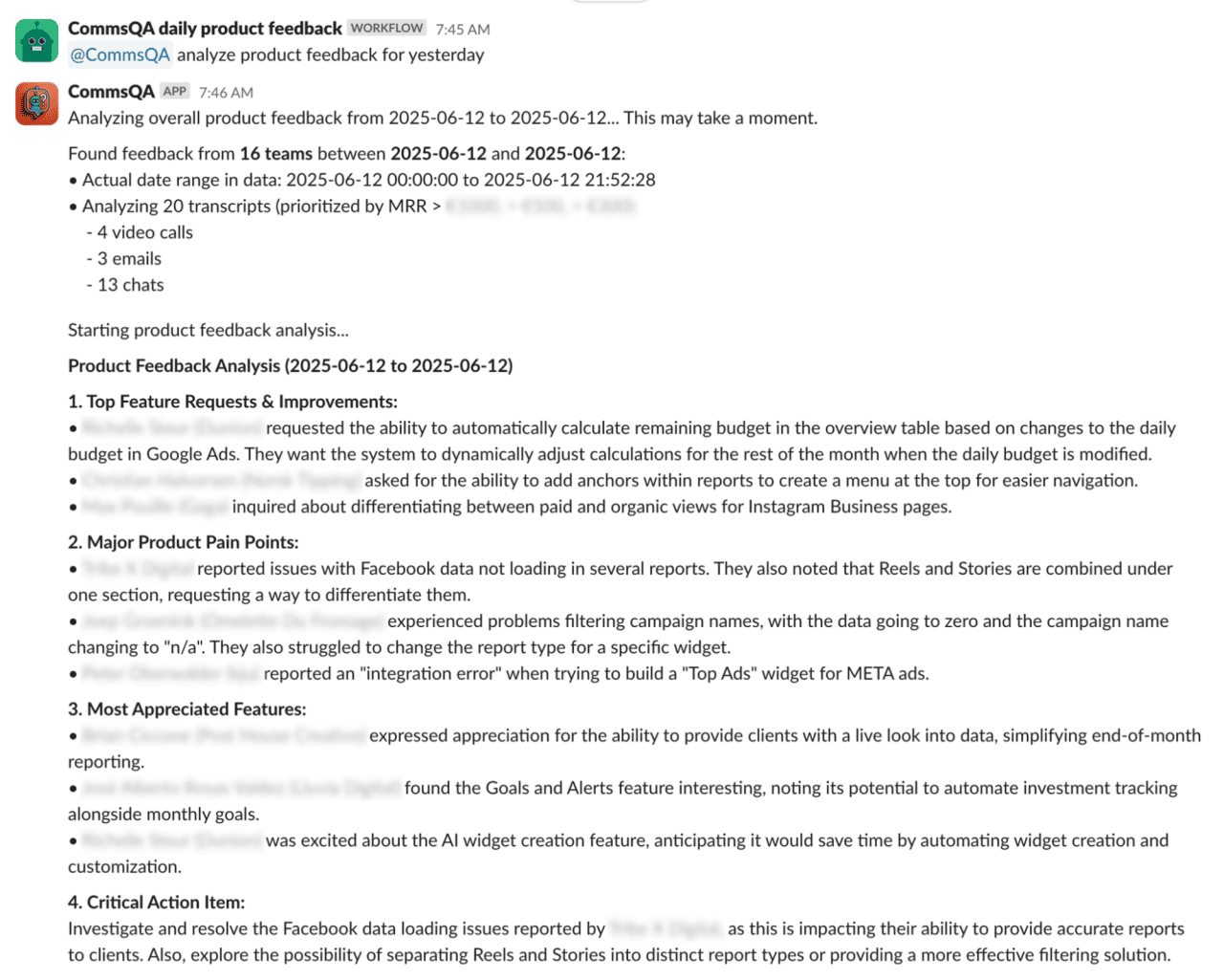
You can also chat with CommsQA in Slack and ask for specific insights about a client.
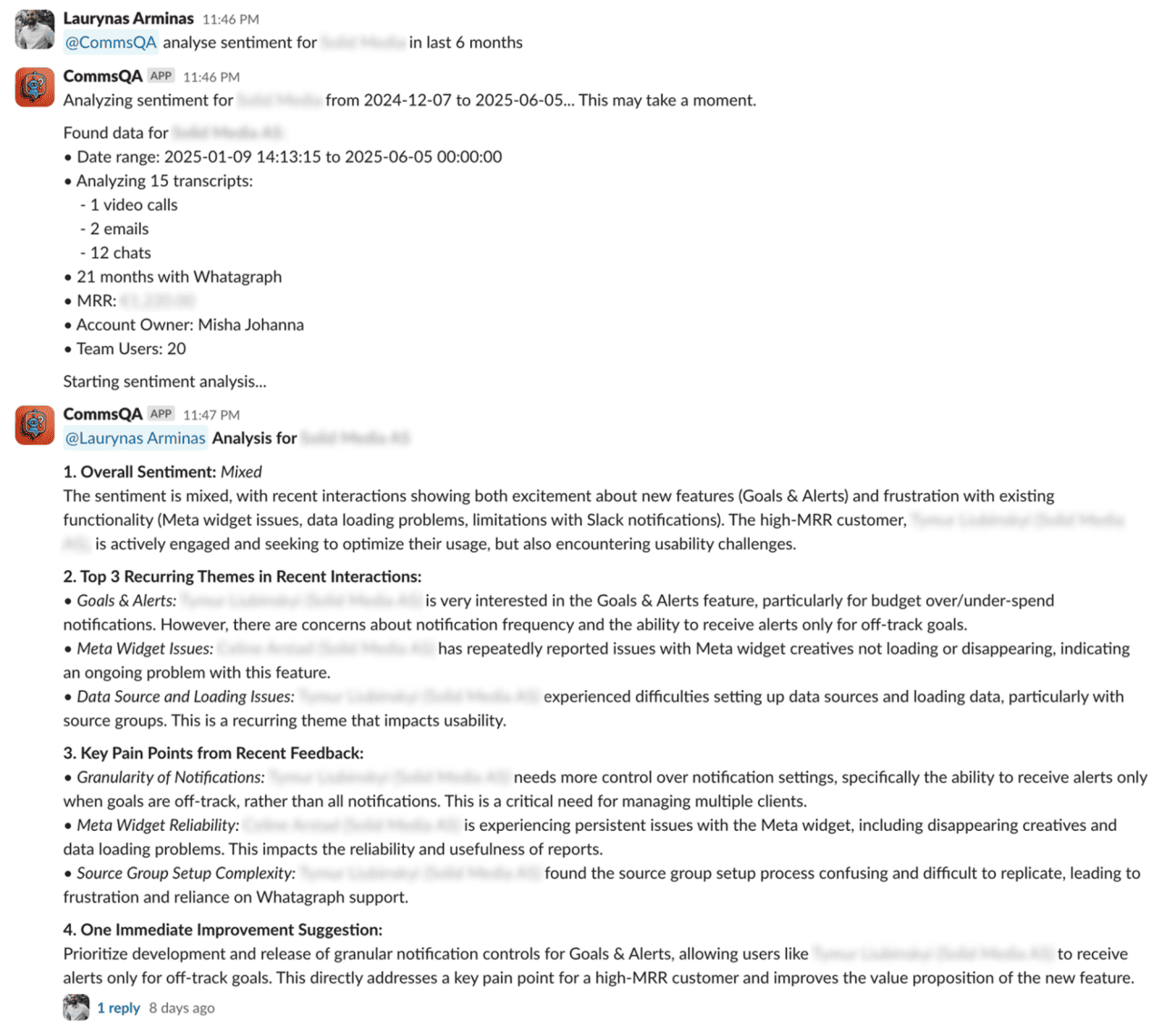
For Lazejeva, the impact of incorporating an AI agent into his workflow is clear. "It's bridged the gap between our customer-facing staff and product development," says Lazejeva. "It's led to a significant reduction in manual analysis time, a much quicker feedback loop, and the ability to make more data-driven roadmap decisions."
2. Pull up-to-date research on prospects and competitors
Usman Mahomed, head of product at egg, built a personal sales research assistant that shrinks hours of manual prospecting into minutes.
The agent learns egg's target profiles and then autonomously scours Google Maps, news sites, and industry directories for live data. From there, it fills in missing details from the profile and compiles everything into a Google Sheet tagged for review.
Mahomed's research assistant also inspired the rest of his team to build custom agents. "Everyone's using it," he says. “It's taking them less than five minutes to do what used to take them three hours.”
3. Recommend products based on dynamic feedback
Jonathan Moore, marketing and e-commerce director at Simba Sleep, uses online quizzes to help customers find their ideal mattress. But the difference between Moore's quiz and, frankly, every which-leave-in-conditioner-is-right-for-you quiz ever taken is that he uses an AI agent to dynamically update the product recommendations so that a customer isn't inexplicably pointed to a one-star product with multiple scathing reviews.
Here's how his AI agent works: "Our AI agent analyzes customer quiz data, inventory data (mattress types sold and returned), and product reviews to suggest refinements to our mattress quiz, which we then apply on a quarterly basis," explains Moore.
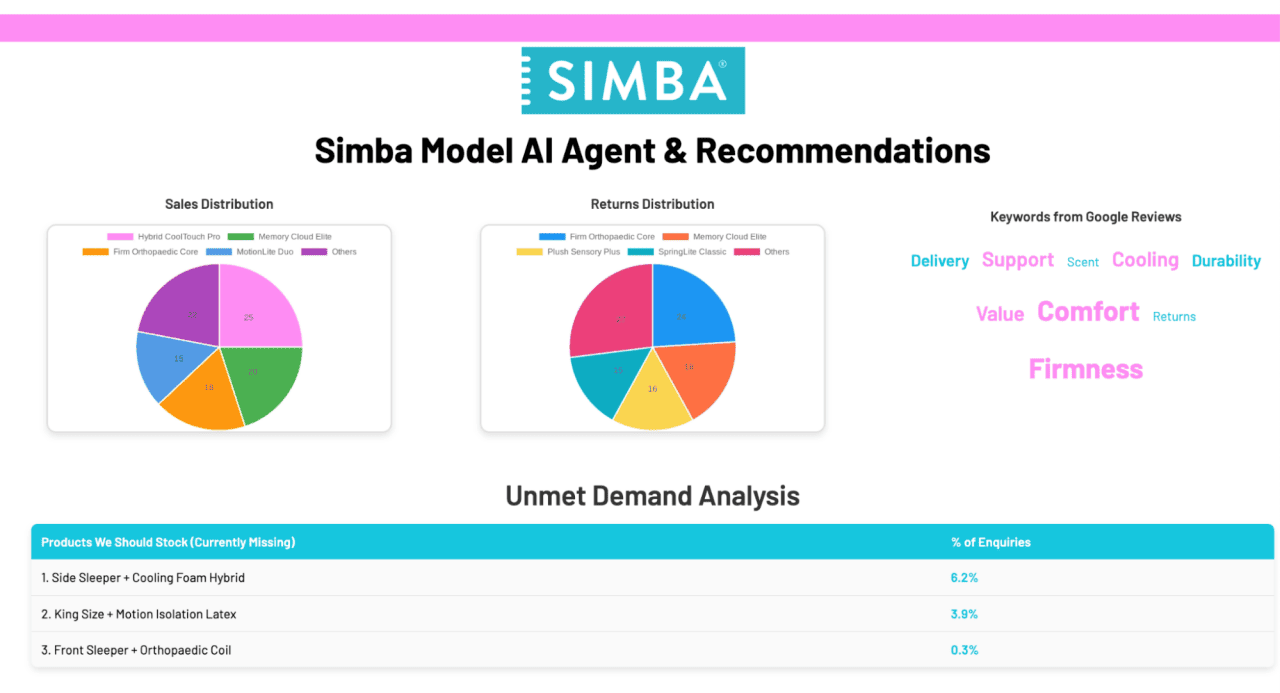
"This helps our team continuously improve the product matching logic and identify any gaps in our product line."
4. Generate and qualify leads at scale
Andrew Harding, VP of marketing and content partnerships at Slate, created an agent when he realized that manual prospecting couldn't keep up with demand.
It became Slate's on-demand sales assistant. Here's how it works: The agent searches the web for ideal prospects based on Slate's target advertiser personas and their audience strategy. It then organizes those prospects in Google Sheets for the marketing team to review, and any contact that meets Slate's criteria flows into their customer relationship management or outreach tools for immediate follow-up. It all happens automatically.
The impact was huge. "It generated over 2,000 leads in a single month," says Harding. "It's generated so many leads that we're still working through them months later."
5. Scale content creation
JBGoodwin REALTORS was stuck in a content bottleneck: They had one marketing coordinator trying to keep over 900 agents visible online.
To fix that, Edward Tull, vice president of technology and operations, built two agents to turn raw research into ready-to-publish blog and social media posts every week. Here's how they work:
"Before this, our VP of marketing and social media manager had to manually search for news," Tull shares. "Now, the agents serve it up ready to go—it's fast, relevant, and fully automated."
Just like a great camera can't frame the shot for you, an AI agent won't deliver results unless you've set it up properly. But once you've trained it on the right inputs, connected it to your tools, and pointed it toward a goal—it can handle the rest.
Every example in this article started with the same thing: a repetitive task worth offloading. If you've got one of those, you've got what you need to start building.
This story was produced by Zapier and reviewed and distributed by Stacker.







Reader Comments(0)