
The people's voice of reason


The people's voice of reason

Investors who navigated 2025 with diversified portfolios didn’t just reduce risk—they enhanced returns. In 2026, the playbook for many investors remains balanced: Stay invested in large-cap AI leaders while broadening exposure beyond the narrowest part of the market. Range highlights three aspects of portfolio construction to pay attention to this year.
Concerns of an AI bubble abound, and they may yet be realized, but that doesn’t mean investors should abandon Big Tech entirely.
The velocity of innovation and growth in the AI sector is simply too high to ignore. The productivity revolution underway is fundamentally reshaping the global economy. Regardless of where valuations stand today, eliminating exposure to large U.S. tech companies at the epicenter of this trend creates a distinct risk for those on the sidelines.
For long-term investors, the opportunity cost of exiting too early is meaningful. Consider the “Dot-Com” era. An investor who sold tech stocks in 1997 because they looked “expensive” missed the structural gains of the following three years. Even after the crash of 2000, the investor who held through the cycle often ended up ahead of the investor who exited prematurely.
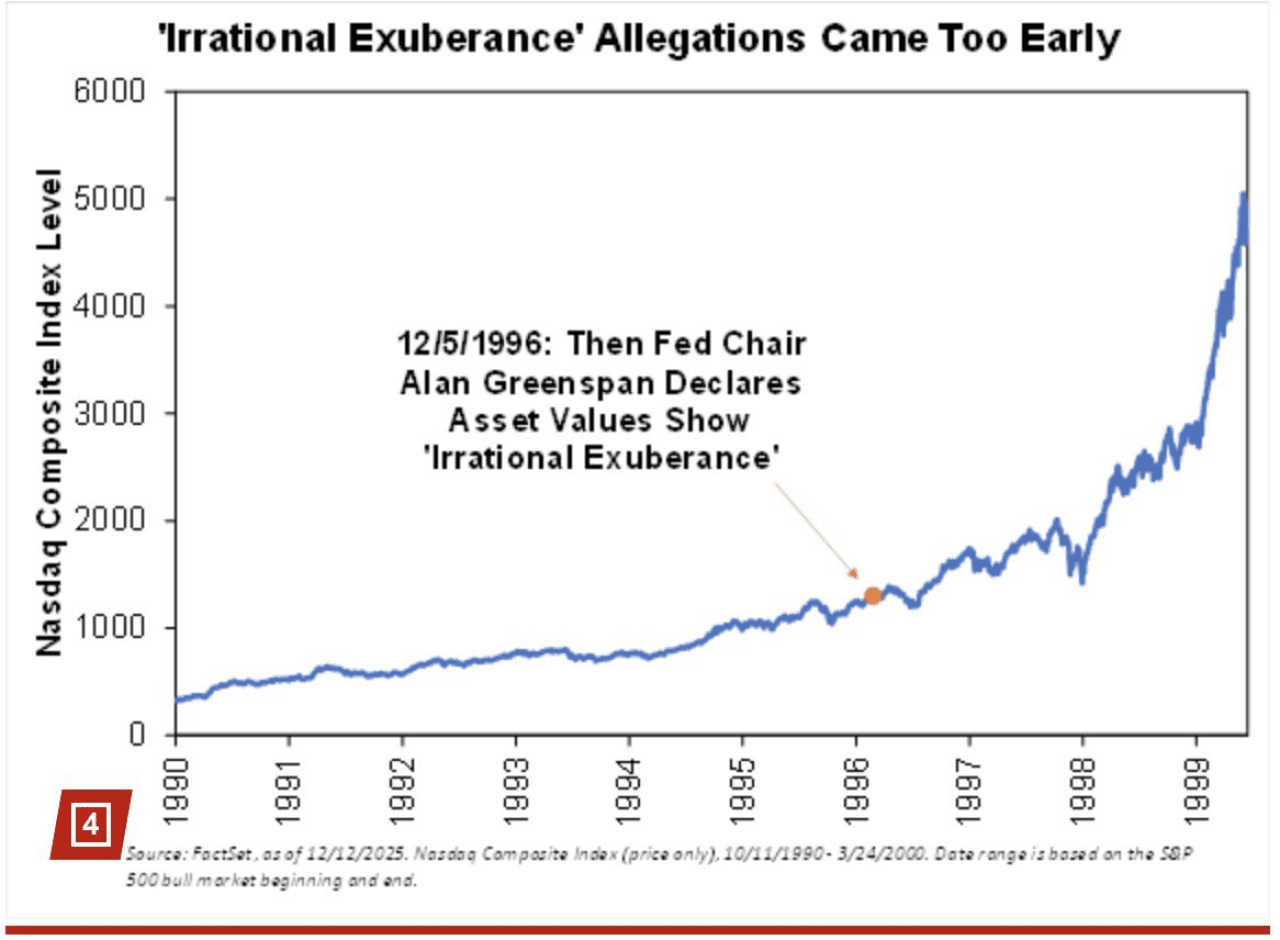
This is particularly relevant in 2026. Unlike the dot-com peak—when the Fed was hiking rates and the regulatory environment was uncertain—today’s AI boom is occurring against the backdrop of a supportive Fed and increasing fiscal stimulus. Betting against a technological revolution is difficult enough; betting against one that is backed by accommodative monetary and fiscal policy could be even riskier.
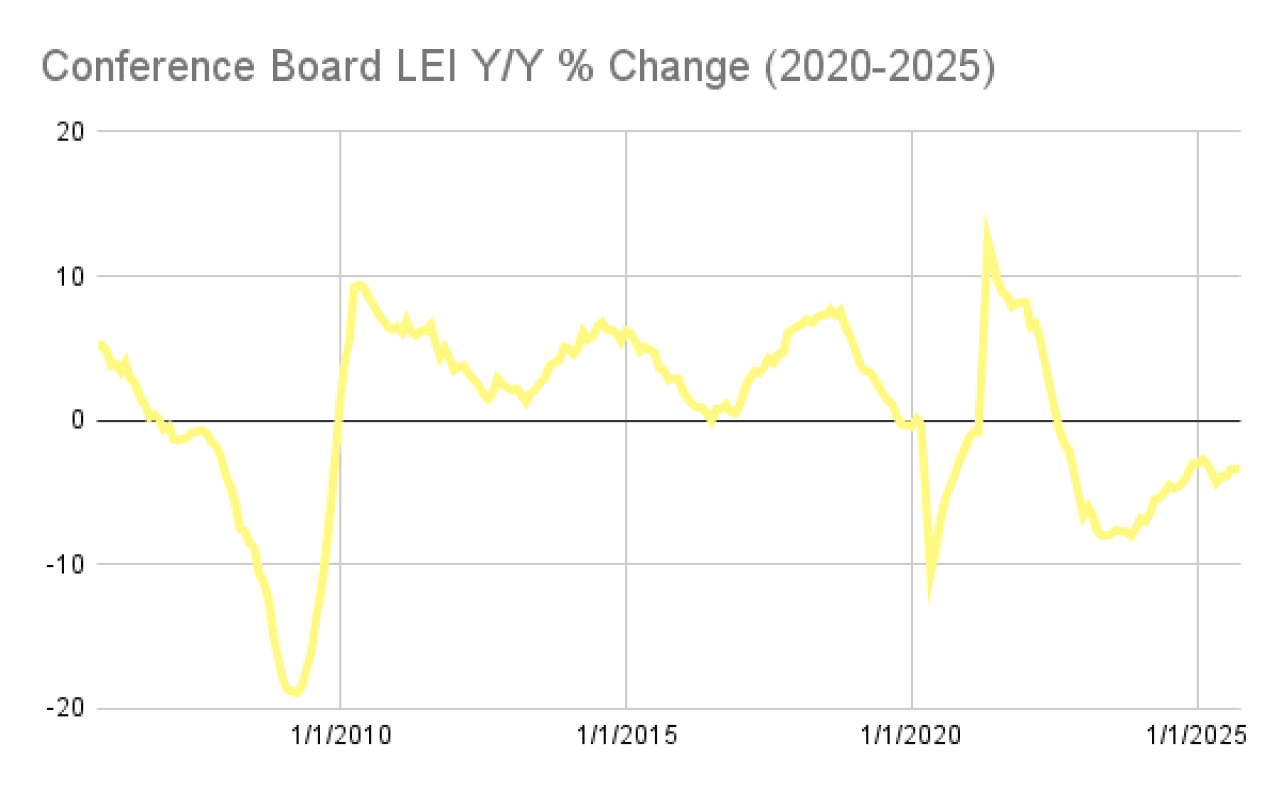
Despite strong headline market performance, large parts of the U.S. economy have been in a rolling slowdown for years—and are only now starting to turn. Manufacturing spent much of the past three years in contraction: The ISM Manufacturing PMI was below 50 for 26 consecutive months before returning to expansion in early 2025. Meanwhile, the Conference Board’s Leading Economic Index has remained persistently weak since mid-2022—at one point logging 23 straight monthly declines—an unusually long warning streak without an official recession.
This malaise shows up when you look beyond headline index earnings. While S&P 500 profits have been disproportionately supported by the “Mag 7,” earnings for the typical U.S. company have been far more subdued and only recently improving. The median stock in the Russell 3000—an index that represents roughly 98% of the investable U.S. equity market—has seen lackluster earnings momentum in recent years and is only now beginning to inflect.
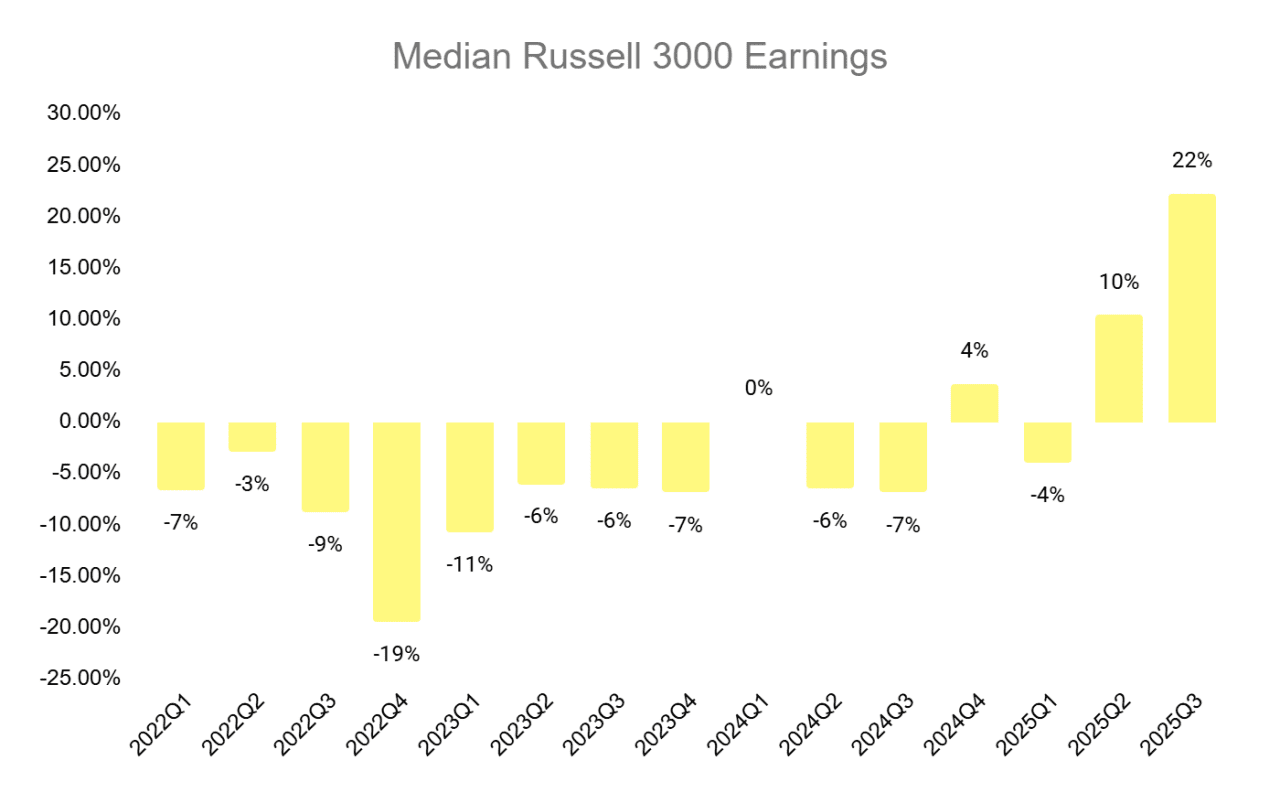
Many of these companies are AI beneficiaries—not as hyperscalers, but as adopters integrating AI to boost productivity:
“In terms of the language courses, we added 148 new language courses. All of this content was done with AI, and it really took us about a year to add these 148 language courses. And like you mentioned, the previous 100-ish courses took us about 12 years to make. So this is an incredible speed-up.” – Duolingo Q1 2025 Earnings Call
“And so we probably didn’t get as much press on this, but in the last quarter…[we saw] through automation and through AI, a 61% improvement in productivity year-over-year. And [we] don’t have less brokers — we’ve redeployed them in other places to generate freight” – Schneider International at MS Industrials Conference in Q3 2025
“Our margins expanded by 90 basis points sequentially as sizable automated startups and productivity initiatives... matured more quickly than expected.” – RXO Q2 2025 Earnings Call
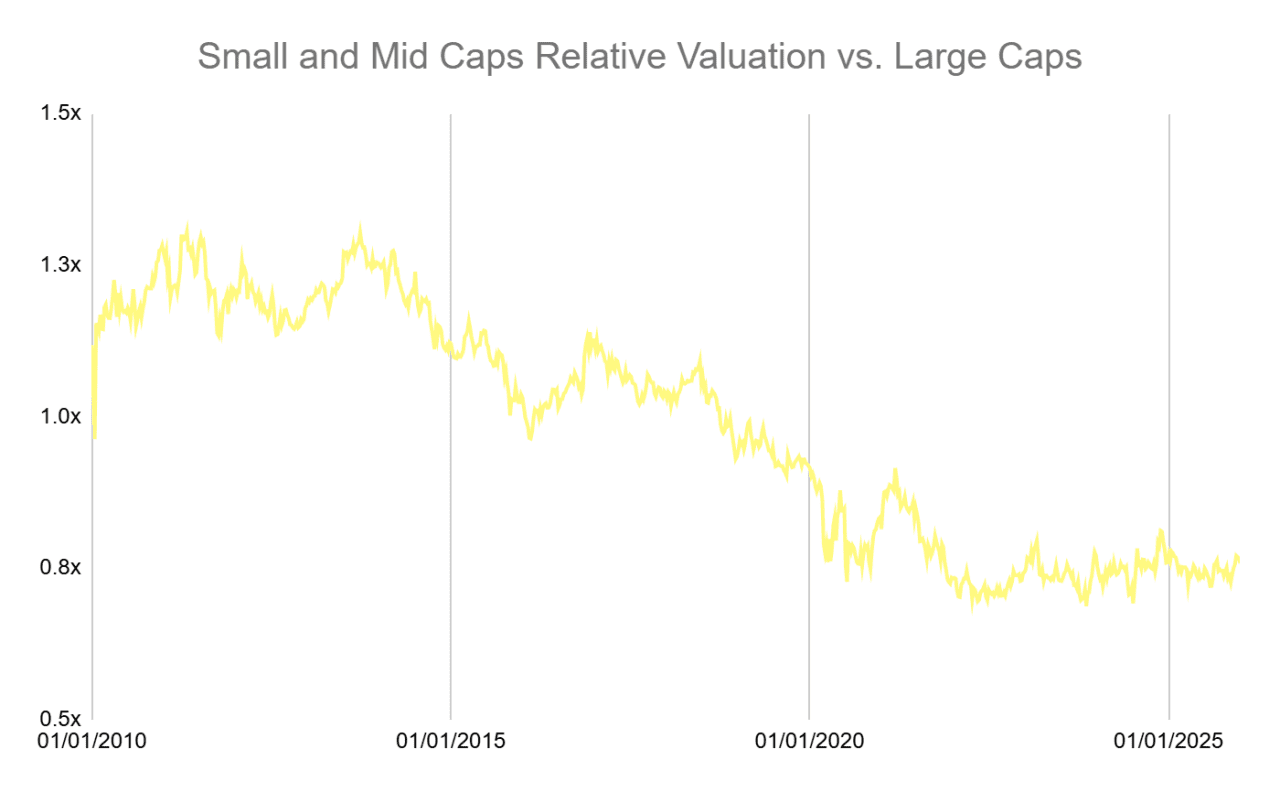
Despite improving earnings trends and increasing evidence of AI-driven productivity, small and midcap stocks continue to trade at a historically wide discount to large caps. If earnings revisions keep trending higher, this segment of the market stands to benefit from a powerful combination: accelerating earnings growth combined with valuation multiple expansion. When this dynamic last occurred between 2020 and 2021, small and midcap stocks outperformed the S&P 500 by over 20%.
After years of U.S. dominance, 2025 proved domestic outperformance isn’t guaranteed. International equities outpaced the S&P 500, helped by a weaker dollar and a catch-up in valuations outside the U.S.
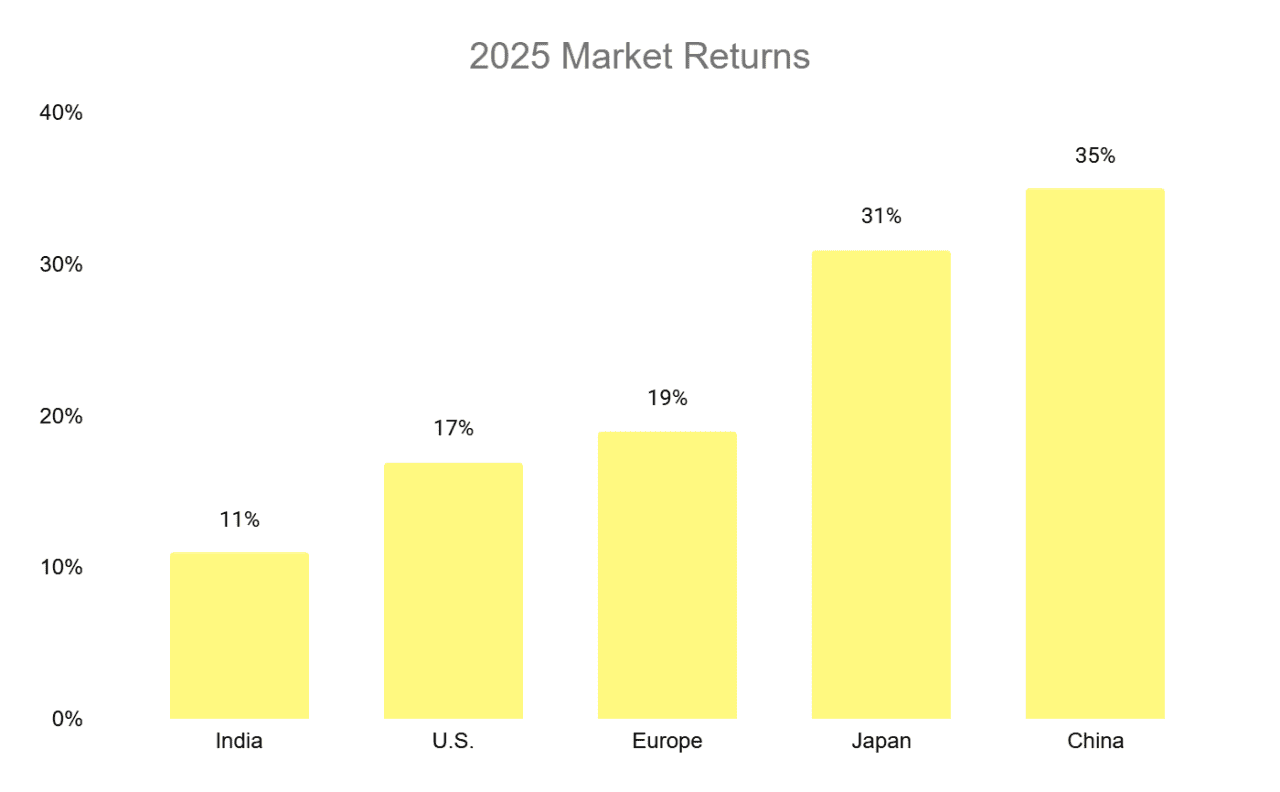
Heading into 2026, the rest of the world has credible, region-specific tailwinds that can sustain continued performance, especially from a starting point of generally lower valuations.
International markets offer more than just a valuation discount; they can offer a different way to win. By allocating globally, investors can own some of the “picks and shovels” of the hardware supply chain and access distinct macro catalysts that provide return drivers uncorrelated to the U.S. tech sector.
2026 can be a year where market leadership broadens.
1. Maintaining Core Exposure to AI Leaders: Despite elevated valuations, the large-cap U.S. stocks remain the primary engines of global earnings growth. We are in the midst of a capital expenditure super-cycle that rivals the build-out of the internet. Exiting a generational technological shift early can be more costly than riding out volatility. These best-in-class companies can be the foundation of a growth portfolio.
2. Capturing the “Real Economy” Rebound (Small and Midcap): Small and midcap stocks offer a dual benefit: a hedge against mega-cap concentration and an offensive play on the U.S. economic recovery with high operating leverage—essentially buying the “real economy” at a historic discount.
3. Participating Globally: International markets offer more than just a value play; they offer distinct drivers of return that are uncorrelated to the U.S. consumer. Distinct local catalysts—such as Germany’s fiscal pivot or India’s demographic boom—provide growth engines that can deliver even if the U.S. slows. International allocations also allow investors to own broad AI exposure at a meaningful discount to U.S. multiples.
Diversification in 2026 is not just about playing defense; it is about capturing the rest of the recovery. By rebalancing into these lagging sectors while holding winners, investors can mitigate the risks of an AI sentiment shift while exposing their portfolios to the parts of the market with the most room to rerate.
This story was produced by Range and reviewed and distributed by Stacker.





Reader Comments(0)