
The people's voice of reason


The people's voice of reason
What occurred in Minnesota was neither a fluke nor an administrative oversight, and it was certainly not an unforeseeable anomaly; rather, it was the predictable and long-developing consequence of a federal culture that has increasingly treated taxpayer dollars as an inexhaustible resource-distributed rapidly in the name of urgency and compassion, tracked loosely under the banner of equity, and audited only after the damage had already been done. Minnesota simply became the place where this reality could no longer be ignored, where the curtain was finally pulled back on practices that had been quietly normalized across the federal system.
It is for this reason that the recent announcement by Vice President J.D. Vance deserves attention far beyond the borders of any single state, because it speaks not to a localized failure but to a national problem embedded in the structure of federally funded programs operating throughout the country. The scale of the Minnesota scandal forced public recognition of something that had long been evident to auditors and investigators alike: fraud in government programs is not incidental, episodic, or rare, but systemic, repeatable, and enabled by design choices that prioritize speed and political signaling over verification and control.
Vice President Vance's decision to launch a multi-state fraud task force represents an acknowledgment of what Washington has resisted admitting for years-that fraud is no longer confined to isolated programs or bad actors, but has become embedded in the largest and most politically sensitive spending pipelines in the federal system. This recognition matters, because it reframes fraud not as a matter of individual misconduct alone, but as a structural failure requiring a coordinated response that reflects how these programs actually operate across jurisdictions.
The Minnesota scandal illustrated how easily public programs can be manipulated when ideological urgency displaces basic controls and when speed is elevated above scrutiny as the primary administrative virtue. Vast sums of taxpayer money were routed through nonprofits, shell entities, and pass-through organizations operating with minimal verification requirements, weak documentation standards, and almost no real-time oversight capable of detecting abuse before it became systemic.
When a system is designed to reward rapid disbursement rather than careful verification, fraud does not merely slip through unnoticed; it flows freely, exploiting every gap that well-intentioned but poorly constructed rules leave behind. Once those gaps are discovered, they are reused, replicated, and exported across programs and jurisdictions, often with remarkable consistency.
Perhaps the most revealing aspect of the Minnesota case is not the headline dollar amount, but the familiar pattern that emerged once investigators began pulling at the threads. They encountered duplicate vendors, overlapping beneficiaries, inflated billing, phantom services, and an institutional culture in which asking probing questions was treated not as diligence, but as obstruction or hostility. This pattern is neither novel nor unique to Minnesota; it mirrors findings that federal auditors have documented repeatedly across multiple programs and multiple states.
For years, Americans were assured that fraud within federal programs was rare, exaggerated, or primarily the product of partisan rhetoric. Yet the federal government's own watchdog has consistently told a very different story-one that has been quietly documented but rarely confronted with the seriousness it warrants.
According to the Government Accountability Office, improper payments-defined not as speculative risks but as taxpayer dollars that should not have been paid as issued-total hundreds of billions of dollars annually. These payments include funds sent to ineligible recipients, duplicate or excessive payments, payments made without required documentation, and payments issued under verification systems that failed to meet statutory or administrative standards. Importantly, these findings do not reflect theoretical exposure, but confirmed failures identified through formal audits of existing programs.
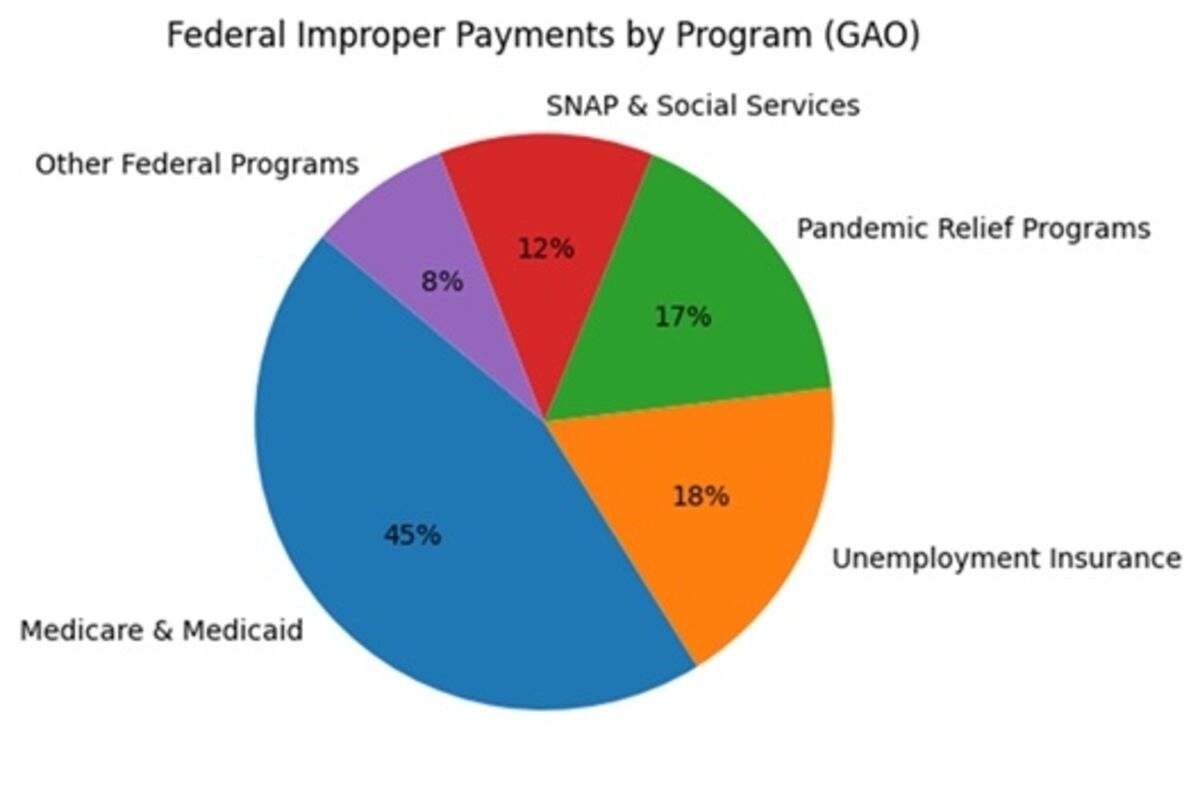
The percentages reflected in this chart represent each major program category's proportional share of all federal improper payments identified in a given year, as documented by the Government Accountability Office. The term "improper payments" refers to taxpayer dollars that were paid out despite failing to meet statutory or administrative requirements, including payments made to ineligible recipients, duplicate or excessive payments, payments unsupported by required documentation, or payments issued without adequate verification controls. These percentages should not be interpreted as reflecting the overall size or total spending level of each program; rather, they illustrate where federal auditors have already documented the greatest concentration of waste, error, and fraud.
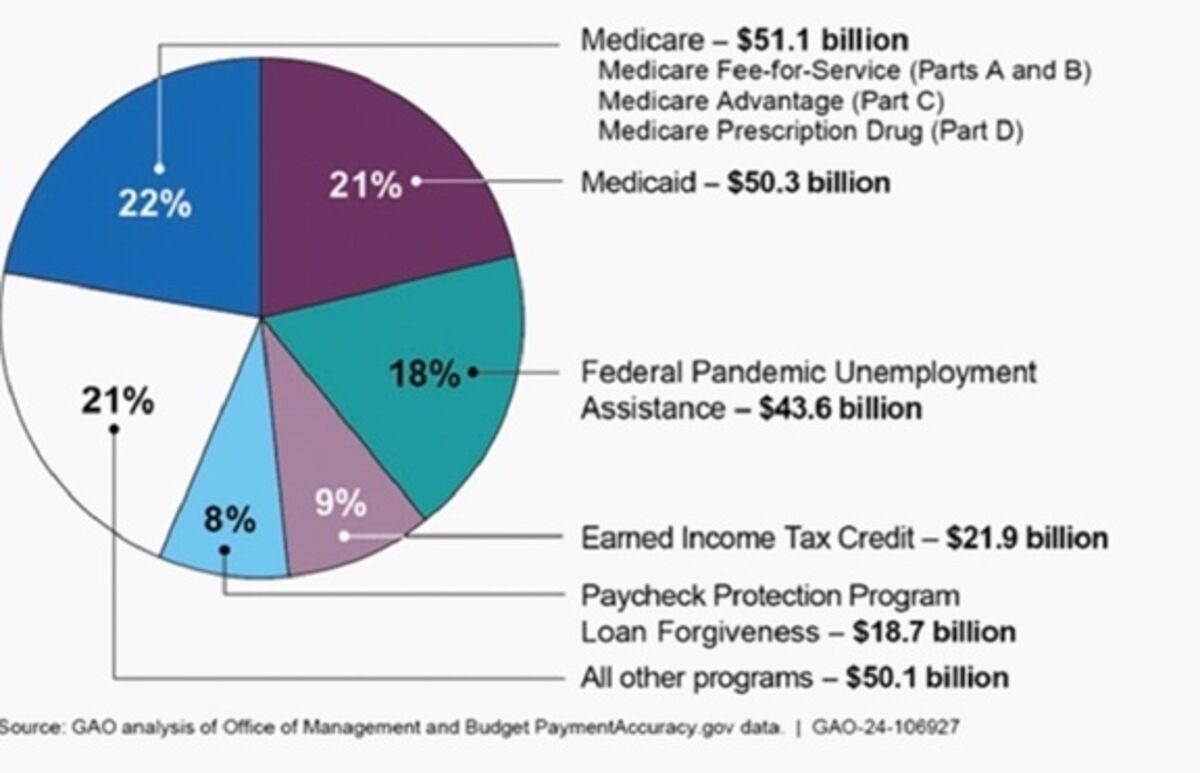
Here we have the staggering dollars amounts of the fraud and abuse in these programs.
Minnesota may have been the scandal that finally forced Washington to confront what it had long preferred to ignore, but the reckoning now underway is unmistakably national in scope. As Vice President J.D. Vance stated in announcing the new multi-state fraud task force, the objective is straightforward and overdue: to “stop defrauding the American people” and to restore respect for taxpayer dollars across every federally funded program, in every state. That responsibility does not belong to federal agencies alone. It necessarily extends to state legislatures nationwide, which serve as the primary stewards of how federal funds are implemented on the ground. In that moment of shared responsibility, Alabama’s Legislature should be the first to step up to the plate—not because it has been singled out, but because leadership now means setting the standard before it is imposed. If this effort succeeds, it will be because states chose to lead in partnership with federal authorities, proving that accountability is not a reaction to scandal, but a governing principle worthy of public trust.
Perry O. Hooper Jr. is a former state representative, current member of the Alabama Republican State Executive Committee, 2016 Trump Victory Chair, and is a widely published political and current affairs columnist.
Opinions expressed are those of the author alone and do not necessarily reflect the views of the Alabama Gazette staff or publishers.







Reader Comments(0)