
The people's voice of reason


The people's voice of reason

LTL (less-than-truckload) shipping allows multiple shippers to share space and costs for smaller freight loads that don’t require a full truck. However, rising LTL shipping costs are a persistent challenge for manufacturers, distributors, retailers and e-commerce businesses. Broussard Logistics explains how strategic contract management can reduce LTL shipping costs.
While many companies focus on negotiating lower rates, true savings come from a strategic, ongoing approach to LTL contract management. By treating contract management as a continuous process, you can unlock significant, long-term savings and bring predictability to your supply chain.
Strategic LTL contract management goes beyond simply shopping for the lowest rate. It’s a cyclical, data-driven process that includes analysis, negotiation, monitoring and continuous optimization. The goal is to create a partnership with your carriers that balances cost savings with reliable service so your shipping contracts are always working in your favor.
Key elements of strategic LTL contract management include:
To better understand how to save money with LTL contract management, start at ground level. Before entering negotiations, consider your shipping profile and anticipate future needs. Gathering the right data and using forecasting tools will enable you to negotiate optimally and avoid unexpected costs down the road.
Before you can optimize your LTL contracts, thoroughly analyze your current shipping profile to understand where your costs are coming from and identify opportunities for improvement:
Ensure your LTL shipping contracts remain effective as your business develops by projecting your future shipping requirements and anticipating changes in demand, volume and service needs:
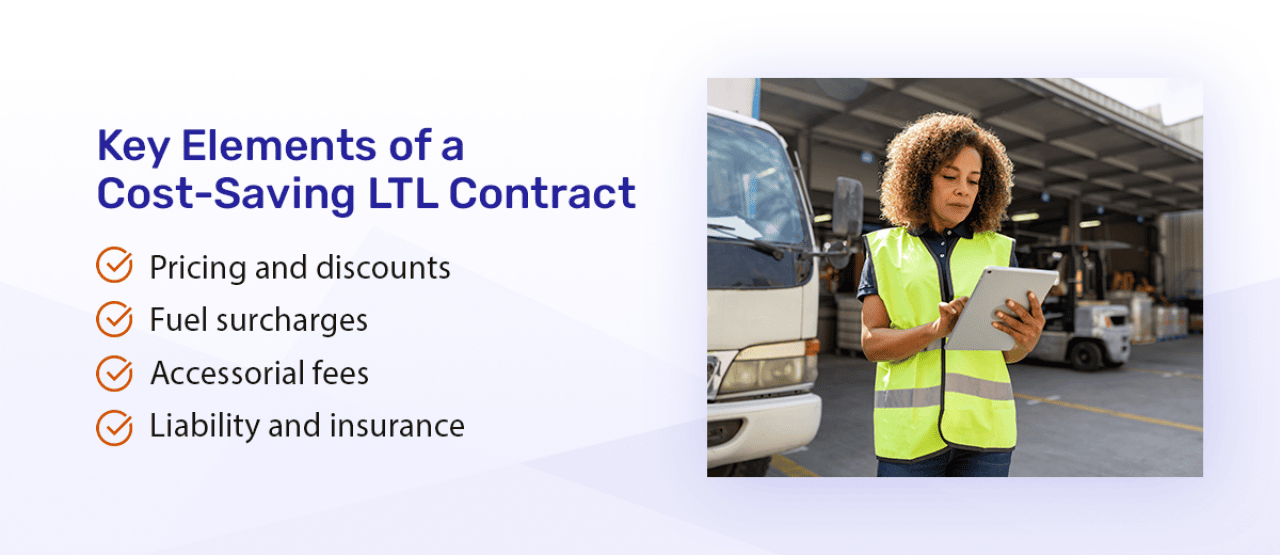
Effective negotiation is about more than the base rate. The most impactful LTL shipping contracts deal with a range of terms that can significantly affect your bottom line. Understanding and negotiating these elements is key to maximizing your savings:
A well-negotiated contract is only as effective as the relationship that supports it. Businesses ultimately save money with LTL contract management because it establishes collaborative partnerships with carriers that lead to better service, more flexibility and a greater willingness to resolve issues in your favor.
Building strong carrier partnerships starts with clear, consistent communication and operational efficiency. When your logistics partner provides carriers with accurate shipment information, ensures timely pickups and maintains efficient dock operations, it positions your business as a preferred customer or “shipper of choice.” This can lead to faster service, fewer delays and greater flexibility from carriers.
Operational excellence not only streamlines your supply chain but also gives you leverage to negotiate better rates and service terms, ultimately driving down your shipping costs.
Committing to longer contract terms or providing consistent shipping volumes can be a powerful tool in negotiations. Carriers value stability and predictability and are often willing to offer more favorable pricing and service guarantees in return. By building trust and reliability with your carriers through long-term commitments, your business is better positioned to secure capacity and maintain stable rates, even in periods of high demand or market volatility.
A collaborative carrier relationship is essential for resolving issues quickly and fairly. Instead of defaulting to extra fees or drawn-out disputes, a strong partnership encourages open dialogue and problem-solving. This helps avoid unnecessary costs and ensures the smooth management of your supply chain.
Encouraging carriers to proactively communicate potential problems or opportunities for improvement further strengthens the relationship. When carriers feel comfortable sharing insights or flagging issues early, your business can address concerns before they escalate, adapt to changes efficiently, and continuously improve shipping performance.
Signing the contract is just the beginning. Real savings and supply chain resilience come from actively managing your LTL agreements and carrier relationships over time. Ongoing contract management ensures you continue to get the best value as your business and the market evolve.
The following are strategies for optimizing contract management:
This story was produced by Broussard Logistics and reviewed and distributed by Stacker.





Reader Comments(0)