
The people's voice of reason


The people's voice of reason
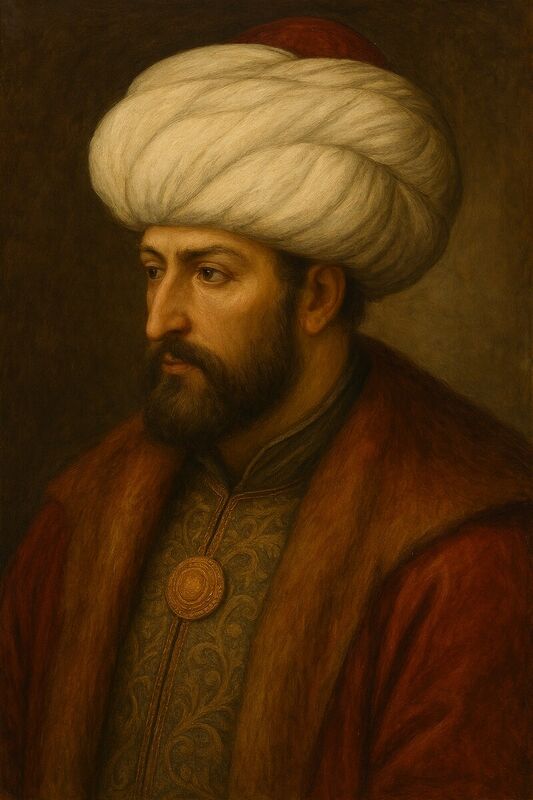
Mehmed the Conqueror
The accession of Mehmed II to the Ottoman throne on February 3, 1451 stands as one of the most consequential turning points in medieval history. At just nineteen years old, Mehmed inherited not only the vast and diverse territories of the Ottoman state but also its most enduring strategic challenge: the presence of Constantinople, the ancient Byzantine capital, still standing-though weakened-at the heart of Ottoman lands. His rise to power marked the beginning of a transformative era, one that would reshape the political, cultural, and religious landscape of southeastern Europe and the eastern Mediterranean for centuries.
Mehmed was no stranger to the burdens of leadership. As a young prince, he had briefly ruled once before, from 1444 to 1446, during a turbulent period when his father, Sultan Murad II, attempted to retire from political life. That first reign was short-lived. European crusaders, sensing weakness in the teenage sultan, launched a major campaign that culminated in the Battle of Varna. The crisis forced Murad to return to the throne, and Mehmed stepped aside. Yet this early experience left a deep impression on him. It taught him the precariousness of power, the ruthlessness of foreign rivals, and the necessity of strong, decisive rule. When he returned to the throne in 1451, he did so with a far more mature understanding of statecraft and a clear, ambitious vision for the empire's future.
At the center of that vision was the conquest of Constantinople. For centuries, the city had been a symbol of imperial grandeur, the last remnant of the once-mighty Byzantine Empire. Its strategic position between Europe and Asia, its control of key trade routes, and its immense symbolic value made it a prize coveted by generations of Ottoman rulers. Mehmed, however, approached the challenge with a level of determination and preparation unmatched by his predecessors. He recognized that taking the city would not only secure Ottoman territorial continuity but also elevate the empire to a new level of prestige and legitimacy.
One of his first major undertakings was the construction of Rumeli Hisarı, a massive fortress on the European side of the Bosphorus. Built directly across from the older Anadolu Hisarı fortress, it allowed the Ottomans to control naval traffic and cut off aid to Constantinople from the Black Sea. This bold move signaled to both allies and enemies that Mehmed was serious about his intentions. He also reorganized the military, strengthened the Janissary corps, and invested heavily in new technologies. Most notably, he hired foreign engineers-among them the Hungarian master cannon-maker Urban-to design and cast enormous siege cannons. These weapons, including the famous Basilica, were capable of breaching even the most formidable medieval walls.
By the spring of 1453, Mehmed was ready. The siege of Constantinople began in April and lasted 53 days. Despite the city's legendary defenses, including the towering Theodosian Walls, the Byzantines were vastly outnumbered and lacked the resources to withstand a prolonged assault. Mehmed's forces combined relentless bombardment with innovative tactics, including naval maneuvers that brought Ottoman ships into the Golden Horn by land. On May 29, 1453, the city fell. The last Byzantine emperor, Constantine XI Palaiologos, died defending his capital, and the thousand-year-old Byzantine Empire came to an end.
The conquest was more than a military triumph. It was a civilizational shift. Mehmed entered the city not as a destroyer but as a ruler intent on revitalizing his new capital. He declared himself Kayser‑i Rum, or "Caesar of Rome," asserting continuity with the Roman imperial tradition. He restored the city's infrastructure, repopulated its districts with diverse communities, and transformed Constantinople-soon known as Istanbul-into a thriving center of commerce, culture, and learning. Under his patronage, scholars, architects, and artists from across the Islamic world and beyond flocked to the city, contributing to a flourishing intellectual climate.
Mehmed's ambitions extended far beyond Constantinople. In the years that followed, he launched campaigns across the Balkans, capturing Serbia, Bosnia, and parts of Albania. In Anatolia, he subdued rival Turkish beyliks and expanded Ottoman authority eastward. His confrontations with the Mamluk Sultanate of Egypt and Syria, though not resulting in their immediate defeat, weakened their influence and set the stage for the Ottomans' eventual conquest of the region under his successor, Selim I.
Despite his military focus, Mehmed II was also a man of culture and intellect. He spoke multiple languages, collected books, and engaged with scholars from diverse traditions. His court blended Islamic, Persian, Byzantine, and even Renaissance influences, reflecting his cosmopolitan outlook. By the time of his death in 1481, Mehmed had transformed the Ottoman state into a powerful, centralized empire poised to dominate the eastern Mediterranean for centuries.
His reign remains a defining chapter in world history-a moment when a young ruler's ambition, strategic brilliance, and relentless drive reshaped the map and ushered in a new imperial age.



Reader Comments(0)