
The people's voice of reason


The people's voice of reason
The tragic loss of U.S.S. Maine led the U.S. to declare war on Spain
February 15, 1898 - The Night That Changed U.S. Foreign Policy
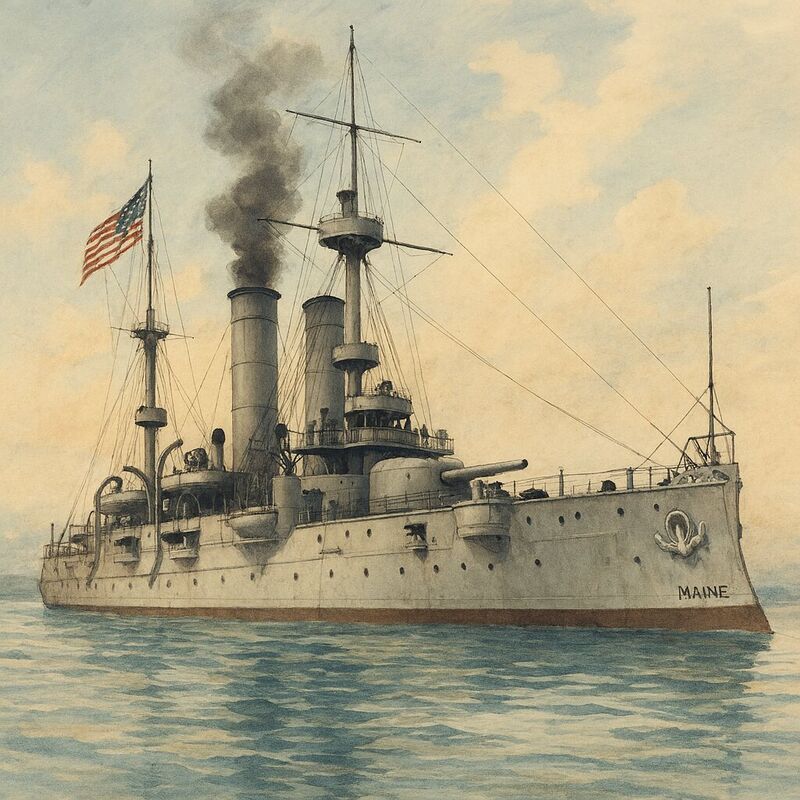
On a warm February night in 1898, as Havana Harbor lay quiet under the Cuban sky, the American battleship USS Maine suddenly erupted in a massive explosion that shattered the stillness and sent shockwaves far beyond the island. More than 260 American sailors were killed instantly or died soon after-one of the deadliest peacetime naval disasters in U.S. history.
Within weeks, the tragedy would ignite a political firestorm, fuel a media frenzy, and propel the United States into the Spanish‑American War, reshaping America's role on the world stage. The sinking of the Maine remains one of the most consequential-and debated-events in American history.
A Ship Sent to Keep the Peace
In early 1898, Cuba was in the midst of a violent struggle for independence from Spain. The conflict had drawn intense American attention, especially as reports of Spanish brutality circulated in U.S. newspapers. Tensions were high, and Washington wanted to protect American citizens and interests on the island.
To signal concern-but not aggression-the United States dispatched the USS Maine to Havana on a "friendly visit." The ship arrived on January 25, 1898, anchoring peacefully in the harbor. For three weeks, the crew carried out routine duties, unaware that their mission would soon become a turning point in American history.
The Explosion That Rocked a Nation
At 9:40 p.m. on February 15, a thunderous blast tore through the forward section of the Maine. Witnesses in Havana described a fireball rising above the harbor and debris raining down across the water. The ship sank rapidly, leaving only twisted metal and a stunned city in its wake.
Rescue efforts were chaotic and heartbreaking. Many sailors were trapped below deck. Others were thrown into the water by the force of the explosion. Spanish authorities in Havana assisted in recovery efforts, but suspicion immediately clouded the tragedy.
"Remember the Maine!" - A Rallying Cry Takes Hold
In the United States, the explosion became front‑page news overnight. Newspapers-especially the sensationalist "yellow press" led by William Randolph Hearst and Joseph Pulitzer-published dramatic illustrations and bold headlines suggesting Spanish sabotage.
The phrase "Remember the Maine! To hell with Spain!" spread rapidly across the country.
Although the cause of the explosion was not proven, public anger surged. Many Americans believed Spain had attacked the ship, even as Spanish officials insisted they were innocent and called for a neutral investigation.
Investigations and Uncertainty
A U.S. naval court of inquiry convened in March 1898. Its report concluded that an external explosion-likely a mine-had detonated the ship's forward magazines. However, the investigation could not determine who placed the mine or whether it was intentional.
Spain conducted its own inquiry, arguing that the explosion originated inside the ship, possibly from a coal bunker fire igniting ammunition.
To this day, historians and naval engineers continue to debate the cause. Modern studies have suggested that an internal coal fire was plausible, but no definitive answer has ever emerged.
From Tragedy to War
Regardless of the uncertainty, the political momentum was unstoppable. The sinking of the Maine intensified calls for intervention in Cuba, where the independence movement had strong American sympathy.
By April 1898, diplomatic efforts had collapsed. On April 25, the United States formally declared war on Spain, citing the need to free Cuba and respond to the loss of the Maine.
The war was brief-just four months-but transformative. The United States emerged with new territories, including Puerto Rico, Guam, and the Philippines, marking the nation's arrival as a global power.
A Legacy of Mystery and Memory
The wreck of the Maine remained in Havana Harbor for years before being raised and ceremonially scuttled at sea in 1912. A memorial to the lost sailors stands today in Arlington National Cemetery.
The event continues to symbolize:
• The power of public opinion in shaping foreign policy
• The dangers of acting on incomplete information
• The moment the U.S. stepped onto the world stage as an imperial power
For many Americans, especially those who study naval history or the evolution of U.S. foreign policy, the sinking of the Maine is a reminder of how a single night can alter the course of a nation.







Reader Comments(0)