
The people's voice of reason


The people's voice of reason

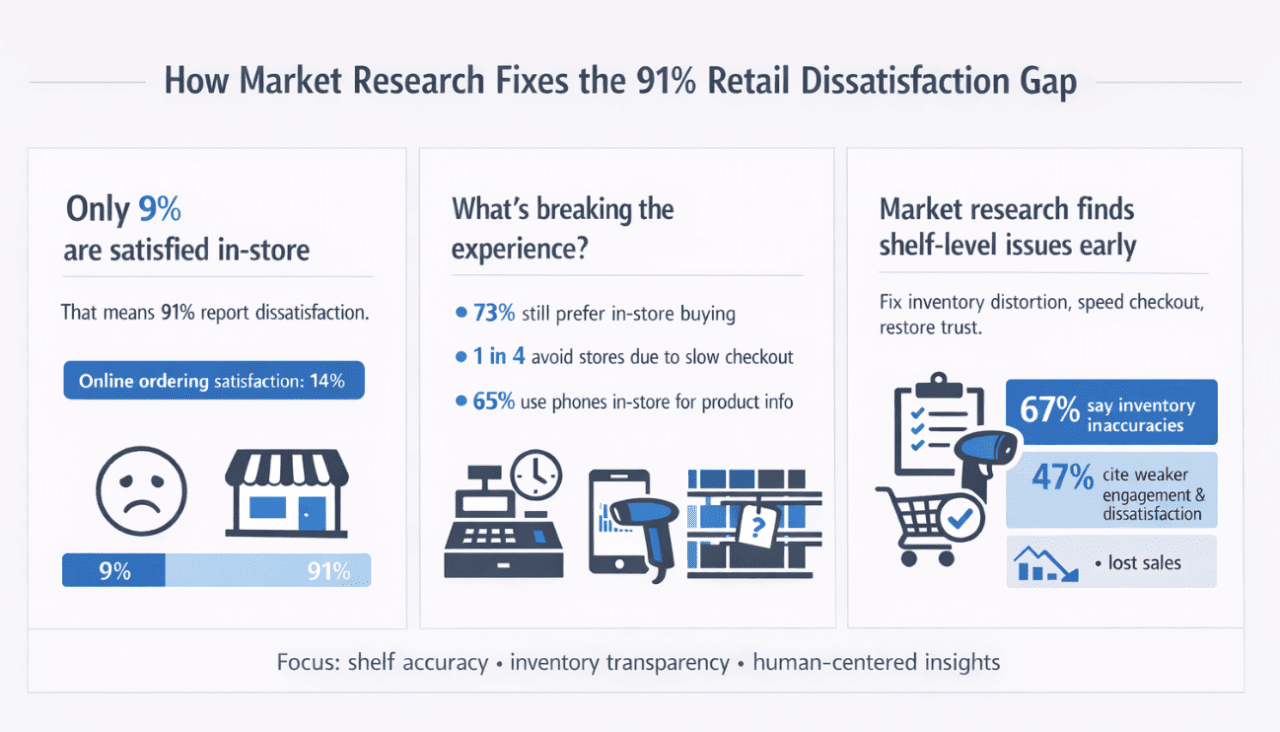
For retailers attempting to capitalize on the persistent preference for physical storefronts, the gap between consumer expectations and operational reality has reached a critical fracture point. While the majority of shoppers still favor brick-and-mortar environments for purchasing decisions, 2024 research from the IBM Institute for Business Value revealed a stark disparity: Only 9% of consumers reported being satisfied with the current in-store experience.
The numbers tell a clear story. Even in the more convenient context of online ordering, satisfaction levels remained stagnant at 14%. As digital integration raises the bar for personalization, physical retail is struggling with friction points—specifically inventory transparency and checkout velocity—that actively erode brand loyalty.
In this analysis, The Barcode Group evaluates the data driving this dissatisfaction and how high-level market research is being deployed to reclaim the competitive advantage.
That aforementioned IBM study pinpoints a few other interesting facts about the state of retail experiences, especially in-store.
First and foremost, brick-and-mortar retail retains the upper hand in terms of customer preference, with 73% of respondents citing in-person visits as their choice for making buying decisions and purchases. The utilization of physical space is often undermined by operational friction. One in 4 shoppers cites sluggish checkout times as a primary deterrent to in-store retail.
Next, there’s the lack of digital integration. Sixty-five percent of people said they turn to their smartphones to enhance the in-store shopping experience, in part because they feel there isn't enough product information available in most physical retail environments.
Finally, the often impersonal experience that’s associated with brick-and-mortar stores is increasingly under fire. Modern consumers are used to receiving a totally tailored approach to retail in an e-commerce context. Replicating this in-store requires increased digital integration and a better understanding of what individual customers actually want.
Dialing into the specifics of what’s going wrong in brick-and-mortar outlets requires a shift to focus on data derived from a 2025 study from IHL Group. Here, retailers, rather than consumers, were surveyed, with 67% reporting that inventory inaccuracies hurt their relationships with customers on a daily or weekly basis.
Consumer brand engagement is also strained by this issue, with 47% citing inventory inaccuracies as a stumbling block here. The same proportion said this caused customer dissatisfaction, while half said sales took a hit as a result.
Grouped under the category of shelf issues, the sales being lost because products are either not in their proper place or out of stock due to a miscalculation of demand, reveal an underlying complication. Consumers want to make purchases, but are being let down by store inventory, both in terms of item availability and the product information issue covered earlier.
The idea of applying market research to address imperfections in the retail experience is not novel, but the optimal approach has evolved with changing consumer expectations.
Conducting high-level market research can help proactively identify shelf issues, rather than allowing lost sales and disgruntled customers to result from inventory gaps and inaccuracies. This process can center on the human element rather than pure data analysis. Retailers benefit from understanding why customers pick up products in the first place, why they might return an item to the shelf without buying it, and how to prevent this in the future.
In addition to solving short-term sales issues, market research helps build trust, leading to long-term loyalty among an increasingly fickle consumer base. When retailers can anticipate the needs and expectations of customers, and align their shelving setup to suit what the research tells them, people who have previously been dissatisfied with in-store experiences will no longer feel ignored. It’s effectively a method of delivering a sense of personalization to the brick-and-mortar sphere, keeping individual shoppers engaged even if top-level data has been put to work to suss out their desires.
Industry data shows us that the vast majority of retailers are failing their consumers, losing sales and trust in the process. Deep, human-centered market research may help address the facets of in-store experiences that frustrate today’s buyers, and a human-oriented approach could be helpful.
Inventory inaccuracies and shelf issues that come with them won’t be solved instantly by market research. However, it provides a base of understanding on which companies can build better experiences in the months and years to come, even with online shopping and digitization holding sway over more of the sector.
This story was produced by The Barcode Group and reviewed and distributed by Stacker.





Reader Comments(0)