
The people's voice of reason


The people's voice of reason
February 26, 2026 - WASHINGTON, D.C. - Hillary Clinton's closed‑door testimony before the House Oversight Committee marked one of the most politically charged moments yet in Congress' ongoing investigation into Jeffrey Epstein's network. Her appearance, held in Chappaqua, New York, brought together years of speculation, partisan tension, and demands for transparency - but ultimately produced a consistent message from the former secretary of state: she maintains she had no knowledge of Epstein's criminal activities and believes her testimony is being used for political distraction.
Congressman Barry Moore (R-AL01) has been a vocal supporter of the Epstein investigation.
"Today, I voted for the Oversight Committee to continue its full and thorough investigation into Jeffrey Epstein," said Moore. "Congress has a responsibility to pursue the truth wherever it leads and ensure there is accountability. President Trump's administration has been the most transparent administration in history, and I have no doubt they will continue to support a full and thorough investigation until the American people have the truth."
The Setting and Stakes
Clinton testified behind closed doors after months of negotiations with the GOP‑led committee, which had threatened contempt proceedings if she and former President Bill Clinton did not comply. Both Clintons had pushed for a public hearing, arguing that transparency would better serve the investigation, but Chairman James Comer insisted on the standard closed‑door format.
The committee traveled to Chappaqua for the deposition - a compromise that avoided the spectacle of Capitol Hill but did little to reduce national attention. Bill Clinton is scheduled to testify under similar conditions the following day.
Clinton's Core Message
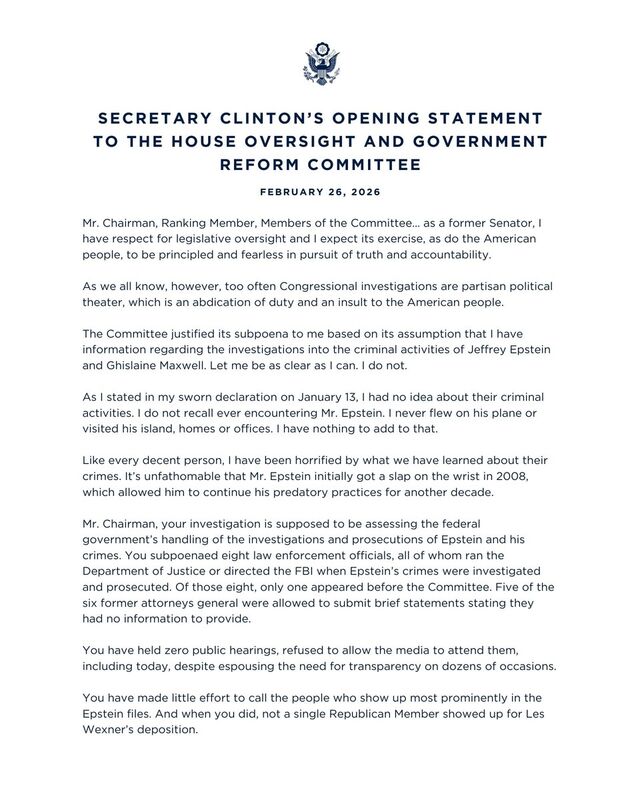
In her opening statement, Clinton forcefully rejected the premise that she possessed any relevant information about Epstein or Ghislaine Maxwell. She reiterated several key points:
- She had "no idea" about Epstein's criminal activities and does not recall ever meeting him.
- She never flew on Epstein's plane, visited his properties, or engaged with him professionally or personally.
- She believes the committee compelled her testimony to distract from questions surrounding President Trump, whose name appears extensively in the Epstein files.
Clinton framed the inquiry as a partisan misuse of investigative power, arguing that if lawmakers were serious about uncovering the truth, they would question individuals with documented ties to Epstein rather than those with none.
Committee Dynamics and Political Tension
Chairman Comer emphasized that the Clintons were not being accused of wrongdoing and would receive due process. He also noted that the motion to bring them in had bipartisan support.
Still, the deposition was not without drama. At one point, proceedings paused after Rep. Lauren Boebert shared a photo from inside the room with a conservative influencer - a breach of House rules that briefly overshadowed the substance of the testimony.
Broader Context: Epstein's Legacy and Public Pressure
The Epstein investigation continues to cast a long shadow over political, financial, and social elites. While no evidence has emerged linking either Clinton to Epstein's crimes, Bill Clinton's past interactions - including several flights on Epstein's jet in the early 2000s - remain a recurring point of public scrutiny. He has expressed regret for the association and has denied any wrongdoing.
Both Clintons have called for the full release of Epstein‑related documents, arguing that transparency is essential for justice and for the victims. Roughly three million documents remain sealed within the Justice Department, despite the requirements of the Epstein Transparency Act.
What Comes Next
Transcripts and video excerpts from the deposition are expected to be released in the coming days, setting the stage for renewed political debate. Republicans may seek to highlight inconsistencies or raise new questions, while Democrats are likely to frame the testimony as a distraction from more substantive investigative targets.
The next major development will be Bill Clinton's testimony, which is anticipated to be longer and potentially more scrutinized due to his documented interactions with Epstein.





Reader Comments(0)