
The people's voice of reason


The people's voice of reason

Sales employees work in a high-pressure environment. When they lack proper training to feel confident and comfortable in their roles, it increases their likelihood of struggling with job dissatisfaction and pressure, which can lead to higher turnover rates.
Well-structured, customized sales training programs equip sales teams with the practical skills needed to succeed in a competitive environment. This helps boost productivity, morale and overall retention.
The reality is that sales training alone is not sufficient. You need to reinforce the training to achieve profitable outcomes such as high retention rates. This guide by Janek Performance Group explains how supplementing sales training with reinforcement measures is critical to employee retention.
Traditional sales training programs that are usually delivered as short courses or one-off workshops rarely have a long-term impact. That’s not to say these programs are not thorough. While they introduce valuable knowledge and new techniques, sales professionals often struggle to apply what they learn consistently over time.
There are several reasons for this, but the most striking one is that they will forget. Humans forget about 50% of new information within a day and about 70% within a week unless it is reinforced.
In a sales environment where skills such as negotiation, objection handling and relationship building need ongoing practice, this rapid knowledge decay becomes costly if there is no structured follow-up process. This targeted follow-up process is known as sales training reinforcement.
Sales training reinforcement learning is an ongoing development approach designed to strengthen and sustain skills after the initial sales training. Instead of relying on one-off sessions, reinforcement learning uses continued coaching, microlearning, feedback, real-world practice scenarios and other methods to reinforce key concepts over time.
In sales, reinforcement learning ensures that the information acquired in a training program is consistently practiced, refined and applied in real customer interactions. This improves skill adoption and performance outcomes. Over time, what might have appeared challenging to a sales employee starts to look like an effortless part of their day-to-day.
Sales training reinforcement improves retention rates by turning learning into a continuous process rather than a one-time event. It removes the pressure on sales teams to retain information in a short period and use it during their activities, which can be overwhelming and may lead to loss of morale. Here is a breakdown of the ways reinforcement learning boosts retention:
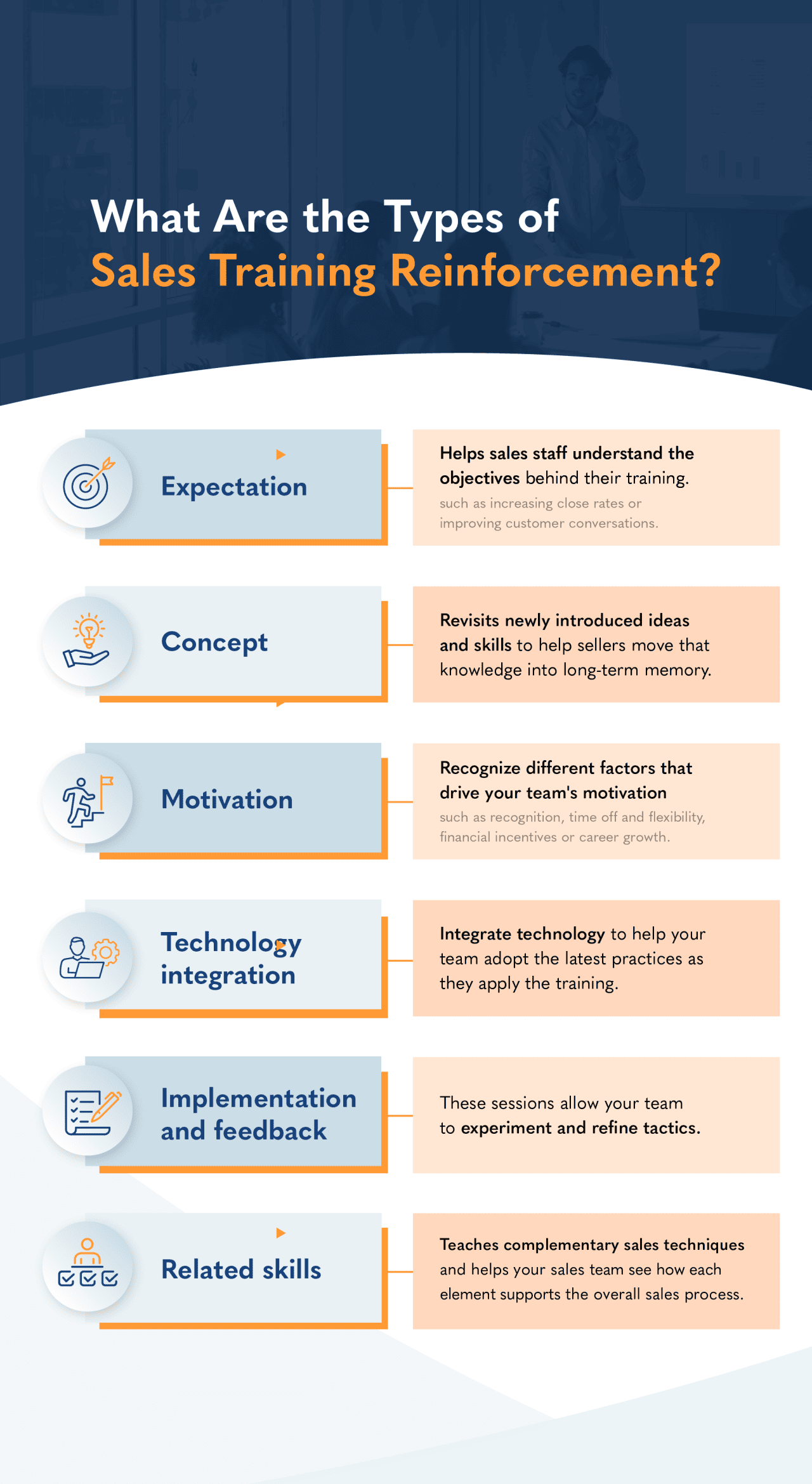
Effective sales training reinforcement involves various approaches that work together to strengthen how your team learns and encourages skill adoption. These areas of reinforcement go on to influence the strategies you use to create a supplementary learning framework that aligns with your performance goals. Here are the different areas of reinforcement learning to focus on:
Employee retention is already one of the biggest challenges facing organizations. Considering salespeople churn at a much higher rate, it makes sense to understand how reinforcing sales training translates into benefits that impact retention.
1. Improves Performance and Job Satisfaction
When employees underperform, they often feel disengaged and unmotivated, which can lead to resignations. Reinforcing sales training helps employees retain skills designed to improve their performance, which in turn uplifts their morale and overall satisfaction.
Given that well-trained sales teams often meet their top performance metrics consistently, ensuring they have a roadmap — not just for learning but also for retaining and refining their knowledge — is vital. Consistent performance in a competitive sales environment makes employees proud of their achievements and reduces the pressure that comes with struggling to meet KPIs.
2. Boosts Confidence
How confident a salesperson feels in their role directly correlates to their success within that role. If the initial training leaves them uncertain or confused about the way forward, they may feel underprepared or unsupported.
The expectations of a training program are to provide a clear understanding of the sales process that the organization wants to take. Supplementing this program with follow-up measures allows the sales staff the time to learn what to do and build up the confidence that keeps them engaged in their work.
3. Maintains Accountability
Reinforcement is key to ensuring accountability and helping sales staff realize professional growth. Regular actions such as check-ins, progress tracking and skill challenges allow teams to set and achieve goals. When employees see gradual improvements through daily actions that keep term accountable, they understand what works and are more likely to become invested in their personal growth.
At the same time, ongoing reinforcement signals that learning is a priority, and that creates a culture where improvement is expected and supported.
4. Improves Companywide Alignment
Beyond developing each sales rep’s skills, reinforcement learning creates a culture of alignment that one-time programs rarely establish. When everyone receives ongoing support on the same methods and messaging, it creates a unified sales approach.
A well-aligned team has a consistent process that allows reps to use a similar language and stick to best practices. The consistency of a reinforced approach makes it easier for managers to coach, track performance and scale successful strategies.
5. Makes Staff Feel Valued
Investing in sales training programs shows employees that you are committed to their success. However, that genuine interest in employee development can miss the mark if there is no supportive approach that helps them realize the value of the training.
Reinforcement pushes your sales staff to grow in their role. It creates a progressive structure around performance, encouraging employees to work toward senior sales roles. All of these can make them feel:
These factors can make sales employees more comfortable in the workplace and more loyal to the company.
6. Strengthens Work Relationships
Reinforcement learning involves coaching, daily actions, regular feedback and progress tracking. These approaches make managers and sales staff feel less disconnected and more like a team working toward a common goal. This improves the relationship between these groups, which has a direct impact on retention.
When you bridge the gap between the sales team and leadership through supplementary learning and support, you:
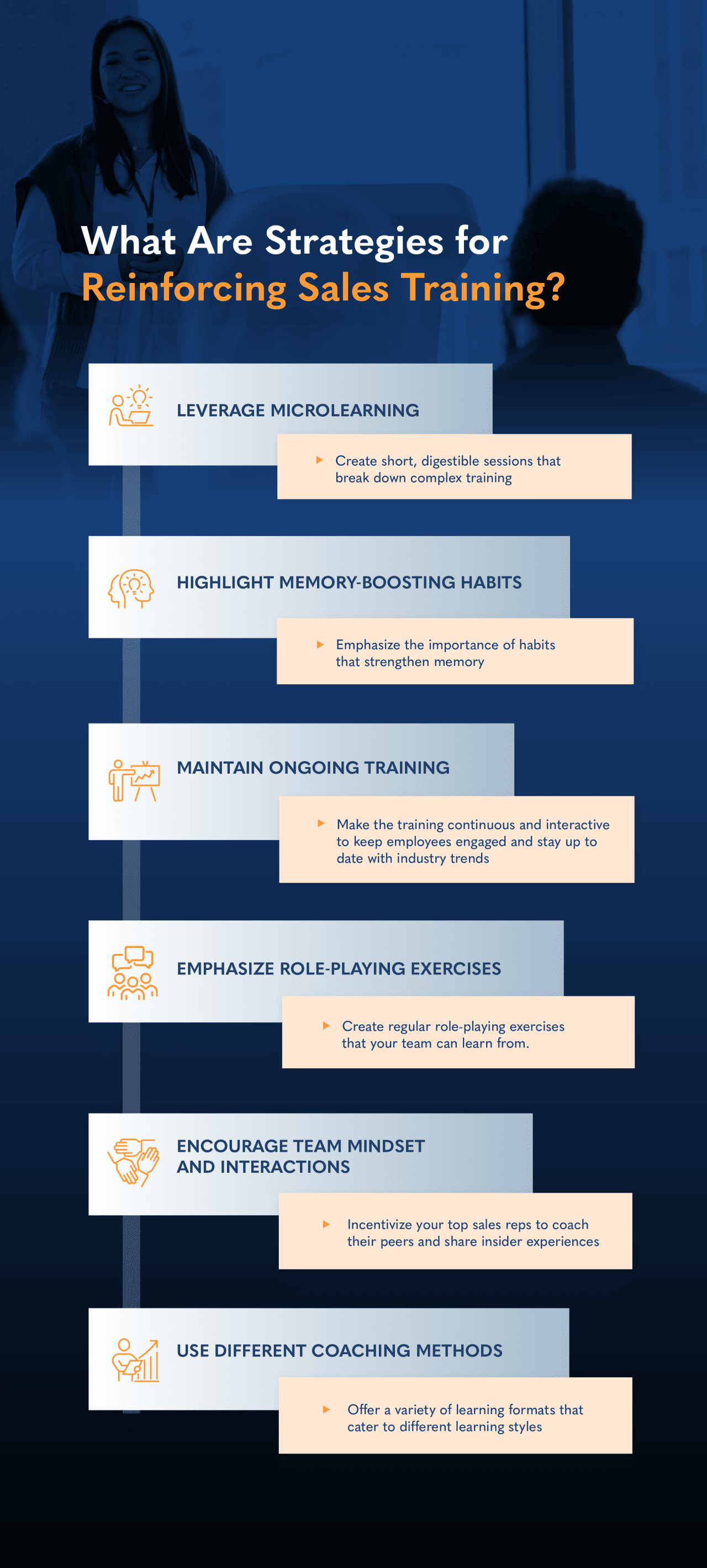
Knowledge retention in sales training comes down to supplementing traditional training with a structured approach to continuous improvement. You will need to integrate reinforcement learning into daily workflows to help your sales team implement what they learn. Here are strategies you can use to reinforce sales training effectively:
The impact of reinforcement on sales performance is undeniable. Without sustainment efforts, much of what sales teams learn through training programs degrades over time. Reinforcement learning helps decision-makers make the most of sales training.
More importantly, when salespeople understand and apply what they learn, they are less likely to experience burnout and lack of motivation, which eventually leads to resignations. By investing in continuous reinforcement, companies can foster a resilient, highly skilled and motivated sales force poised for long-term success and growth.
This story was produced by Janek Performance Group and reviewed and distributed by Stacker.





Reader Comments(0)