
The people's voice of reason


The people's voice of reason

Many individuals and organizations rely on private aviation for mission‑critical mobility, meaning safety is a risk variable with direct financial consequences. A single operational failure can disrupt deals, impair executive availability, and increase liability exposure. In this context, the question “Is fractional ownership safer than charter?” moves beyond the merely academic. It is a strategic assessment of operational continuity.
The newest safety data from the FAA, NTSB, and ICAO all point to a clear pattern. Part 91K fractional programs exhibit more consistent, more standardized, and more reliable safety performance than the broader Part 135 charter ecosystem. In this article, BlackJet, a provider of private jet access services, sifts through the facts and figures to see exactly why structured operating environments outperform fragmented ones.
Charter (Part 135) has always served a wide market, from single‑aircraft operators to large on‑demand fleets. That breadth creates variability. And variability, as highlighted across multiple editions of the ICAO State of Global Aviation Safety Reports, is a core driver of elevated operational risk categories globally. When standardization declines, deviations increase.
For instance, the 2025 report cites 95 accidents, 10 of which resulted in fatalities, across just over 37 million flights. While 65 fatalities per 1 billion passengers may sound low, the aviation industry has an extremely fragile reputation to maintain where safety is concerned.
Moreover, regional discrepancies emerge in the data. Asia-Pacific reported 185 fatalities in 2024, while the Americas reported just 6. The ICAO concludes that standardization must be prioritized, in order to address current safety trends.
Meanwhile, the NTSB’s 2024 Special Investigation into Part 135 Safety reviewed 500 accidents between 2010 and 2022, and concluded that on‑demand charter suffers from inconsistent adoption of safety management systems, variable training programs, and uneven maintenance oversight. Although overall accident numbers remain low, the pattern demonstrates that decentralized operations create more points of failure.
Fractional ownership, regulated under Part 91K, operates in a fundamentally different environment. The model consolidates aircraft, pilots, maintenance, training, and safety oversight under one centralized system. That structure creates a statistically safer profile even before looking at specific numbers.
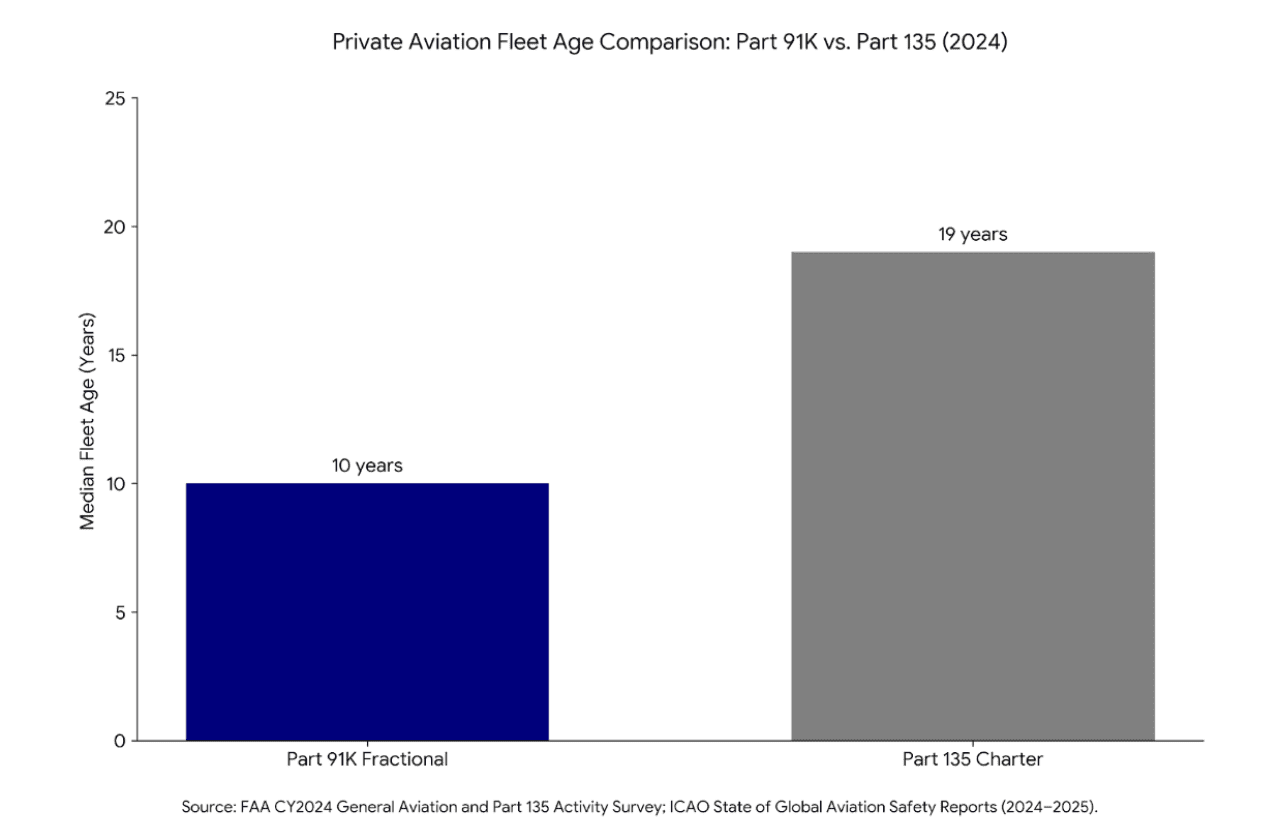
The FAA’s 2024 General Aviation and Part 135 Activity Survey provides further context for our discussion. Data shows that Part 135 charter operations span one of the widest aircraft‑age distributions in private aviation, with significant portions of the fleet exceeding 20 years old.
Why does that matter? Older fleets carry higher maintenance burdens and more downtime, increasing the probability of operational risk events. By contrast, major fractional programs maintain some of the youngest business jet fleets in the market, with replacement cycles typically under 10 years. This creates the tipping point. When aircraft age doubles, maintenance‑driven unscheduled events increase, but fractional programs structurally avoid that exposure.
Part 91K’s uniform training, consolidated maintenance, and young fleets convert directly into fewer operational disruptions. That alignment with ICAO’s global findings is what places fractional programs at the top of the safety performance rankings.
ICAO’s safety reviews repeatedly note that pilot deviation remains one of the most persistent global risk categories. Part 91K operators mitigate this through:
In contrast, Part 135 operators vary widely. Some invest heavily in training, while others meet only the minimum requirements.
The FAA’s CY2024 survey highlights substantial differences in fleet age distribution across private aviation. The broader Part 135 ecosystem includes older light jets and turboprops that remain economically viable for charter but escalate mechanical exposure.
Fractional fleets, by design, avoid that pattern. Newer aircraft reduce unscheduled downtime, minimize dispatch uncertainty, and align with the higher reliability rates that fractional programs consistently report.
ICAO’s global safety findings emphasize the importance of integrated SMS frameworks. Part 91K programs typically operate:
This centralization directly matches ICAO’s definition of enhanced organizational safety capability. Part 135, meanwhile, encompasses hundreds of operators with uneven program maturity.
Fractional providers often exceed 99.9% dispatch reliability, a figure enabled not by marketing but by structure. One fleet, one maintenance system, one safety program. When one aircraft goes offline, another identical or similar aircraft fills the gap without compromising continuity.
Charter’s variability limits that redundancy. Operators with only a few aircraft cannot offer the same level of predictability.
It's important to acknowledge the primary counterargument when discussing charter safety. There are conditions where Part 135 is the rational choice. Specifically:
Charter’s flexibility remains its core value proposition. For irregular travelers or those with niche routes, it performs well. But the structural consistency needed for peak safety performance is inherently more challenging in the Part 135 environment.
ICAO’s most recent safety updates, including its 2025 global safety release, emphasize a growing need for uniform safety management across all business aviation segments. As regulatory pressure increases and data transparency improves, Part 135 operators may close the gap.
But today, based on the most recent available data, fractional ownership retains a measurable structural advantage across the variables that matter most:
Organizations and individuals evaluating private aviation models must look into the cost, convenience, and operational risk factors. Current data indicates that Part 91K is operating at a higher level of safety performance than the broader charter market. A closer look at your specific travel profile, asset utilization, and risk exposure can further clarify whether fractional ownership aligns with your long‑term mobility strategy.
This story was produced by BlackJet and reviewed and distributed by Stacker.










Reader Comments(0)