
The people's voice of reason


The people's voice of reason
Tommy Tuberville
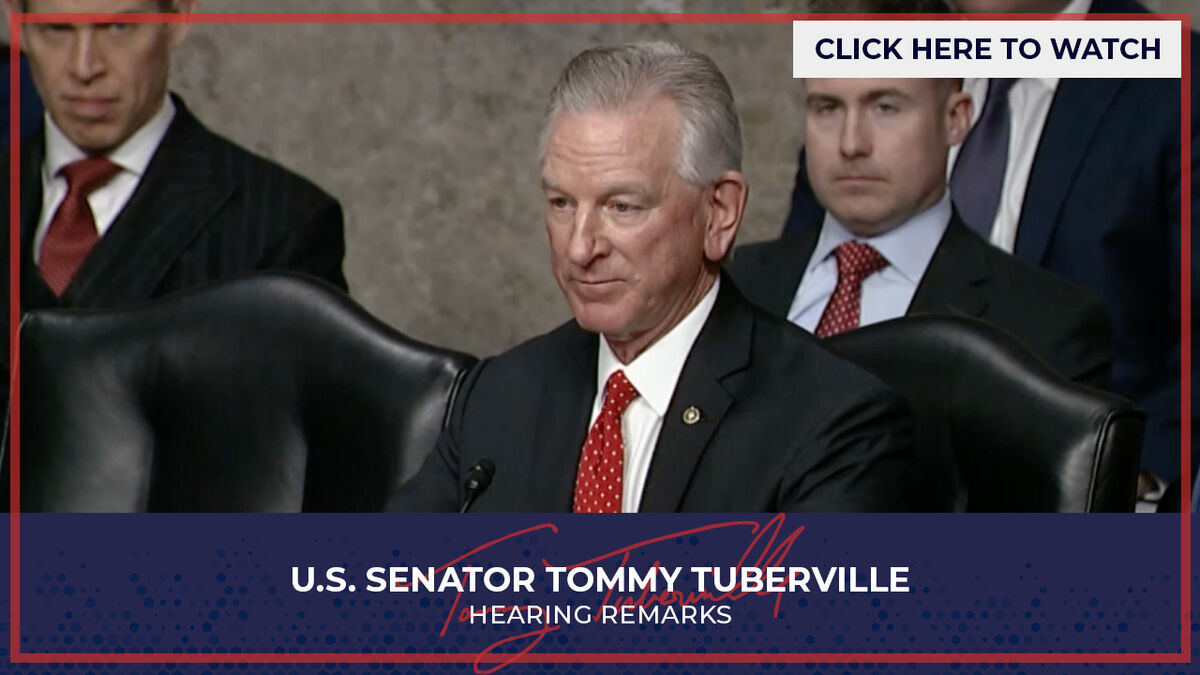
March 10, 2026 - WASHINGTON, D.C. – U.S. Senator Tommy Tuberville (R-Ala.) spoke with American agriculture leaders at a U.S. Senate Agriculture, Nutrition, & Forestry hearing titled "Increasing Domestic Consumption of U.S. Grown Agricultural Products." The witnesses that spoke before the committee include: Zippy Duvall, Scott Metzger, Cathy Burns, Jed Bower, Nathan Reed, and Matt Perdue. Tuberville asked them to share their recommendations for bolstering American farmers and producers. They also spoke about the need to pass the Buying American Cotton Act, which incentivizes the American cotton consumption and revitalize the U.S. cotton industry. Sen. Tuberville is a strong supporter of the American Cotton Act.
"[In] my state of Alabama, we're leaking oil bad," said Sen, Tuberville. "We had lost 150,000 farms and 25,000 farmers nationwide just a few years ago. Y'all know that. Mr. Duvall, I'm gonna get all of you to answer this. One wish to correct this god-awful mess. What do we do?"
Duvall - the President of American Farm Bureau - replied, "I don't know that there's just one wish that can solve this problem, but we need open markets. We need a labor force. And we need to tear down regulation to take down those barriers that gets in the way of us actually being able to make a living on the farm."
Scott Metzger is the President of the American Soybean Association (ASA), a national organization representing U.S. soybean farmers. He is a soybean farmer from Williamsport, Ohio.
Metzger answered, "Well, let's get some new markets opened up, continue with the trades that we've had. And then on domestic markets, getting those ramped up-45Z, we get the RVO numbers out and finalized, get some domestic use done. That's gonna help."
Cathy Burns is the Chief Executive Officer of the International Fresh Produce Association (IFPA).
Burns answered, "Since Zippy said labor in open markets, I'll do a third one. And I think the federal government can take action to incentivize healthy eating. And to incentivize and provide better access to domestic-grown products, especially crops products here in the U. S. And we can do that by driving consumption-huge opportunity for us in the U.S. and Americans will be healthier."
Jed Power is known in U.S. agriculture as a policy analyst and industry advocate who works on issues related to farm economics, crop insurance, and federal agricultural programs.
Bower said, "Senator, short term-I think that it's a challenge for new markets. I think we all know. E15 is poised to be right there. But another one I need to bring up is we need to continue to support for the renewal of USMCA. I think that is critical to row crop farmers. Mexico is our number one exporter of corn. Canada is our number one export market of ethanol, truly critical for growers in the short-term while we build out these domestic markets."
Nathan Reed is a row‑crop farmer from Marianna, Arkansas. He has served in multiple leadership roles within the National Cotton Council (NCC) and the USA Rice Federation, making him one of the more influential producer‑voices in Southern agriculture.
"Speaking for the cotton market or for the cotton production, as a cotton farmer, we need to be able to leverage the power of the American consumer through the Buying American Cotton Act and get that passed," said Reed. "So, thank you."'
Matt Perdue is a prominent figure in U.S. agriculture, best known for his work in farm policy, rural development, crop insurance, and federal agricultural programs. He has served in major leadership roles with the National Farmers Union (NFU) and is widely recognized in Washington, D.C. ag‑policy circles.
Perdue said, "Senator, I'd say that the single biggest impact would be growing our renewable fuels markets. That's gonna improve prices for corn and for soybeans. It's gonna produce prices for-or improve prices for-wheat. We also need to make sure that we have strong, competitive, fair markets for farmers to buy inputs from and sell their commodities to."
Tuberville followed up: "Mr. Reed-thank you very much-Mr. Reed, [you] just talked about the Buying American Cotton Act, which I'm sponsoring with my cohort, [Senator] Cindy Hyde-Smith here, I hear that this would totally revamp the cotton market because if we don't do something, we're gonna lose it all. In Alabama, we're losing 400 dollars an acre before we even plant it. I mean, it's ridiculous. Why would we get in the cotton business? We have to do something. Could you explain what this act would do?"
Reed answered: "Well, the American cotton farmer, we can produce the highest quality, most environmentally friendly, best crop, best cotton in the world. We can't produce it cheaper. And unfortunately, between other countries without as much regulatory environment and synthetics, [...] we have been unable to compete on a world market. Our domestic textile industry has been decimated, not only as a cotton farmer, but our whole industry-domestic textile industry-the farm or the gins and cottonseed crushing facilities. There's so much that goes into cotton production just beyond the cotton farmer. A lot of these small, rural communities depend on all that. So, when you lose the cotton industry, you don't just lose the farmers, you lose the whole industry in America. And we feel that the Buying American Cotton Act will reverse that trend and provide-allow us to use the power of the American consumer that consumes 40 million bales of textiles a year. It will allow us to bring that market back into because there's rewards in there for domestic produced thread and fiber. There's a bigger tax credit. But it'll allow us to-until our American mill industry comes back further-export cotton, and then American cotton comes back in and garments that may have been produced overseas, and brands and retailers get a tax credit. So, it will increase demand for American cotton."
Tuberville thanked Reed for the answer: "Thank you. Good explanation. Thank you, Mr. Chairman."
Farmers across all four major row crops are being squeezed by high input costs, volatile markets, and tightening margins, with several crop‑specific pressures making 2026 one of the most challenging seasons in recent years. Fertilizer prices-particularly urea-have surged due to global energy tensions and shipping disruptions. This is pushing farmers away from nitrogen‑intensive crops like corn, rice, and cotton and toward soybeans, which require far less nitrogen. input inflation is outpacing revenue for many crops.
Economists estimate that soybeans may still produce negative returns, but less negative than corn, rice, or cotton. Corn margins are being crushed by fertilizer and chemical costs. Rice and cotton face some of the worst cost‑to‑price ratios in the South. Trade tensions-especially with China-continue to affect: soybean exports, corn and cotton demand, and rice market access in Asia. In 2025, soybean acreage fell sharply partly due to early‑year trade tensions with China, and those concerns continue to influence planting decisions in 2026. Corn acreage is projected to drop significantly after hitting a near 90‑year high in 2025. Farmers are pulling back due to: High fertilizer costs, lower expected returns, and rotation pressure after a massive 2025 corn crop. Economists expect corn acres to fall from 98.7 million (2025) to somewhere between 91–95 million acres in 2026. Beyond fertilizer, farmers are paying more for: herbicides, insecticides, seed technology, fuel, and machinery repairs. These costs hit cotton and rice especially hard, as both crops require more intensive management. Cotton acres fell by 1.9 million in 2025, and economists expect little recovery in 2026. Farmers are hesitant due to: high input costs, weak global cotton demand, competition from synthetic fibers, and price volatility.
Senator Tommy Tuberville represents Alabama in the United States Senate and is a member of the Senate Armed Services, Agriculture, Veterans' Affairs, HELP and Aging Committees. He is a 2026 Republican candidate for Governor.
(A.I. contributed to this report.)
To comment or to ask a question email: brandonmreporter@gmail.com





Reader Comments(0)