
The people's voice of reason


The people's voice of reason
Jack Warner
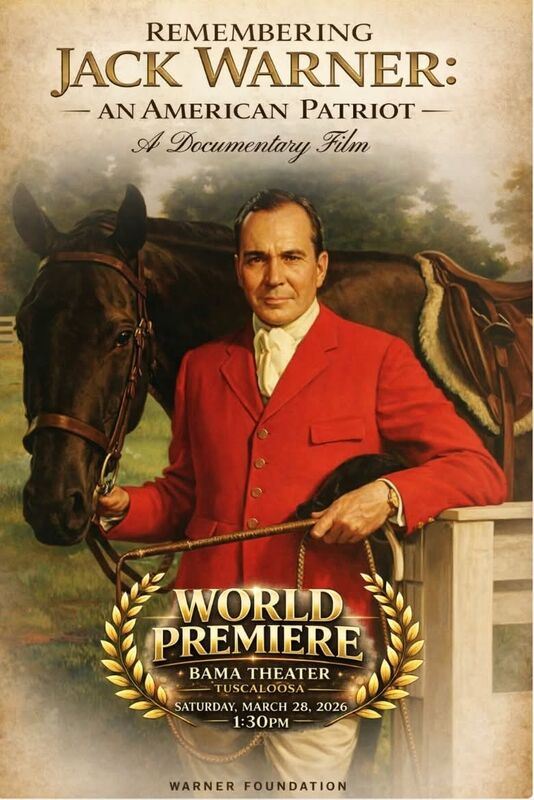
The late connoisseur of early American art and late former president and chairman of what is now known as the Westervelt Company, Jack Warner, is the subject of a documentary that will be screening at the historic Bama Theater in Tuscaloosa on Saturday, March 28th, 2026 at 1:30PM. The screening is open to the public at no cost. With the Chairman of the Warner foundation, Susan Warner, and the filmmakers being available for a thirty minute "talkback" immediately after the screening of the "Remembering Jack Warner: An American Patriot" documentary.
Although born in Illinois on July 28th, 1917, Jonathan Westervelt "Jack" Warner" became a name in the West Alabama region as he was raised in Tuscaloosa, Alabama where his mother's father's company, Gulf States Paper, was based. He attended the Culver Military Academy in Indiana. A military academy that states that their "Military System empowers students to find themselves in the process of living and learning" while enrolled in their military high school. Warner then studied business administration after high school at Washington and Lee University in Virginia.
Jack Warner followed through with his military training when he served in the U.S. Army cavalry as a commissioned officer with the MARS Task Force in the China – Burma – India Theaters of Operations during World War II. This experience in Burma greatly impacted Mr. Warner as he used a Burma theme when building the NorthRiver Yacht Club in Tuscaloosa. He also amassed a beautiful collection of early American art that was once a cultural gem in Tuscaloosa before being sold off beginning in 2011. His art collection once featured works by Winslow Homer, James NcNeil Whistler, Childe Hassam, Georgia O'Keefe, Andrew Wyeth, Mary Cassat, and even silver crafted by the legendary Paul Revere of Longfellow's, "The Midnight Ride of Paul Revere", fame.
River Road in Tuscaloosa was renamed "Jack Warner Parkway" in May of 1999 to honor Jack Warner's philanthropic legacy in the college town. Although, he did raise eyebrows in the community when he announced the closing of his company's flagship mill in Tuscaloosa in 1978. An announcement that rendered 1,120 mill workers who were then on strike, permanently out of work. Leading to "The New York Times" referring to him as a self-proclaimed defender of "robber baron" capitalists in a May 29th, 1978 article.
Jack Warner remained loyal to his collegiate alma mater throughout the duration of his life. He was honored by Washington and Lee University when they included his name among the first alumni featured on the Honored Benefactors Wall in Washington Hall. During his college days at Washington and Lee, Warner was an accomplished swimmer who once held the school record in the breaststroke. He was a trustee emeritus of Washington and Lee University, having been a member of the Washington and Lee Class of 1940, when he passed away on February 18th, 2017 at 99 years of age.
In Tuscaloosa, Jack Warner was known for his generous contributions to The University of Alabama, the First Presbyterian Church, the United Way, and the City of Tuscaloosa where he helped build community swimming pools and helped fund programs for underprivileged children to receive swimming and water safety lessons. Knowing the importance of both universities in the State of Alabama, Jack Warner contributed to Auburn University, as well.
Warner was preceded in his passing by his first wife, Elizabeth Butler Warner, his son, David T. Warner, his mother, Mildred Westervelt Warner, and his father. He was survived by his wife Susan Austin Warner, his son, Jonathan W. Warner, Jr. and his grandchildren, Matthew Cade Warner, Jonathan Westervelt Warner III and Elizabeth Butler Warner Hannah, among other family members.




Reader Comments(0)