
The people's voice of reason


The people's voice of reason

For most of her adult life, Katherine Sanders had what she calls a typical career for someone with attention deficit hyperactivity disorder.
After finishing her doctoral thesis on Bronze Age Syrian mythology, she bounced between unrelated jobs. She tutored university students. She sewed Victorian corsets for bridal outfits. She designed stained glass and sold picture frames. She enjoyed the work, but none of it felt like a calling.
Life got harder when she found herself juggling part-time work with caring for a spirited five-year-old. Sanders, who lives in Edinburgh, Scotland, burned meals on the stove and forgot to pick up her daughter from school.
Finally, she decided to work with a coach to help her cope with her ADHD, a bedeviling condition whose hallmark symptoms are distraction, forgetfulness, restlessness and impulsivity.
She began by enrolling in a digital course called Your ADHD Brain is A-OK. Like most ADHD coaches, Tracy Otsuka, the course producer, has herself been diagnosed with the disorder. Otsuka, based in Northern California, says she focuses on helping her clients shed shame as a prelude to finding their purpose and living more fulfilled lives. Participants in the self-paced course watch 26 videos and fill out worksheets designed to identify their values and strengths.
Sanders says working with Otsuka led to a lightbulb moment for her. “This woman is very smart, she’s very savvy,” she says. “And she still did stuff like forget to pick her kid up from school .… She still does the same things as me.” The experience made Sanders realize that she, too, was smart but had a specific challenge she needed to learn to manage.
After completion of the course, as Sanders exchanged online messages with Otsuka, the coach startled her with a suggestion: Perhaps she’d like to be a coach herself?
Two years later, armed with training and credentials from the ADD Coach Academy (ADDCA), Sanders, pictured below, joined a field that has exploded as ADHD diagnoses have multiplied and patients have scrambled to find scarce professional help.

ADHD coaching is a fast-growing niche within a much larger, heterogeneous coaching industry that is mostly unlicensed and unregulated, Knowable Magazine reports. Executive coaches aim to help managers navigate leadership challenges; health coaches support people with chronic conditions; and life coaches promise everything from improving work habits to reviving “your body, mind and soul.”
ADHD coaching sits at a particularly busy intersection, promising relief from a sometimes disabling and stigmatized condition. It is also one of the least-studied domains in an enterprise that is understudied in general, and for which evidence of effectiveness is sparse. These deficits matter because demand is rising even as coaching’s low barriers to entry make it easy for under-trained practitioners to oversell their services. That’s an especially risky recipe for clients who may be extra-vulnerable due to their mental health challenges. Experts warn prospective customers to be cautious and informed.
Theoretically, coaching could be useful for people with ADHD as part of a toolkit that might include medication and therapy, says clinical psychologist and researcher Stephen Faraone, president of the World Federation of ADHD. But he worries about the industry’s lack of standards and regulation, noting that licensed health professionals must train for years and pass rigorous exams. “Coaching seems to me to be more of a business, and that worries me,” he says.
The origin of coaching for better mental and emotional performance dates at least as far back as 1974, when former tennis coach Tim Gallwey wrote “The Inner Game of Tennis,” offering techniques to counter the anxiety that can sabotage sports performance. ADHD coaching came later, pioneered in the 1990s by advocates including Nancy Ratey, Sue Sussman and Madelyn Griffith-Haynie. Yet it wasn’t until the COVID-19 pandemic that a confluence of factors — increased mental health problems of all kinds and self-diagnosis-by-TikTok among them — led to explosive global growth of ADHD coaching and coaching in general.
Today, annual revenue from all sorts of coaching has reached $5.34 billion, according to the International Coaching Federation. The number of self-identified coaches has climbed by 15% since 2023, reaching a total of 122,974, the federation reported in 2025. The true number is likely much larger, due to the many, many coaches who put up a shingle — or claim a job title on LinkedIn — without any training or accreditation. Trying to estimate the number of coaches is like “counting fish in the sea,” says Jonathan Passmore, a psychologist, executive coach and researcher in England.
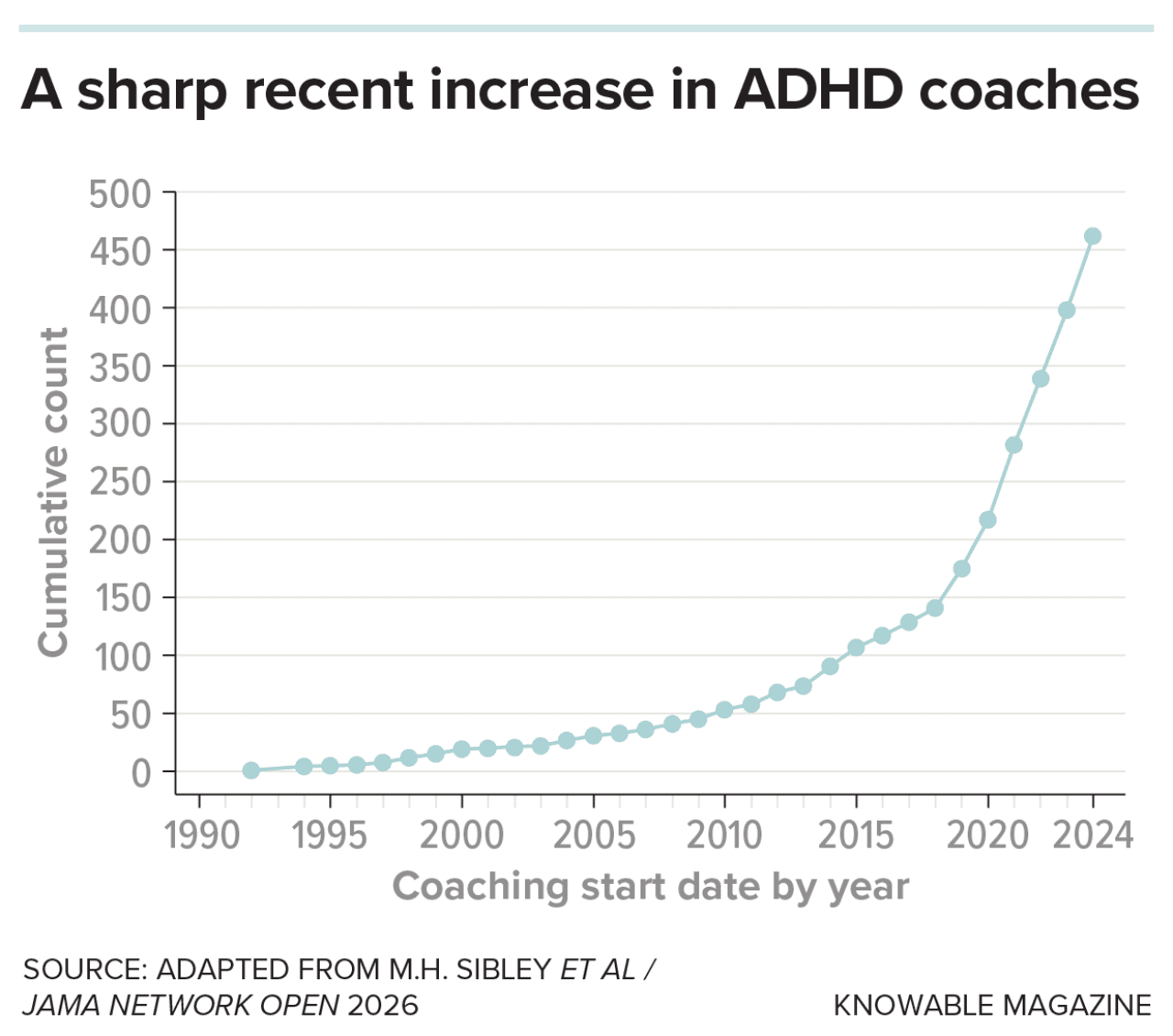
And ADHD coaching? With roughly 7 million children and 15.5 million adults in the United States diagnosed with the condition, and more being diagnosed all the time, ADHD coaches have plenty of prospects, especially given the drawbacks of established treatments. Medication may tame symptoms, but it has side effects and doesn’t work for everyone. Licensed psychotherapists are costly and often hard to find, whereas the lack of state licensing requirements means coaches can practice, remotely, from anywhere.
On the other hand, coaches may be even more expensive than licensed professionals, notes Margaret Sibley, a clinical psychologist at the University of Washington and Seattle Children’s Hospital and a coauthor of a recent JAMA Network Open article about a large survey of ADHD coaches.
“They charge $150 an hour on average (and some charge well above $500 an hour),” Sibley says. “This is similar to reimbursement rates for psychologists for mental health therapy. Except ADHD coaching isn’t reimbursable by insurance at this point so it’s only accessible to those with high financial resources.”
In a typical ADHD coaching session, coach and client will meet to work on a goal of the client’s choosing and produce an action plan to reach it. Sanders, for instance, says that most of her clients struggle with feeling overwhelmed. “They’ll come up with a laundry list of things they’re trying to do, and by the time they’ve listed everything, I say, ‘How does that feel for one person to try and do in two to three days? Is that reasonable?’”
Coaches will often help clients break tasks into pieces that are more easily achieved, suggest tools such as timers, journals and calendars to keep them on track, and schedule meetings to hold them accountable. However, as Otsuka and many other coaches agree, increasing self-awareness and dispelling shame that has accrued over the years are essential.
“Adults with ADHD get really good at being hard on themselves … everybody else is always telling us we should do things differently,” says David Rickabaugh, president of the ADHD Coaches Organization, an international professional association.
Coaching appears to be increasingly popular for people with ADHD, although a recent survey in ADDitude magazine found that just 17% of the adults who responded had tried it. Ninety-three percent of the respondents who had experienced coaching recommended it to others, making it the second-most recommended ADHD intervention after exercise and before medication.
Yet the coaching industry remains a therapeutic Wild West compared to licensed health care. Consider the difference between pharmaceuticals and supplements: Both may help, but only the former must meet standardized thresholds for evidence and supervision. As with supplement manufacturers, coaches often appear to feel free to make sweeping claims. “Change your life in 30 days!” proclaims the website of a coach who calls herself “the World’s #1 Authority on How to Master Fear.”
Sibley and her colleagues, who surveyed 481 ADHD coaches for the JAMA Network Open report, found that 89% had no professional mental health background. Only about 63% had completed a curriculum endorsed by the ADHD Coaches Organization. More than 72% of the coaches said they had, or suspected they had, ADHD, and more than 90% said they shared their lived experience in their work.
The survey found similarities in coaches’ strategies. More than 90% said they coached clients in executive function skills, which include planning, impulse control and self-motivation strategies. More than 90%said they addressed sleep, self-worth, emotional concerns and healthy behavior such as nutrition and exercise.
Despite their relative lack of mental health training, about half of the coaches said they also addressed substance use or addictions and trauma, and roughly 42% said they covered “suicide, abuse and/or harm to self or others.” This invites special risks, especially given that most adults with ADHD also meet criteria for at least one other psychiatric disorder, such as anxiety, depression or substance use. Such complications may produce both more distress and more susceptibility to promises of quick relief. “The absence of standards and regulations about who can declare themselves an ADHD coach make it particularly important to practice due diligence when vetting an ADHD coach, especially as there are no legal protections for clients,” write Sibley and her colleagues.
Close to 80% of respondents in the survey said they would refer clients to a mental health professional to obtain a formal diagnosis. Sanders goes further, saying she scrupulously refers clients with trauma, addiction or suicidal thoughts to licensed therapists, who she says are more qualified to deal with those issues.
Despite the growing market for ADHD coaching, there’s limited concrete evidence that it works. (Sibley and colleagues wrote that they were “struck by the glaring disconnect between the maturity of ADHD Coaching as a profession and the infancy of its science.”) A widely cited 2018 descriptive review provides some of the strongest evidence about the field to date. The four authors, all working as coaches, considered 19 studies, the majority of which reported statistically significant improvements in ADHD symptoms, which commonly include inattention, hyperactivity and impulsivity. Yet as they noted, many of the studies were small and lacked control groups — people who had not been coached — for comparison, while also including extremely varied coach qualifications, making it hard to measure how much training matters.
Research on coaching in general is somewhat more advanced. Over the past decade, scientists have published more than a dozen meta-analyses — studies that interpret several studies as a group — most of which showed small to moderate positive results across different kinds of coaching. Some of the strongest findings suggest business executives may improve skills related to leadership and management, and people with chronic health conditions may take better care of themselves, including by managing their weight and exercising more. Motivated coaching clients are “likely to grow in self- and interpersonal awareness,” wrote the authors of a 2023 article in the “Annual Review of Organizational Psychology and Organizational Behavior.”
Yet some of these reviews also noted problems similar to those affecting the ADHD coaching research, including small samples and limited follow-up, as well as overreliance on self-reports, which are often biased.
Here, according to ADHD coach Katherine Sanders, are signs of an underqualified coach:
Scientists and coaches themselves have been calling for a more rigorous look at what makes coaching effective.
“I understand the concern about regulation some have raised, and we share a number of those concerns,” Rickabaugh, the ADHD Coaches Organization president, wrote to members in the wake of the JAMA Network Open report that, as he noted, highlighted “variation in our field — in training, scope, and practice.” That focus “may feel uncomfortable,” he added, “but documenting this reality is actually necessary if we want to shape conversations about ADHD coaching standards rather than have standards imposed upon us. Quality matters, and credentials and training do serve our clients and our profession.”
Researchers are trying to figure out what essential practices deliver the most benefits for coaching in general. How is the skillful interviewing and active listening that coaches say they practice different from what a close and attentive friend could provide?
That question is key, because despite robust research linking social connection to better mental health, 17% of Americans today say they have no close friends. The numbers could be worse for people with ADHD, who notoriously struggle with relationships. Whether a paid, one-way social connection can deliver the same benefits as a reciprocal and free one remains an open question.
As coaching for all sorts of purposes becomes more widespread, the risks are becoming more obvious. Sanders recently authored a white paper documenting “systematic failures” of the ADHD coaching field that, she said, “require immediate industrywide intervention.”
Some regulators are already stepping up.
In March 2025, Utah created a special fund to increase its ability to investigate potential unlawful conduct by coaches treating mental health conditions. This followed a 2024 investigation by the Salt Lake Tribune and ProPublica, which found that clinicians who had lost their licenses were marketing themselves as “life coaches,” claiming to treat depression or “untangle” clients’ emotional “chaos.” One man told the Tribune and ProPublica that a coach ordered him to cut off his family and live in a tent to “humble” himself.
Sanders is encouraged by some of these trends and continues to enjoy her work — even as she’s sometimes distracted by a familiar hunger for novelty.
“I keep thinking maybe I should try ceramics,” she said recently. “I really love porcelain, you know?”
Here are resources and warning signs compiled from experts:
SOURCES: Jonathan Passmore, Katherine Sanders, ADHD Coaches Organization.
This story was produced by Knowable Magazine and reviewed and distributed by Stacker.





Reader Comments(0)