
The people's voice of reason


The people's voice of reason
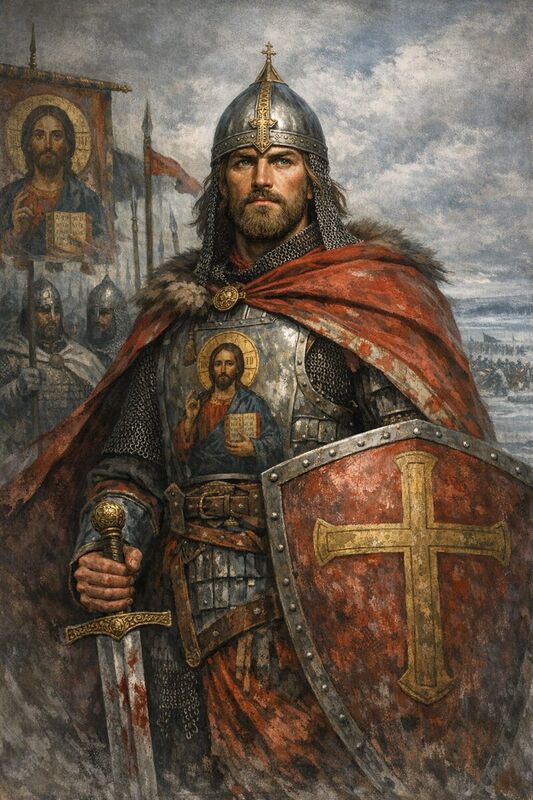
Russian Prince Alexander Nevsky
On April 5, 1242, a frozen lake in the far north became the stage for one of medieval Europe's most dramatic and consequential battles. Known to history as the Battle on the Ice, the clash on Lake Peipus between the forces of Prince Alexander Nevsky of Novgorod and the Teutonic Knights halted Germanic expansion into Russian lands and reshaped the balance of power in the Baltic region. Though fought nearly eight centuries ago, the battle remains a defining moment in Russian historical memory - a symbol of resistance, national survival, and the defense of Orthodoxy against foreign domination.
The roots of the conflict lay in the turbulent politics of the 13th century, when the lands around the Baltic Sea were a patchwork of pagan tribes, Orthodox principalities, and Catholic crusader states. The Teutonic Knights, a German military order originally founded in the Holy Land, had turned their attention to the Baltic after the decline of the Crusades in the Middle East. Backed by the Papacy and German princes, they sought to convert - and often conquer - the peoples of the region. Their expansion brought them into direct conflict with the Novgorod Republic, a wealthy and semi‑independent Russian state whose trade routes and religious identity were threatened by the crusading order.
Alexander Nevsky, the young prince of Novgorod, had already proven himself a capable commander. In 1240, he defeated a Swedish invasion at the Battle of the Neva, earning the honorific "Nevsky." But the threat from the west did not end there. The Teutonic Knights, allied with German settlers and crusaders from the Bishopric of Dorpat, pushed eastward into Russian territory, capturing the city of Pskov and threatening Novgorod itself. Their advance was part of a broader effort to bring the Orthodox Slavs under Catholic influence - a campaign justified by the language of religious conversion but driven by political ambition.
By early 1242, Alexander had returned from exile, rallied the Novgorodian militia, and forged alliances with neighboring princes. His goal was clear: expel the German crusaders and secure the western frontier. After retaking Pskov, he pursued the retreating Teutonic forces toward Lake Peipus, a vast body of water straddling the modern border between Russia and Estonia. There, on the frozen lake, the two armies met in a confrontation that would become legendary.
The Teutonic Knights entered the battle confident in their heavy cavalry, the elite armored horsemen who had dominated battlefields from the Holy Land to Central Europe. Their wedge‑shaped formation - a powerful, spear‑like thrust designed to break enemy lines - had proven effective against less organized foes. But Alexander Nevsky understood both the strengths and weaknesses of his enemy. He deployed his troops in a flexible formation, placing lightly armored archers and skirmishers at the front and holding his heavier infantry in reserve. His goal was to absorb the initial shock of the German charge, then envelop the crusaders once their momentum faltered.
When the battle began, the Teutonic Knights drove forward in their signature wedge, smashing into the Novgorodian center. The impact was fierce, and for a moment the German cavalry appeared poised to break through. But the ice beneath them - thick enough to hold men and horses, yet still treacherous - slowed their advance. As the wedge lost cohesion, Alexander ordered his infantry to close in from the flanks. The Novgorod militia, supported by cavalry from allied Russian princes, surrounded the crusaders and cut off their retreat.
The battle quickly turned against the Teutonic Knights. Their heavy armor, an advantage on solid ground, became a liability on the slick, uneven surface of the frozen lake. Some accounts - especially later Russian chronicles - claim that sections of the ice cracked under the weight of the German cavalry, sending men and horses plunging into the freezing water. While historians debate the literal truth of this detail, there is no doubt that the conditions of the battlefield played a decisive role. The crusaders, unable to maneuver effectively, were overwhelmed by the more mobile Russian forces.
By the end of the day, the Teutonic advance had been decisively halted. Many of the crusaders were killed or captured, and the survivors retreated westward, abandoning their ambitions of conquering Novgorod. The victory secured Alexander Nevsky's reputation as one of medieval Russia's greatest military leaders and preserved the independence of the Novgorod Republic at a moment when Russian lands were also under pressure from the Mongol Empire to the east.
The Battle on the Ice had lasting consequences. It marked the end of major German crusader incursions into Russian territory and helped define the cultural and religious boundaries of Eastern Europe. For Russia, the battle became a foundational story - celebrated in chronicles, folklore, and later in Sergei Eisenstein's iconic 1938 film Alexander Nevsky. It symbolized the defense of Orthodoxy against Western aggression and the resilience of the Russian people in the face of foreign threats.
Today, the battle remains a powerful historical touchstone. Though separated from the modern world by centuries, the events of April 5, 1242 continue to shape national narratives and geopolitical identities. On the frozen expanse of Lake Peipus, Alexander Nevsky not only won a military victory but helped define the future of a region whose borders and allegiances still echo the struggles of the medieval past.







Reader Comments(0)