
The people's voice of reason


The people's voice of reason

AI-referred visitors aren’t just increasing. They’re more likely to convert.
In an analysis of 2.3 billion sessions (January 2024 to December 2025):
What this means for marketers:
WebFX breaks down the data.
Note: This report was updated in March 2026 to reflect expanded data from January 2024 through December 2025. Earlier versions of this study (January 2024–February 2025) reported that generative AI traffic grew 165 times faster than organic search. The updated analysis extends the dataset and timeframe.
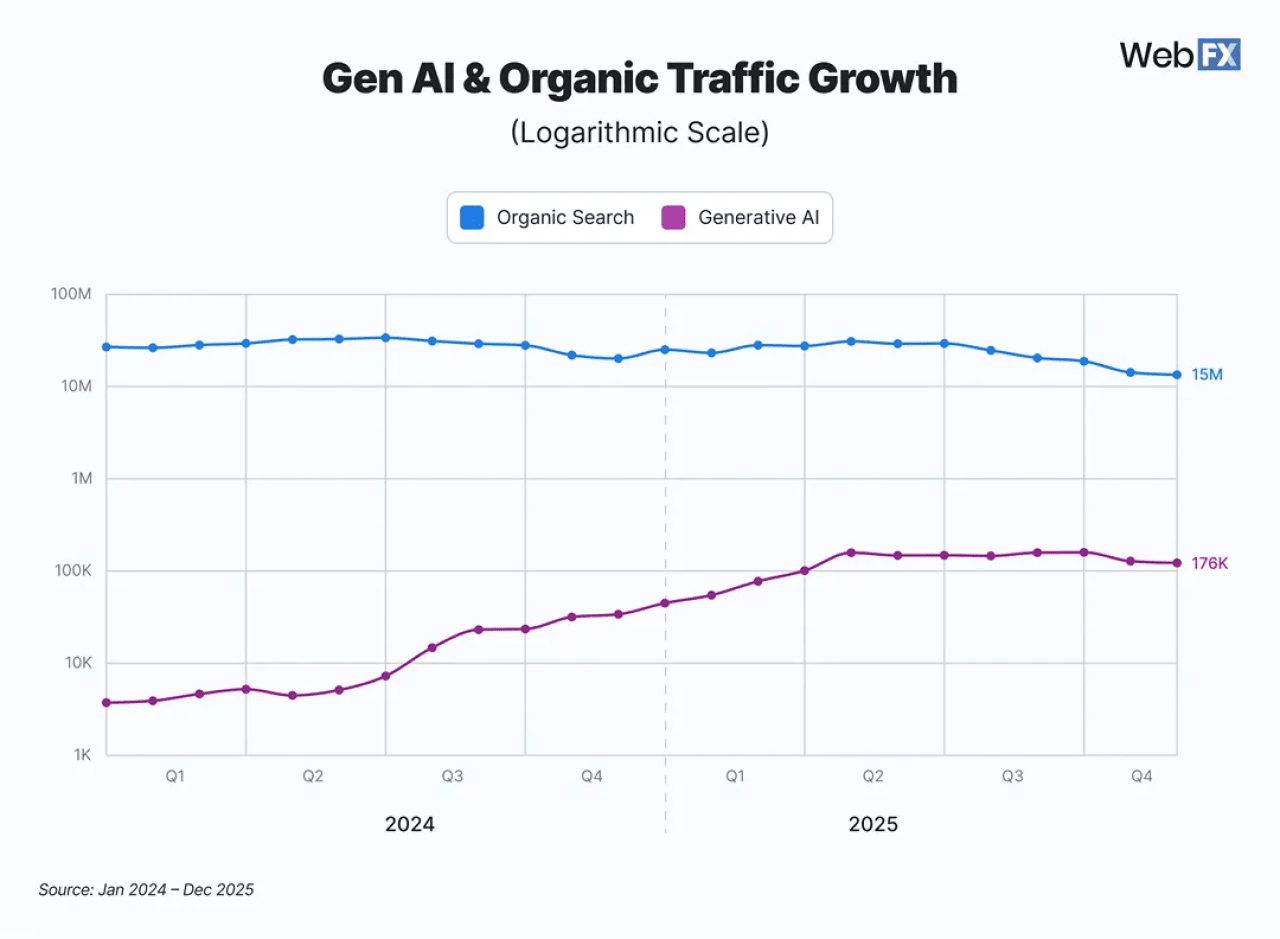
By 2025, generative AI traffic was no longer behaving like a one-time spike. Generative AI grew approximately 796% from January 2024 to December 2025.
The quarterly growth pattern also shows how the channel evolved, explaining why it now deserves strategic attention. Growth in 2025 unfolded in three distinct phases: early adoption, acceleration, and maturation.
These numbers indicate the channel is maturing and stabilizing.
In 2025, generative AI accounted for 0.18% of total sessions. The share remains modest, yet its sustained growth and measurable conversion activity elevate its strategic relevance.
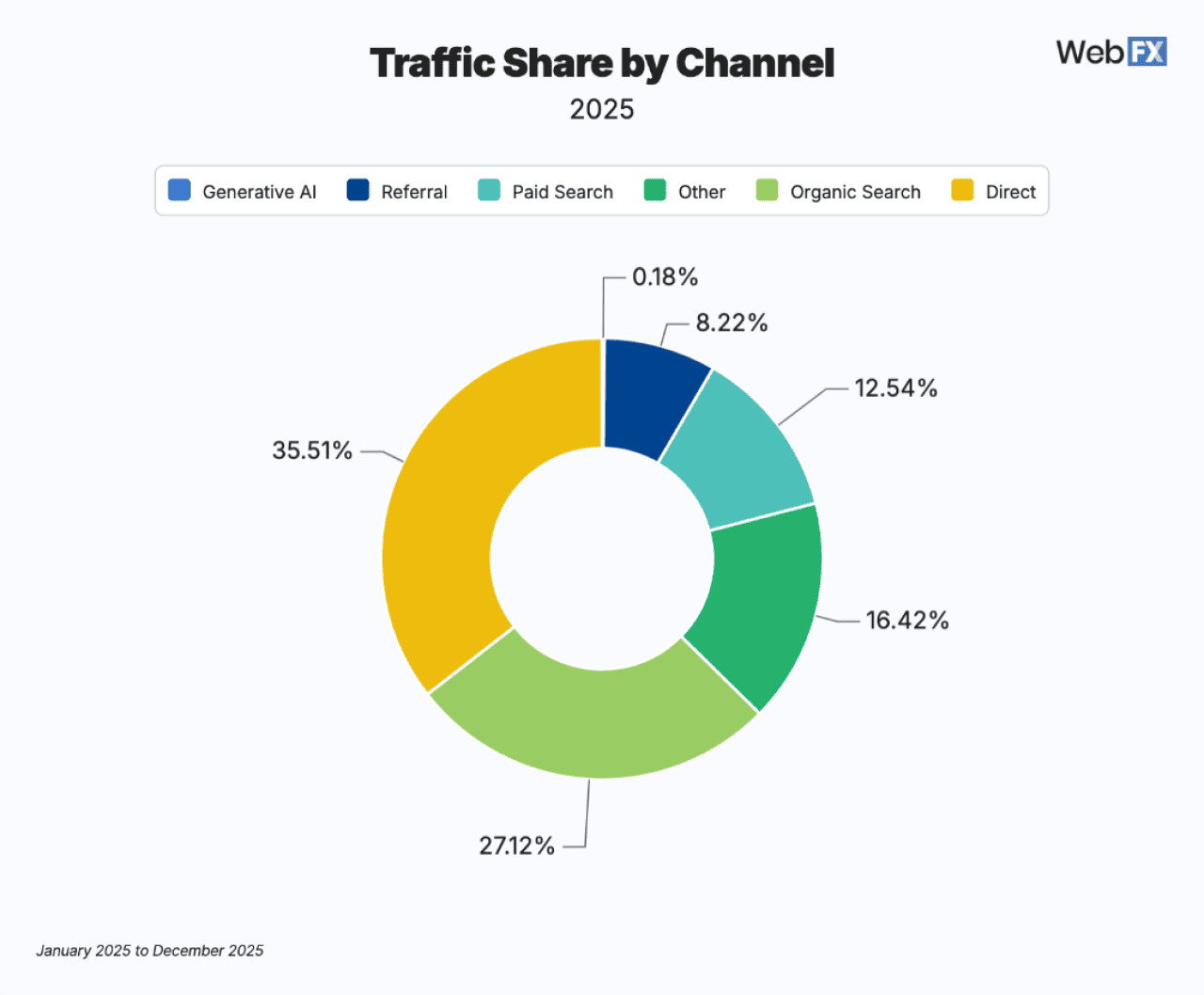
Organic Search still remains a primary traffic channel, though, holding the second-highest market share at 27.12% and trailing only Direct. Together, the two make up more than 60% of website traffic.
Traffic distribution across channels changed measurably in 2025, reflecting users’ evolving search and discovery behavior. When taken together, the quarterly growth pattern and traffic-share data show that generative AI is no longer an experimental referral traffic source. It is measurable, sustained, and tied to revenue activity.
Generative AI should now be tracked, benchmarked, and forecasted like any other revenue channel.
Here’s what marketers should do.
Track AI referrals separately
In GA4, create a dedicated channel grouping or source filter for traffic from generative AI platforms so it does not merge into generic referral buckets. Doing so lets you accurately examine quarterly trends.
Monitor channel share alongside volume
Track AI’s percentage of total sessions alongside raw session growth to understand how your acquisition mix is changing. Monitoring traffic share tells you whether AI is becoming an important contributor to your pipeline or simply expanding from a small base.
Evaluate quality with scale
Session growth alone doesn’t tell you how important a channel is. Review conversion events per user and assisted conversion paths to measure generative AI’s revenue influence.
If AI-assisted sessions are high-quality, which means they lead to conversion actions, it may justify deeper content optimization or increased efforts to improve your visibility. If traffic quality is inconsistent, you may need to adjust your targeting or landing pages.
From 2024 to 2025, sessions from generative AI platforms increased 796% YoY, while conversions increased by 6,432% YoY.
When conversions grow faster than sessions, it means a larger share of visitors are turning into leads, customers, or taking other meaningful actions. Generative AI traffic is not only expanding its reach but also improving conversion efficiency.
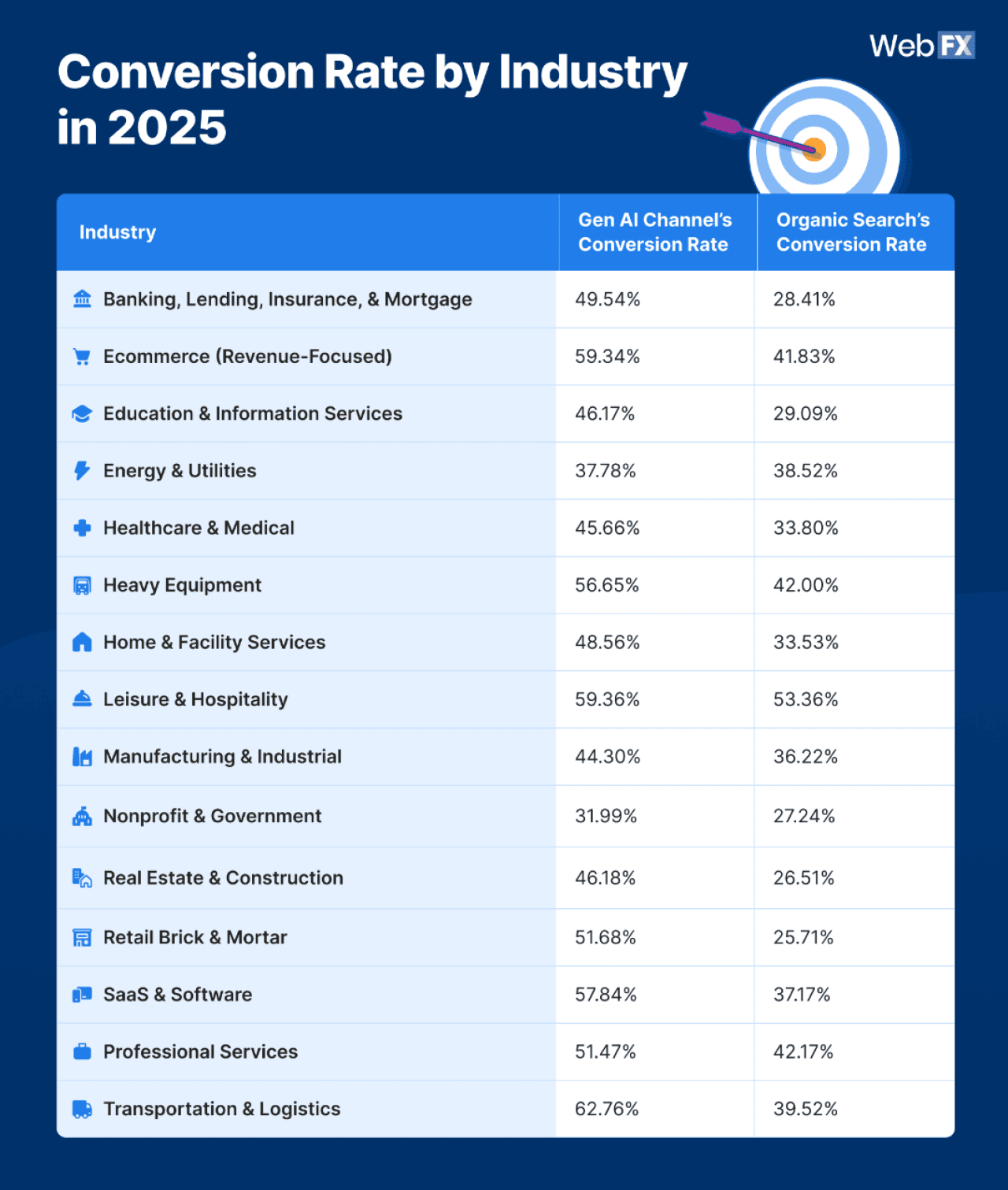
Across industries, users referred by generative AI consistently converted at higher rates than organic search throughout 2025. Industries like SaaS and Retail saw AI referrals convert at more than 50%, while organic search conversions were between 20% and 30%.
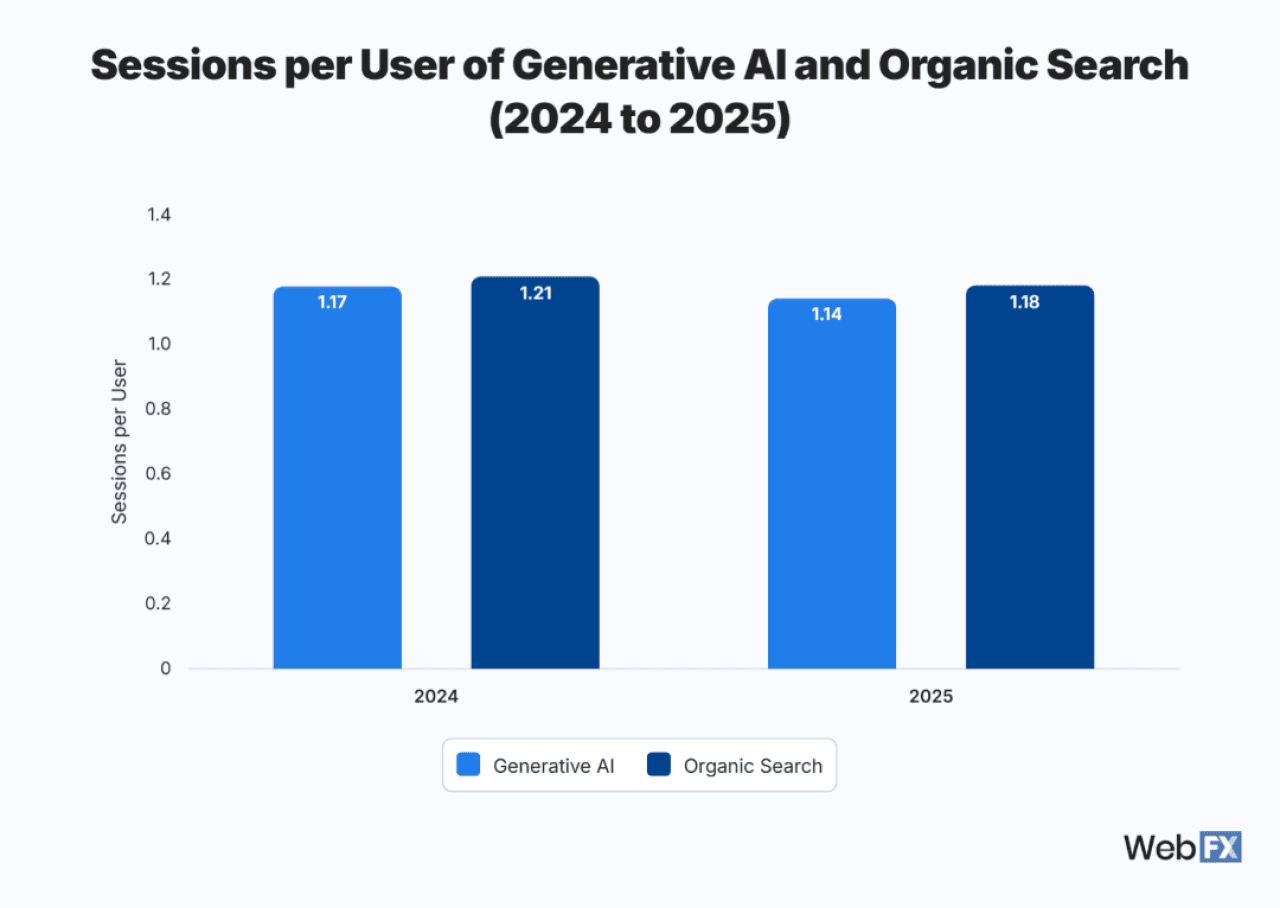
AI traffic had fewer sessions per user than organic search in both 2024 and 2025. In 2025, AI visitors averaged 1.14 sessions per user compared to 1.18 for organic search.
This pattern suggests less back-and-forth exploration. Many AI-referred visitors have already begun evaluating options elsewhere:
When these users reach a company website, they’re confirming pricing, specifications, credibility, or contact information.
Generative AI delivered 0.79 tracked interactions per user. In practical terms, that’s roughly eight tracked interactions for every 10 visitors arriving from AI platforms.
For context, organic search generated approximately 12 tracked interactions per 10 visitors.
High-intent channels such as Affiliates and Paid Search generated even more interactions per visitor, which implies that visitors coming from these channels are in the earlier stages of their research.
Generative AI outperformed Direct, Organic Social, Referral, Paid Social, and Display in terms of tracked interactions per visitor. This places the generative AI channel in the middle tier of conversion efficiency — competitive but not the most efficient or highest-converting.
On its own, midtier efficiency is not unusual. What distinguishes generative AI is the combination of:
No other unpaid channel grew this quickly while still driving meaningful conversion activity. This combination reflects a growing share of visitors arriving through AI platforms with meaningful conversion activity.
Generative AI functions as a prequalification tool for prospects. For this reason, AI traffic behaves more like bottom-of-funnel traffic than early-stage discovery.
The data suggests several shifts in digital strategy.
AI as a decision-stage channel
Visitors arriving from AI platforms are often validating options rather than beginning research. Landing pages that clearly present key information—such as pricing, specifications, comparisons, and proof points—align with the verification behavior of these visitors.
AI-driven visitors are more likely to convert when information is immediate and structured.
Shifts in performance measurement
AI visitors averaged fewer sessions per user than organic search in both 2024 and 2025, yet generated several interactions with visitors. If you measure performance primarily on session depth or repeat visits, AI traffic may appear weaker than it is.
Benchmarking AI performance against high-intent channels rather than informational organic queries provides more accurate context.
Changes to reporting and attribution models
With 796% YoY session growth and meaningful interactions per user, AI is no longer experimental traffic. Tracking it as a defined channel in dashboards, revenue reporting, and forecasting models provides better visibility.
Tracking referral sources from AI platforms separately will prevent their impact from being absorbed into “referral” or “other” categories.
Content alignment with confirmation behavior
AI-driven visitors frequently arrive to confirm pricing, review technical details, or assess credibility. Landing pages that provide clear pricing and technical information, boost brand credibility with proof points, and guide visitors to next steps align with this behavior.
As AI visibility increases, the ability to appear in AI-generated responses directly influences which brands receive this decision-stage traffic.
Generative AI accounted for just 0.18% of traffic in 2025. While small, it’s unique: What sets it apart from other traffic sources is how AI-referred visitors behave when they land on a business’s website.
In 2025, generative AI recorded a 66.48% engagement rate and a 54.15% session conversion rate. Organic search, by comparison, recorded a 70.86% engagement rate with a 45.23% session conversion rate during the same period.
Their difference shows up in how concentrated the visitors’ intent appears to be.
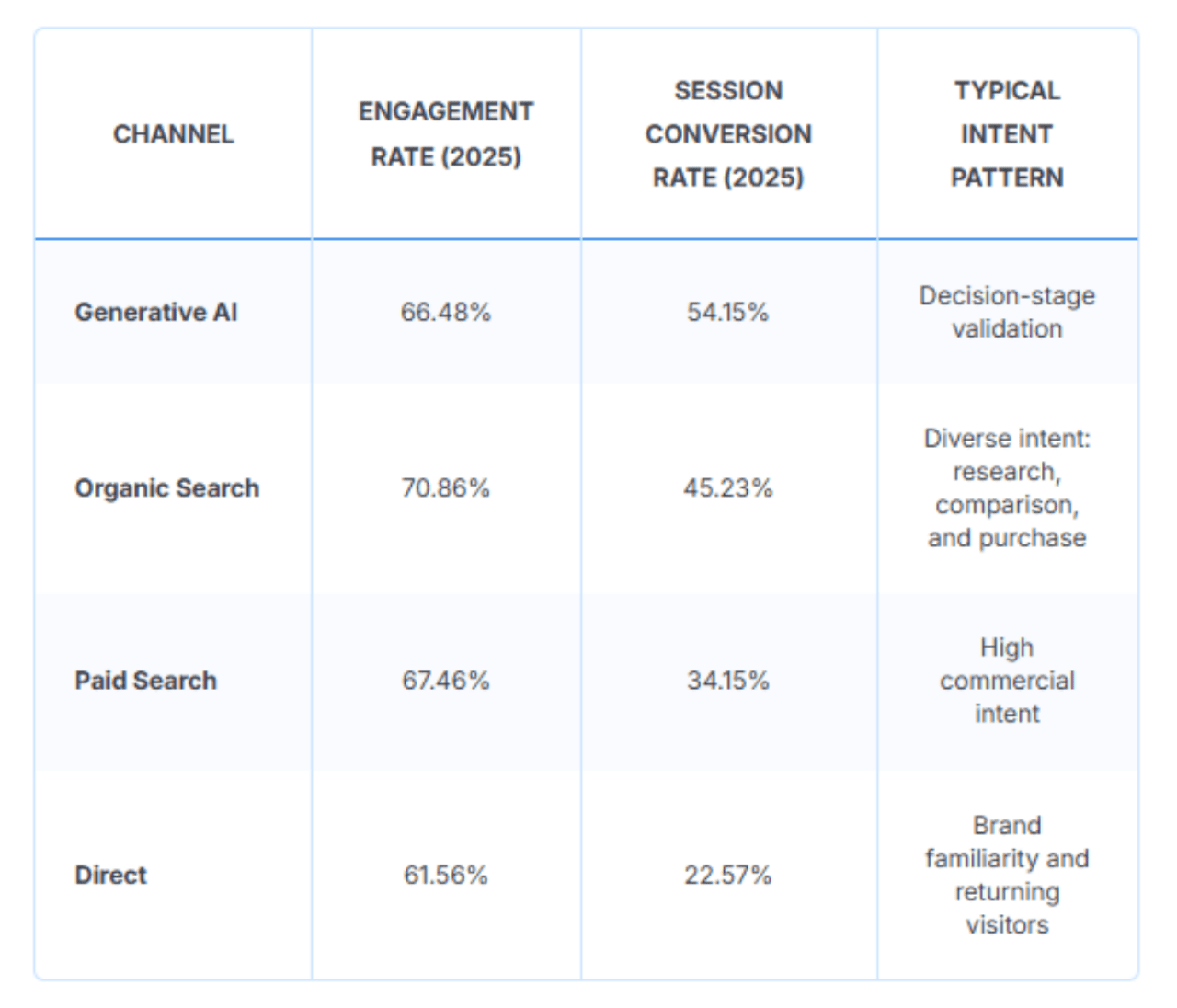
Organic-driven sessions include a variety of intents. Visitors land on a brand website to conduct early research, casual browsing, comparison shopping, fill out a form, or make a purchase.
On the other hand, generative AI sessions are more likely to include a measurable action. That’s why its session conversion rate is high (54.15%).
In practical terms, a higher percentage of AI-referred visits result in form submissions, resource downloads, quote requests, or other conversion events within the same session.
For marketers, that suggests something important: AI-referred users may have done some research before they click through your site. By the time they land on your site through an AI-assisted search, they’ve already learned so much about their options and are not starting from scratch.
This trend affects how you design high-intent experiences for AI-assisted visits.
While generative AI traffic accounts for only a small fraction today, the behaviors seen — higher session-level conversion activity — also apply to other high-intent visitors, whether they arrive via organic search, paid search, or direct.
The objective is to optimize websites so that when visitors arrive ready to act, the process is streamlined.
Making the next steps obvious and simple
When someone lands on a product or service page, the next steps should be immediately clear. High-conversion pages often share several characteristics
Adjusting messaging for returning visitors
Not every high-intent visitor converts on the first visit. Some return to confirm or compare pricing, so some organizations personalize content for returning visitors instead of repeating introductory messaging.
If someone has already viewed technical specifications, they likely don’t need a brand overview. Messaging can be adjusted by adding excerpts from case studies to provide reassurance.
Small personalization changes can support that momentum without requiring a full redesign.
Reinforcing credibility during the decision-making process
High-intent visitors — including AI-referred users — often concentrate on decision pages. Product, pricing, and demo pages often display social proof such as:
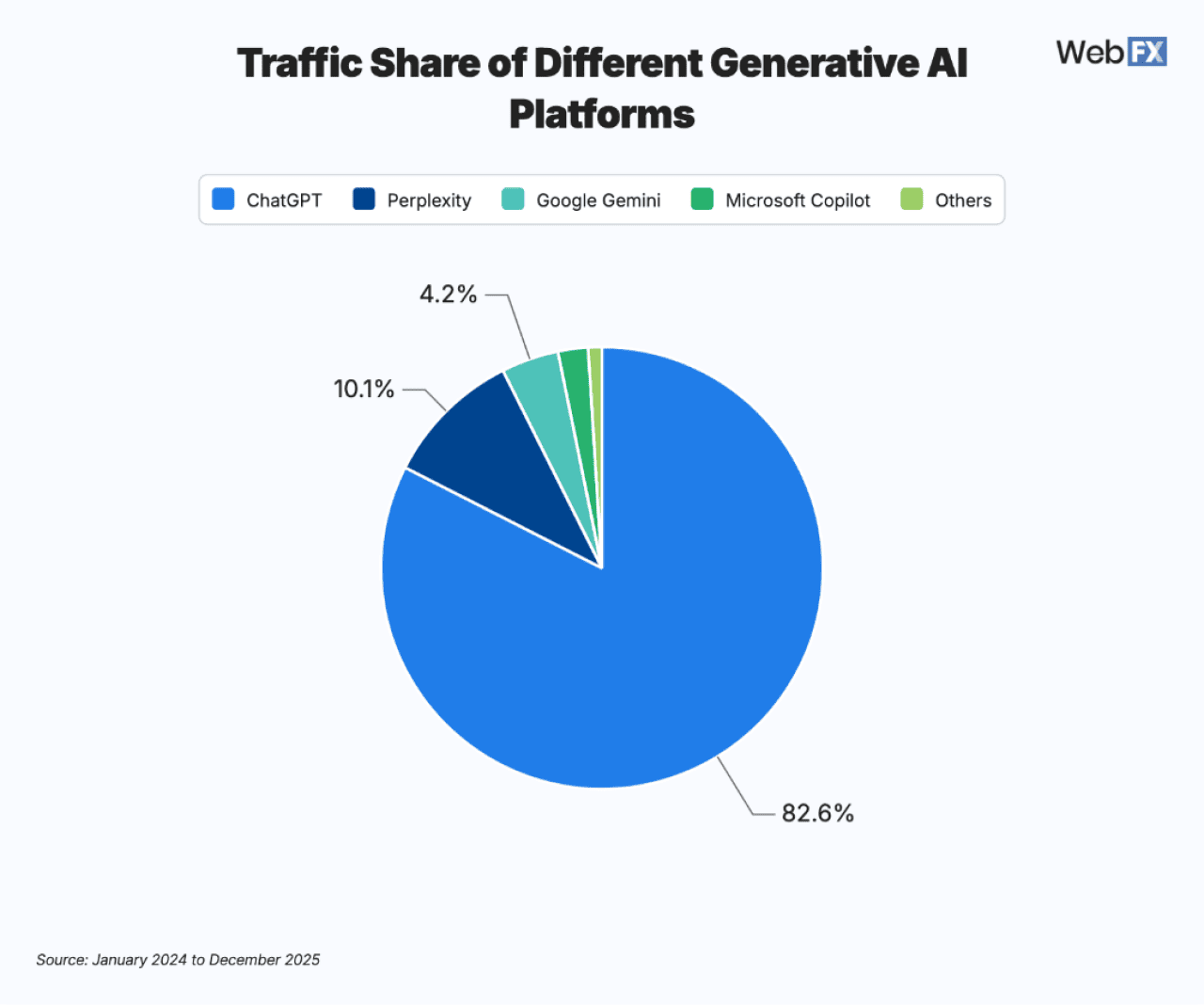
From 2024 to 2025, ChatGPT accounted for 82.6% of all generative AI traffic. The next-closest platforms — including Perplexity and Google Gemini — accounted for much smaller shares.
When combined, the top three AI platforms generated 96.9% of all AI-driven visits. In other words, AI discovery is not spread across dozens of tools. Instead, most AI discovery happens on just a few platforms.
This concentration suggests that optimization principles remain consistent across the landscape, requiring authoritative content, clear explanations, structured information, and credible sources. While ChatGPT currently represents the largest share of AI answers, other platforms continue to play specific roles.
That doesn’t mean other platforms are irrelevant. Perplexity continues to serve research-heavy queries, and emerging assistants from Google and Microsoft are still evolving.
Although traffic is concentrated, the foundations of AI visibility are largely universal.
AI platforms tend to reference authoritative content, such as original research, expert explanations, and clear answers to specific questions. Well-structured pages also assist crawlers in finding, extracting, and citing information. This suggests that building content robust enough for any AI system to rely on is more effective than creating tool-specific content.
Perplexity, Gemini, and Copilot still contribute smaller shares of traffic today. As generative AI evolves as a channel, the distribution of traffic may change.
Generative AI traffic growth in 2025 was not confined to SaaS or technology companies. Adoption accelerated across research-intensive B2B sectors.
In this dataset, Manufacturing, Professional Services, and SaaS accounted for roughly 35% of generative AI traffic in 2025. These industries often require buyers to carefully compare options, validate capabilities, and align stakeholders before inquiring.
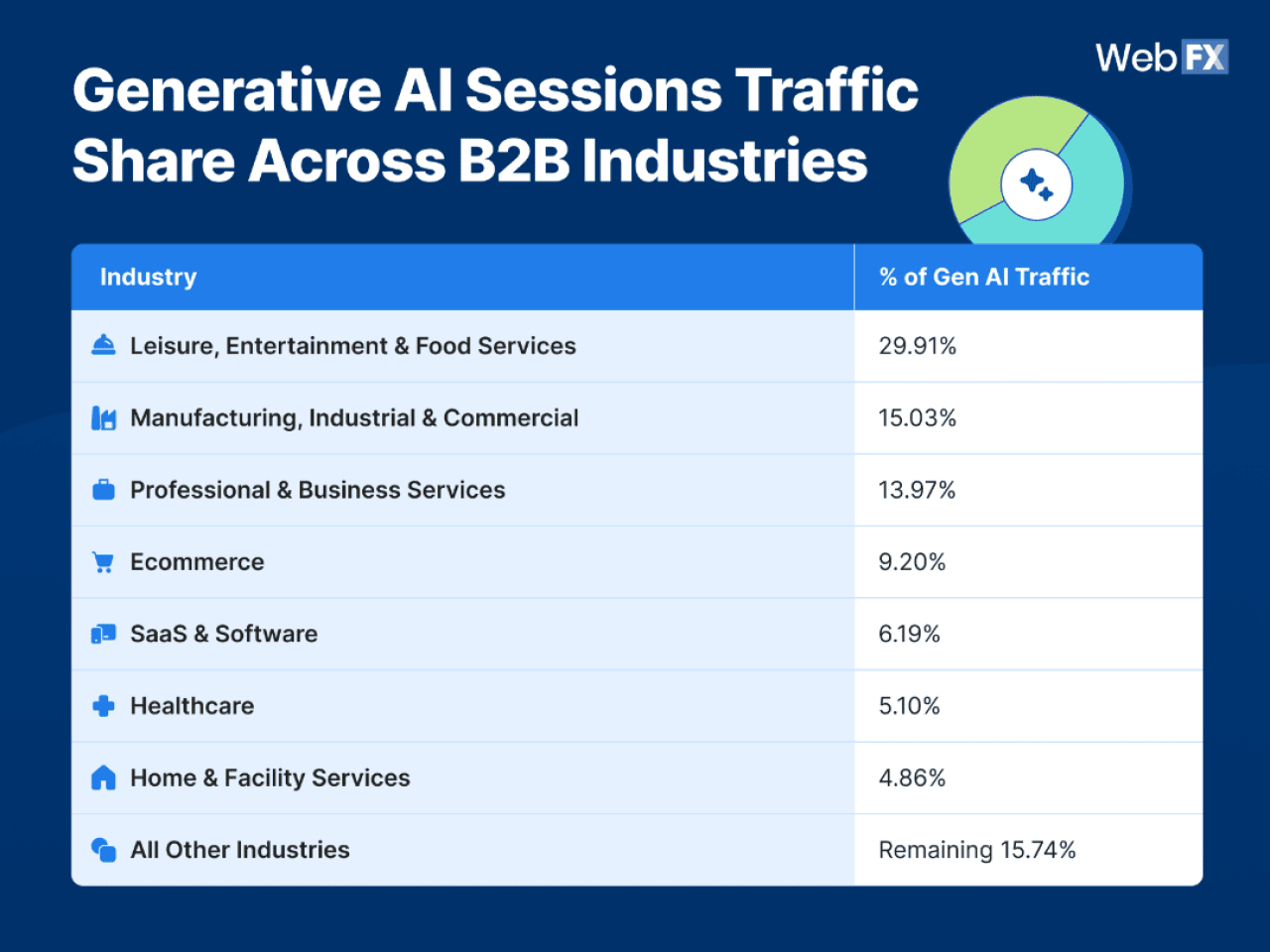
Manufacturing and Heavy Equipment showed sustained acceleration into late 2025, while Professional Services experienced an early-2025 surge followed by stabilization. As quarterly growth stabilized overall, these industries continued to see sustained increases in AI-referred sessions, showing us that technical buyers are incorporating AI tools into procurement workflows.
Home Services followed a different trajectory. AI traffic in this category moved from negligible volume in early 2024 to steady, conversion-producing streams by late 2025.
While total session share remained modest in Home Services, AI-assisted visits showed conversion activities, suggesting that AI platforms power vendor discovery and assist with initial outreach. Total session share in the SaaS and Software industry also appears small compared to other industries and is likely due to larger datasets coming from other B2B sectors.
B2B buyers increasingly use AI platforms to compare vendors, review specifications, and narrow options before visiting company websites. By the time they visit your website, they are confirming details, not starting their research.
If your specifications, service descriptions, or case studies are not surfaced in AI-assisted research, buyers may never discover or consider your business. That makes visibility during their early comparison critical — vendors mentioned at this stage have a chance of getting evaluated.
B2B buyers use AI platforms to gather, compare, and shortlist options before visiting vendors’ websites and inquiring. To get their attention at this stage, you must have structured, authoritative content.
Publish comparison-ready documentation
Make product specifications, service packages, compliance details, and pricing models easy to find and easy to interpret.
Front-load key information at the top of your pages. In addition, ensure product specs and key details are consistent across pages so buyers and crawlers can easily find and understand them.
Use structured data to reduce ambiguity
Structured data (or schema markup) won’t guarantee citations, but it helps crawlers extract and summarize your content accurately. For many B2B organizations, useful schema markups include:
Use the types that match what you actually publish to make important details clear.
Use consistent naming so you can be cited correctly
Keep product names, categories, and terminology consistent across pages. Doing so increases the likelihood that AI-generated summaries will reflect your correct offerings and details.
Earn trust with expert-backed, proof-focused content
B2B buyers look for credibility signals, while AI-powered searches look for statements that they can reference. When applicable, incorporate insights from subject-matter experts, case studies, and data-backed comparisons into your content.
For example, a manufacturing supplier can publish an engineer-reviewed specification table comparing material tolerances, performance metrics, and compliance standards across product lines, along with a case study.
By providing specific, technical details, you’re improving both buyer trust and AI interpretability.
Audit how your brand appears in AI answers
Regularly check how your B2B business appears for high-intent queries on major AI platforms. AI visibility tools can help monitor and analyze a brand's presence on ChatGPT and other major AI search experiences.
Generative AI has not replaced traditional traffic channels, with direct and organic search still dominating with 35.51% and 27.12% of total sessions, respectively, in 2025. However, generative AI platforms are increasingly influencing how online users evaluate vendors and make purchase decisions.
This shift suggests there are different ways for audiences to discover brands and services. Appearing in traditional search results remains essential, but being mentioned in AI-generated answers is critical to getting noticed and shortlisted.
Here’s how.
1. Prioritize traffic quality along with volume
As earlier sections showed, the AI-referred visitors often arrive at websites ready to take action. Instead of focusing only on session growth, monitoring the quality of traffic arriving from different channels with metrics such as:
These metrics reveal which channels drive revenue, helping you identify the optimization efforts to prioritize.
2. Track generative AI visibility as a distinct channel
Creating a separate reporting view for generative AI traffic in analytics platforms makes it easier to evaluate their influence. As AI platforms become a measurable source of discovery, isolating that traffic makes it easier to evaluate their influence.
Monitoring referral sources from major AI tools and comparing how those visits behave compared to other channels can reveal which pages, resources, and topics are most frequently surfaced in AI-generated responses.
Over time, this analysis can reveal which pages, resources, and topics are most frequently surfaced in AI-generated responses.
3. Align SEO and GEO through a “double-dip” strategy
Rather than treating generative engine optimization (GEO) as a separate initiative, it can be integrated with existing SEO strategies.
Search engines still capture a large share of discovery traffic, while AI platforms increasingly shape how buyers validate their options during evaluation. Having a strong content strategy can support both your SEO and GEO efforts.
A strong content strategy can support both. As research expands beyond traditional search, brands that get cited are those that consistently provide helpful answers backed by first-party data and experience across discovery channels.
SEO-focused content helps brands appear during early research. The same pages — when structured clearly and supported with credible information — can become sources that AI systems can cite when users ask deeper questions.
This “double-dip” approach allows a single piece of content to contribute to both discovery and decision stages of the buyer journey.
This story was produced by WebFX and reviewed and distributed by Stacker.





Reader Comments(0)