
The people's voice of reason


The people's voice of reason
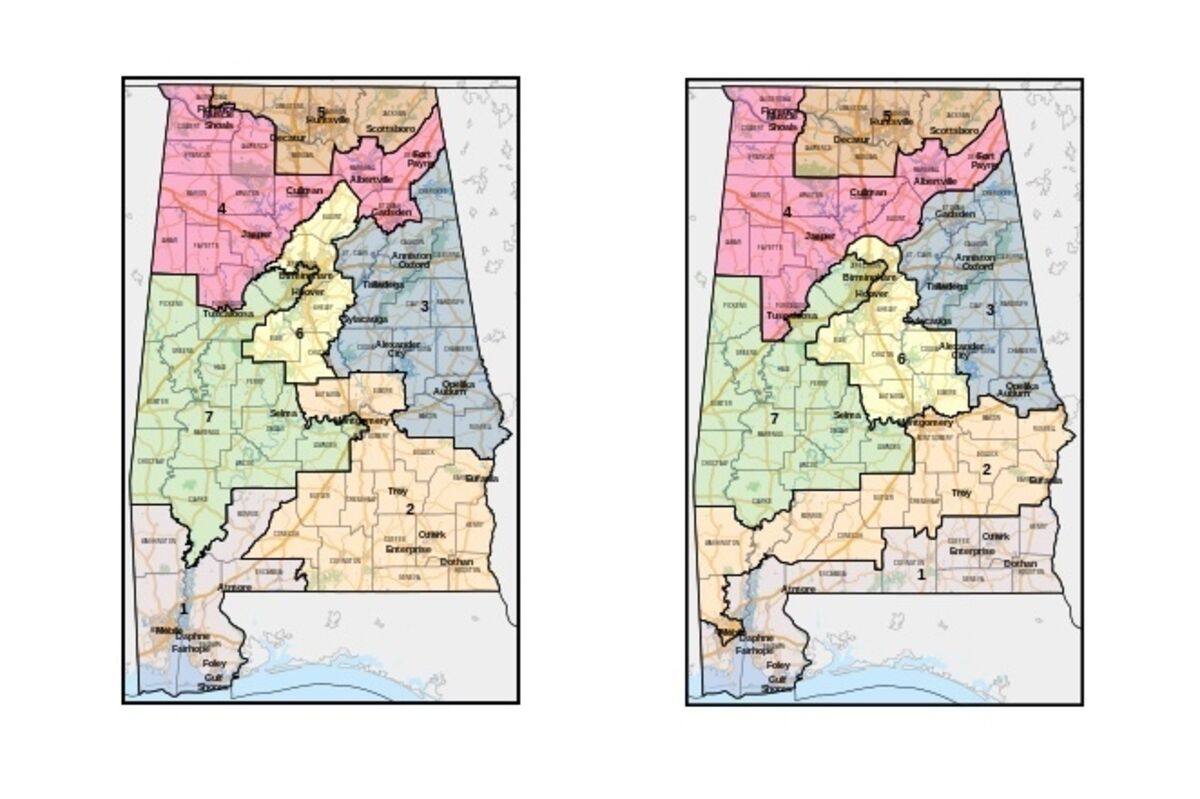
The map on the left is the last congressional map that the Legislature passed. The one on the right is the one that the federal judges in Atlanta forced upon the state.
April 29, 2026 - MONTGOMERY, Ala - Today, the United States Supreme Court struck down a key provision of the controversial Voting Rights Act of 1965, making it unlikely for civil rights groups to carve out Black majority districts across the country subverting the state legislatures' constitutional authority.
While the decision applied to Louisiana where the NAACP and the Democratic Party were trying to use the courts to strongarm the state into creating a second majority minority congressional district, the ruling sets a precedent that will likely impact dozens of other states – nowhere more so than Alabama where U.S Senator Tommy Tuberville, potential Congressional candidate Morgan Murphy, and Congressman Barry Moore (R-Enterprise) all advocated for immediately redistricting Alabama's seven Congressional districts to create seven majority Republican leaning seats.
Murphy told the Alabama Gazette that Attorney General Steve Marshall (R) needs to go back to federal court and ask the court to lift the injunction preventing the state from redistricting. Murphy expressed optimism that if that happens that Governor Kay Ivey (R) could then call a special session of the Legislature to redistrict Alabama's seven congressional districts this year.
Democrats expressed their disappointment in the decision.
The Alabama House Democratic Caucus said in a statement that the ruling makes it, "Nearly impossible to protect Black voters from having their voices diluted through gerrymandering. The court's six-to-three Republican-appointed majority ruled that to create majority-minority districts, there must be evidence of intentional racial discrimination to show that district lines discriminate against voters of color, which is extremely difficult to prove."
The Alabama House Democrats expressed fears that this ruling could have impact far beyond whether or not Louisiana has two majority minority congressional districts or not.
"The ruling will undoubtedly have a seismic and overwhelmingly negative impact on minority representation in multiple states, triggering legal challenges over congressional boundaries," the House Democrats continued. "The case focused on whether Louisiana's 2024 congressional map, which had added a second majority-Black district, amounted to an unconstitutional racial gerrymander."
Alabama House Minority Leader Anthony Daniels (HD53) made the following statement:
"Today's ruling is not simply unfortunate, it destroys the very intent of Section 2 of the Voting Rights Act and gives further license to those who seek to racially gerrymander districts for their own political purposes."
Congresswoman Terri Sewell also expressed her disappointment with the ruling.
Today, U.S. Rep. Terri Sewell (AL-07) released the following statement on the U.S. Supreme Court decision in Louisiana v. Callais gutting Section 2 of the Voting Rights Act:
"Today's decision is a devastating blow to American democracy and a death sentence for the Voting Rights Act of 1965," said Congresswoman Sewell. "The right-wing Supreme Court has not only turned its back on decades of precedent and ignored the intent of Congress and the will of the people, but it has weakened the foundational principle safeguarding fair representation for Black and minority voters."
Rep. Sewell is likely to be challenged by former Trump aide Morgan Murphy – a former Tuberville aide, Navy veteran, and Trump administration official from Mountain Brook – in 2028 if the courts lift the injunction preventing the state from redistricting before 2030 after a federal court appointed special master redrew Alabama's congressional districts to flip CD2 from a safe Republican seat to a safe Democratic seat.
"For decades, Section 2 has been the essential tool that allowed minority voters to challenge discriminatory maps and defend our right to meaningful political power," Sewell continued. "By gutting it, the Court has made it easier for bad actors to discriminate and harder for us to fight that discrimination in court. The decision is a gift to President Trump and his voter suppression scheme, making it easier for Republicans to steal congressional seats by diluting the voices of Black and minority voters."
Prior to a court ordered redistricting, CD7 was a conservative swing district represented by then Congressman Richard Shelby (D-Tuscaloosa) and later by Rep. Claude Harris (D-Tuscaloosa). After the courts forced the state to redraw the map, Birmingham and Bessemer were moved to CD7 and much of Tuscaloosa County went to CD4. CD6 became much more rural and geographically larger. The result was a solid blue majority minority CD7 represented by Rep. Earl Hilliard (D-Birmingham), then Rep. Artur Davis (D-Birmingham), and since 2003 by Sewell. After the redistricting Rep. Ben Erdreich (D-Birmingham) was defeated in CD6 by then State Senator Spencer Bachus (R-Vestavia Hills). Bachus succeeded in 2014 by Alabama Policy Institute cofounder Gary Palmer (R-Hoover).
"As the representative of Alabama's 7th District-a district whose very existence was secured through the Voting Rights Act-I know firsthand what is at stake," said Sewell. "This decision will determine whether communities like ours can elect leaders who understand their lived experiences and fight for their needs. Its impact will not be confined to one state or one election cycle. It will shape who gets heard in our democracy, who gets counted, and whose voice gets left behind."
Congressman Shomari C. Figures (D-Mobile) also issued the following statement after the U.S. Supreme Court issued a decision in Louisiana v. Callais:
"Although today's decision does not make changes to Alabama's current congressional districts, it has made proving future racial discrimination in redistricting cases significantly tougher," predicted Rep. Figures. "It will lead to states, primarily in the South, launching immediate efforts to redraw districts in ways that will dilute the impact of Black voters and drastically reduce the number of realistic opportunities to elect Black members to Congress. This is unfortunate, especially in Alabama, given the role that brave men, women and children played in this State in spearheading the Voting Rights Movement."
Alabama's CD2 was a solidly Republican district represented by Freedom Caucus member Rep. Barry Moore (R-Enterprise); then court at the urging of the NAACP and its Democratic allies led by Obama era former Attorney General Eric Holder redrew the districts over the objection of the Republican controlled Alabama Legislature, Governor Kay Ivey (R), and Attorney General Steve Marshall (R) . The court appointed special master racially gerrymandered Alabama's congressional districts: splitting Mobile County and the City of Mobile between CD1 and CD2; all of Montgomery County went into CD2 as well as the eastern half of the Black Belt and half of the Wiregrass including Troy and Phenix City. Montgomery's suburbs in Autauga and Elmore went to Palmer's CD6. CD1 kept the southern part of Mobile County and the nearby beaches in Baldwin County while picking up the southern half of the Blackbelt, including Moore's native Coffee County. That helped elect Figures (who had left Alabama after college). Moore meanwhile won a GOP primary battle with CD1 incumbent Jerry Carl (R-Mobile). Carl is now running against another Enterprise native in Rhett Marques.
A federal court has placed an injunction on the state redistricting betore 2030 – an injunction that Murphy, Moore, and Tuberville want lifted.
"While Alabama's congressional district lines currently remain in place until after the 2030 census, I hope that courts will vigorously enforce the Voting Rights Act across the country," Figures continued. "The fight for fair representation continues, so now more than ever, it is critical that every American get involved, get registered to vote, and get out to vote. The attacks on our voting rights are coming from every angle," Sewell concluded. "Now more than ever, communities across the nation must mobilize and vote like we've never voted before. If the Court won't protect the rights of Black and minority voters, Congress must act. We must revise and pass the John R. Lewis Voting Rights Advancement Act to restore the full protections of the VRA. And we must reaffirm, through action, that every American deserves an equal voice in our democracy. "The right to vote is the lifeblood of our democracy. In the spirit of John Lewis, we will continue to make 'Good Trouble' until the promise of democracy is real for all."
NAACP President and CEO Derrick Johnson claimed that the Supreme Court "Betrayed Black Voters" after the Louisiana redistricting decision.
Johnson said, "Today's decision is a devastating blow to what remains of the Voting Rights Act, and a license for corrupt politicians who want to rig the system by silencing entire communities."
"The Supreme Court betrayed Black voters, they betrayed America, and they betrayed our democracy," he said. "This ruling is a major setback for our nation and threatens to erode the hard-won victories we've fought, bled, and died for."
The 6 to 3 decision to reject Louisiana's newly drawn congressional map, which created a second majority-Black district closely parallels the controversial 2023 lower court ruling that racially gerrymandered south Alabama to create the CD2 that Figures now represents.
To comment or ask a question email: brandonmreporter@gmail.com








Reader Comments(0)