
The people's voice of reason


The people's voice of reason
The start of the French and Indian War
The Opening Shot of a Global Conflict That Redefined North America
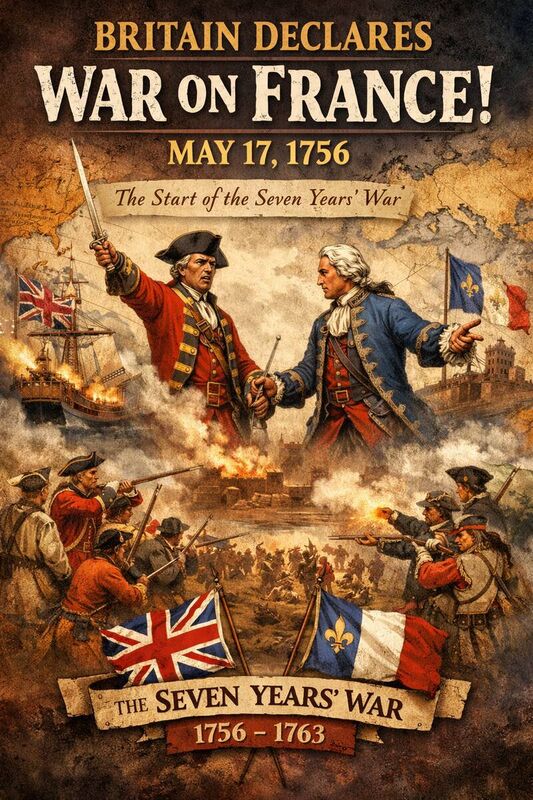
On May 17, 1756, Great Britain formally declared war on France, transforming a series of frontier skirmishes into what many historians call the first true world war. Known globally as the Seven Years' War, and in North America as the French and Indian War, this conflict redrew borders, toppled empires, and set the stage for the American Revolution.
Rivalry on a Collision Course
By the mid‑18th century, Britain and France were locked in a fierce struggle for global influence. Their competition stretched across:
North America, where both nations claimed vast territories
The Caribbean, a region of immense wealth through sugar production
India, where both sought commercial and political dominance
Europe, where alliances and dynastic politics kept tensions high
Long before the official declaration, clashes had already erupted in the Ohio River Valley. British colonists and French forces, each backed by Native American allies, fought for control of the region's lucrative trade routes and strategic forts.
One of the earliest sparks came in 1754, when a young George Washington, then a Virginia militia officer, led an expedition that resulted in the skirmish at Jumonville Glen - an event that helped push the two empires toward open conflict.
Why May 17, 1756 Mattered
Although fighting had been underway for nearly two years, it was Britain's formal declaration of war that transformed the conflict into a global showdown. The declaration meant:
Full mobilization of British naval and military power
Expansion of the war to Europe, the Caribbean, West Africa, and India
A shift from frontier raids to coordinated imperial strategy
France responded in kind, and the Seven Years' War officially began.
The North American Theater: The French and Indian War
In the American colonies, the war took on a distinct character. British regulars, colonial militias, and Native American nations fought against French troops and their own Native allies. Key features of the North American conflict included:
Brutal frontier warfare
Sieges of major forts, including Fort William Henry and Louisbourg
The struggle for control of the St. Lawrence River and Great Lakes
The turning point came under British Prime Minister William Pitt, who poured money, troops, and naval power into the war. Britain captured Quebec in 1759 and Montreal in 1760, effectively ending French rule in Canada.
A War That Reshaped the World
The Seven Years' War ended with the Treaty of Paris in 1763, a settlement that dramatically altered the map:
France ceded Canada and all lands east of the Mississippi to Britain
Spain ceded Florida to Britain
France transferred Louisiana west of the Mississippi to Spain
Britain emerged as the dominant power in North America - but victory came at a cost.
The Road to the American Revolution
The war left Britain with enormous debt. To pay for the cost of defending its expanded empire, Parliament imposed new taxes and regulations on the American colonies:
The Stamp Act
The Sugar Act
The Townshend Acts
These measures sparked colonial resistance, protests, and eventually revolution. In this way, the events of May 17, 1756 indirectly set the American colonies on the path to independence.
A Global Turning Point
Britain's declaration of war on France was more than a diplomatic formality - it was the opening act of a conflict that reshaped continents. The Seven Years' War redrew borders, toppled French power in North America, and set the stage for the birth of the United States.
More than 250 years later, the decision made on May 17, 1756 remains one of the most consequential declarations in world history.







Reader Comments(0)