
The people's voice of reason


The people's voice of reason
The Russians were annihilated by the Mongols at the Battle of the Kalka River
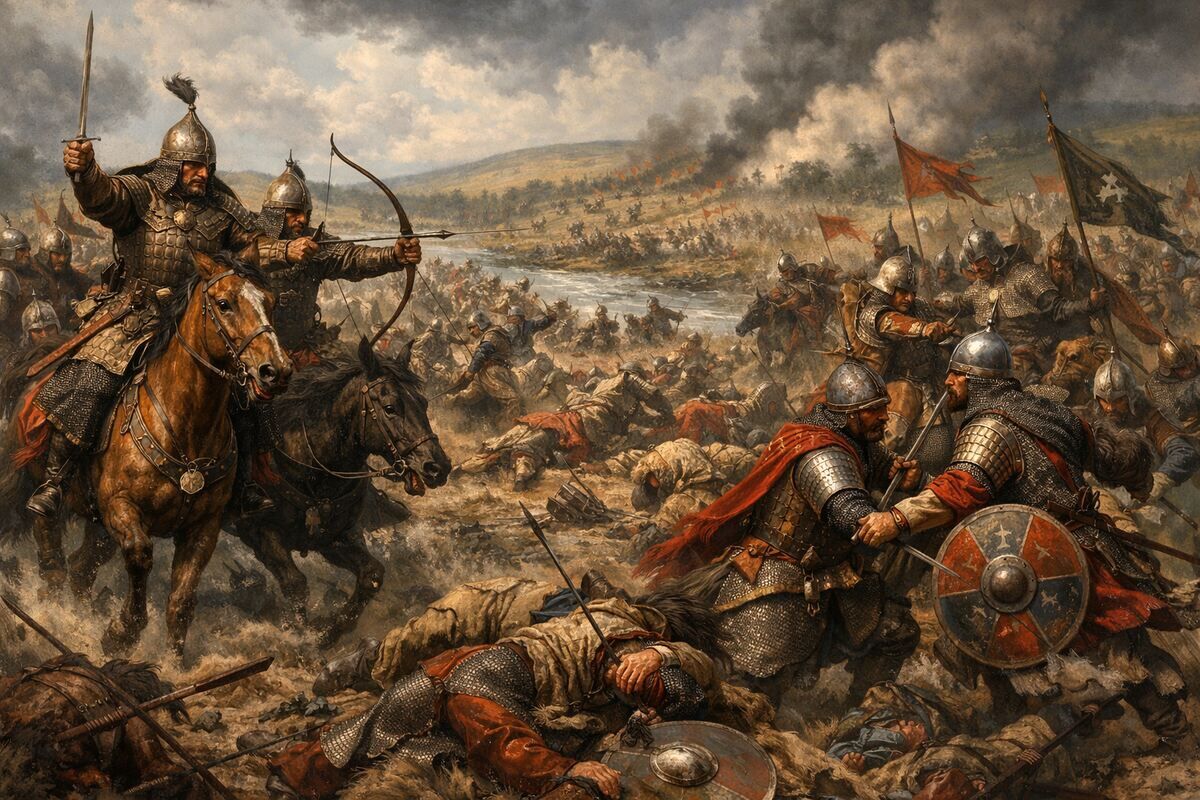
On May 31, 1223, the armies of Kievan Rus' and their steppe allies collided with two of the most formidable commanders in Mongol history-Jebe and Subutai-on the banks of the Kalka River. The resulting clash ended in a devastating defeat for the coalition of Russian princes, with an estimated 20,000 men killed. Though often overshadowed by the later Mongol invasion of 1237–1240, the Battle of the Kalka River stands as a pivotal moment: a warning shot that revealed the Mongol Empire's rising power and the vulnerability of Eastern Europe.
A Reconnaissance in Force
The Mongol presence in Eastern Europe in the early 1220s was not originally intended as a full-scale conquest. Genghis Khan had dispatched two of his most trusted generals-Jebe and Subutai-on a long‑range reconnaissance mission. Their orders were simple but ambitious: pursue the fleeing Khwarazmian Shah across Central Asia, gather intelligence on the western lands, and test the strength of the peoples beyond the steppe.
By 1222, the Mongol vanguard had crossed the Caucasus Mountains, defeated several nomadic tribes, and entered the Pontic Steppe north of the Black Sea. Their presence alarmed the princes of Kievan Rus', who viewed the Mongols as a new and unpredictable threat. When the Mongols defeated the Cumans-longtime allies and trading partners of the Rus'-the Cumans fled westward and pleaded for help.
Their appeal worked. The princes of Rus', often divided by internal rivalries, agreed to unite against the common enemy.
A Coalition Forms
The coalition that marched east in 1223 was impressive on paper. It included forces from Kiev, Galicia‑Volhynia, Chernigov, Smolensk, and other principalities, along with thousands of Cuman horsemen. But unity was superficial. The princes disagreed on strategy, command structure, and even the purpose of the campaign. Some sought revenge for the Cumans; others hoped to demonstrate their own political dominance.
The Mongols, by contrast, operated with a single will. Jebe and Subutai were masters of mobile warfare, deception, and intelligence gathering. They understood their opponents far better than the Rus' understood them.
The Long Feigned Retreat
The Mongols initiated one of their signature maneuvers: a feigned retreat lasting several days. As the Rus' advanced, the Mongols withdrew deeper into the steppe, drawing the coalition farther from its supply lines and scattering its forces across a vast distance.
The princes misinterpreted the withdrawal as evidence of Mongol weakness. Confident and eager for victory, they pressed forward without coordination. By the time they reached the Kalka River, their armies were stretched thin, exhausted, and poorly positioned for battle.
The Battle Unfolds
On May 31, 1223, the Mongols turned and struck.
The first blow fell on the Cuman cavalry, which formed the vanguard of the coalition. The Mongols overwhelmed them with superior mobility and disciplined archery, sending the Cumans fleeing back into the ranks of the Rus'. The sudden retreat caused chaos, and the disorganized Rus' forces were unable to form a unified defensive line.
Jebe and Subutai then executed a classic Mongol encirclement. Their horse archers showered the Rus' with arrows, while heavy cavalry units smashed into isolated pockets of resistance. The coalition collapsed in a matter of hours.
Some princes attempted to flee; others made desperate last stands. The Mongols pursued relentlessly, cutting down soldiers across the steppe. Contemporary chronicles estimate that around 20,000 Rus' and Cuman warriors were killed, though exact numbers remain debated.
The Fate of the Princes
Several high‑ranking Rus' nobles were captured alive, including Mstislav III of Kiev. The Mongols executed them in a manner intended to send a message: the princes were placed beneath wooden boards, and Mongol officers sat on top of them during a victory feast, crushing them to death without shedding noble blood.
It was a chilling demonstration of Mongol ruthlessness-and a warning of what was to come.
Aftermath and Significance
Despite their overwhelming victory, the Mongols did not immediately invade Rus' territory. Their mission was reconnaissance, not conquest. After the battle, Jebe and Subutai continued westward, raiding into the Volga region before eventually returning to Mongolia.
For the Rus', however, the defeat at the Kalka River was a turning point. It exposed deep political fractures, military weaknesses, and a dangerous underestimation of the Mongol threat. When Batu Khan returned with a full invasion force in 1237, the principalities were no better prepared-and the consequences were catastrophic.
Historians often view the Battle of the Kalka River as the opening act of the Mongol expansion into Eastern Europe. It demonstrated the effectiveness of Mongol tactics, the vulnerability of fragmented states, and the strategic brilliance of commanders like Jebe and Subutai.
A Lesson in Unity and Strategy
Eight centuries later, the Battle of the Kalka River remains a powerful case study in military history. It highlights how discipline, mobility, intelligence, and unified command can overcome larger but disorganized forces. It also underscores the dangers of political division in the face of external threats.
For the Mongols, Kalka was a triumph of strategy. For the Rus', it was a tragedy born of overconfidence and disunity. And for historians, it marks one of the earliest encounters between medieval Europe and the unstoppable force that was the Mongol Empire.






Reader Comments(0)