
The people's voice of reason


The people's voice of reason

Recent legal developments have opened the door to significant tariff refunds under the International Emergency Economic Powers Act (IEEPA). For business owners, this presents both an opportunity and a compliance challenge. Importers should file protests promptly to protect their rights and eligibility for refunds during the administrative review cycle.
This guide from Polston Tax clarifies what the ruling means, who qualifies and how to act. You will find clear explanations, practical steps and key deadlines to help you navigate the refund process with confidence and accuracy.
On Feb. 20, 2026, the U.S. Supreme Court issued a decision to implement the Trump tariff refund bill.
IEEPA tariffs were imposed under the International Emergency Economic Powers Act, a law that allows the executive branch to regulate commerce during declared national emergencies. These tariffs were introduced as part of broader trade and foreign policy measures, often targeting goods tied to specific geopolitical concerns.
The legal challenge was whether using IEEPA to impose tariffs exceeded the authority granted by the statute. The Supreme Court ultimately determined that the tariffs weren’t implemented within the right legal framework. The ruling clarified that, while IEEPA grants broad powers, it doesn’t authorize tariff measures as applied in this case.
As a result, duties collected under these tariffs are now subject to refund, creating a pathway for affected businesses to recover funds.
In practice, these tariffs increased costs for U.S. importers across a wide range of industries. Businesses paid these duties at the time of import, often passing the costs through supply chains or absorbing them by reducing margins. Close to 60% of companies saw gross margin decrease due to these tariffs.
Before taking action, you must confirm whether your business meets the eligibility requirements. This process involves reviewing import records, understanding tariff classifications and distinguishing IEEPA duties from other trade measures.
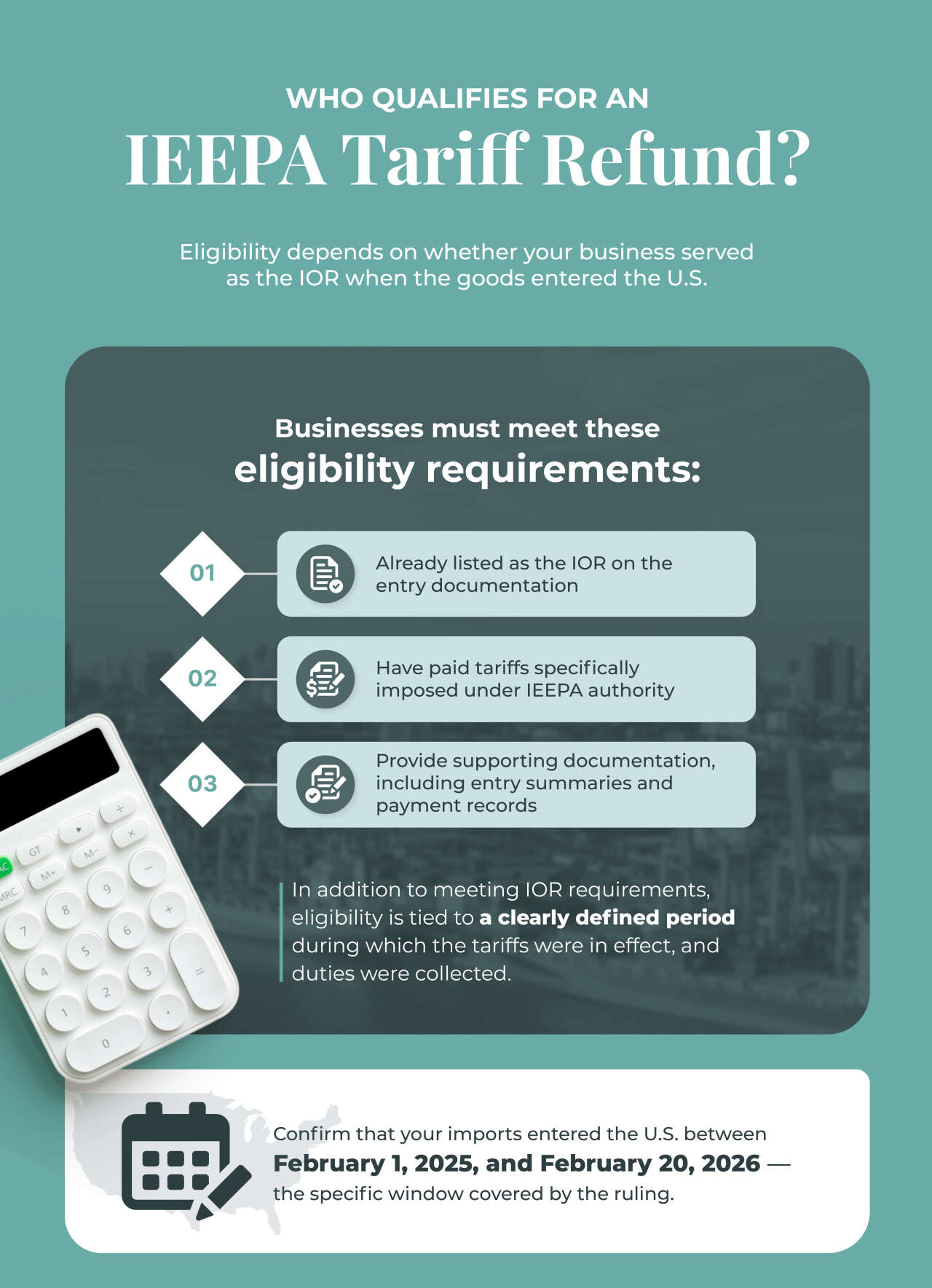
Eligibility depends on whether your business served as the IOR when the goods entered the U.S. The IOR is the entity legally responsible for ensuring compliance with customs regulations and for paying applicable duties.
To qualify for a refund, businesses must meet these eligibility requirements:
In some cases, third parties, such as customs brokers, facilitated the findings, but eligibility remains tied to the entity listed as the IOR. If your business indirectly bore the cost, such as through supplier pricing, it may not qualify unless it was the official importer.
In addition to meeting IOR requirements, eligibility is tied to a clearly defined period during which the tariffs were in effect, and duties were collected. Confirm that your imports entered the U.S. between Feb. 1, 2025, and Feb. 20, 2026 — the specific window covered by the ruling.
Determining which imports are eligible means using a detailed review of the Harmonized Tariff Schedule (HTS) codes. These codes classify imported goods and determine applicable duty rates.
To identify affected imports:
The process may need you to coordinate between finance, procurement and compliance teams. It’s critical to classify each import accurately, as errors can delay or invalidate claims. If your business has high import volumes, you may benefit from automated data analysis tools or external expertise to ensure a complete and accurate review.
Beyond reviewing HTS codes, your business can strengthen its claims by reinforcing publicly available tariff lists and product classifications relevant to IEEPA enforcement.
Government and trade agencies release product categories that are impacted most frequently, which commonly include:
It’s essential to distinguish IEEPA tariffs from other trade measures — particularly Sections 232 and 301 tariffs:
Only tariffs imposed under IEEPA are eligible for these refunds. Section 232, Section 301 and Most-Favored Nation (MFN) tariffs are explicitly excluded from the refund process.
There are several potential pathways to recovering IEEPA tariff payments. Each option depends on the status of the original import entries and any prior actions taken.
Some businesses pursue administrative solutions through U.S. Customs and Border Protection (CBP), especially if entries stay open or within protest periods. This is the main avenue for refunds, using the new Consolidated Administration and Processing of Entries (CAPE) System in the Automated Commercial Environment (ACE) Portal, which went live on April 20, 2026. Others may need to file formal claims or initiate legal action through the Court of International Trade (CIT).
Each import entry’s liquidation status is another important factor. Liquidation refers to the final consumption and duty assessment by U.S. Customs and Border Protection. Unliquidated entries or those within the allowable protest window typically offer the most direct path to recovery. In these cases, businesses can pursue administrative corrections or protests, which are more likely to result in a timely resolution.
This distinction highlights the importance of segmenting import data by liquidation status early in the process. Doing so lets companies prioritize claims with the highest recovery probability while developing strategies for more complex cases.
CBP has introduced a four-step CAPE framework to refund approximately $166 billion in duties to over 330,000 importers. In this initial phase, the CAPE system accepts submissions for entries marked as suspended, extended, or under review. However, CBP will only process refunds for unliquidated entries or those within the current 90-day voluntary reliquidation period. CBP plans to expand eligibility to liquidated entries in the future.
For validated entries, CBP will remove the corresponding HTS codes, recalculate duties, and move the entry through the standard liquidation process.
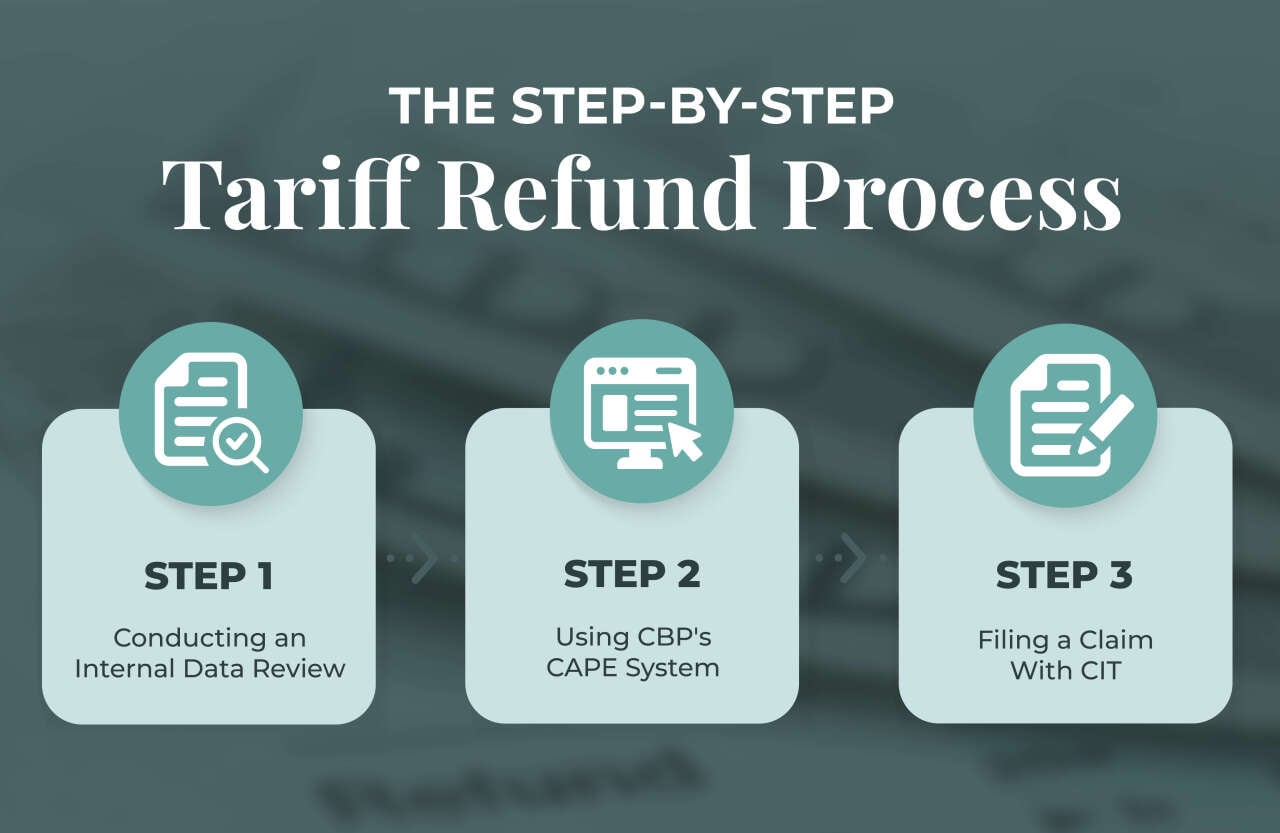
Claiming a refund requires careful coordination and attention to detail. It’s beneficial to use a tax professional to support you through the IRS or state taxing entity appeals process, as each step builds on the previous one, making thorough preparation crucial.
Step 1: Conducting an Internal Data Review
The first step is conducting an internal import data review. Note entry numbers, dates and the amount of tariffs paid. This process involves gathering all relevant documentation for import entries that were subject to IEEPA tariffs, including:
Analyze this data to identify entries subject to IEEPA tariffs. During this step, you may uncover discrepancies or classification issues that need to be addressed before you file a claim. For larger organizations, cross-functional collaboration is key to capturing all relevant imports.
Step 2: Using CBP’s CAPE System
CBP’s ACE system is the primary interface for filing refunds and post-summary corrections once you’ve collected the relevant paperwork. Through ACE, businesses can:
Businesses unfamiliar with ACE may rely on customs brokers or internal compliance specialists to manage filings. Regardless of who submits the claim, the IOR remains responsible for its accuracy. To file through CAPE, your business should:
CAPE supports bulk submissions, which are useful for businesses managing large volumes of entries. Built-in validation tools help identify inconsistencies before submission, reducing the likelihood of delays.
Step 3: Filing a Claim With CIT
In some cases, administrative remedies aren’t enough. Businesses may need to file a claim with the CIT when:
Filing with the CIT involves a more formal process, including legal pleadings and adherence to court procedures. While this route can extend timelines, it may be necessary to preserve the right to recover funds. With CIT claims, you’ll face additional statutory limits. These deadlines are often measured from the date of a denied protest or other triggering event. Missing these deadlines can permanently bar recovery, regardless of the claim’s merits.
The earliest deadline for commencing litigation is Feb. 3, 2027, which is two years from the date of the first IEEPA tariff payments.
It’s essential to act quickly. Refund opportunities are tied to strict deadlines, and missing them can mean missing out on recovering funds. Key timelines include:
The statutes of limitations vary based on the procedural path. To manage this, businesses should map each entry against its applicable deadlines. A proactive approach ensures that no viable claims are lost due to timing constraints. Under 28 U.S.C. § 2636(i), you have a two-year statute of limitations for filing in the CIT under residual jurisdiction. Accrual dates start from the tariff payment date, which may include:
Securing a refund is only part of the opportunity. Managing the financial impact requires careful planning.
You should evaluate how the recovery will affect your business’s current and prior reporting periods. Key tax considerations include:
Reinvestment strategy also plays a key role in maximizing the value of your recovered funds. You may consider allocating capital toward supply chain diversification, technology upgrades or operational expansion.
Maintaining strong trade compliance practices is equally important. This includes regularly reviewing tariff classifications, monitoring regulatory changes and documenting import processes. Strengthened compliance reduces future risk and positions the business to respond quickly to similar opportunities. This process includes:
A disciplined approach ensures that refunds are not only recovered but also used to support long-term growth and stability.
IEEPA tariff refunds are a good opportunity for eligible importers. The Supreme Court’s decision has opened the door to recovering substantial funds, but success depends on timely and informed action.
By moving quickly, understanding eligibility, identifying affected imports and following the right recovery pathways, your business can position itself to claim what it’s owed. The process demands diligence, but the potential rewards justify this effort.
This story was produced by Polston Tax and reviewed and distributed by Stacker.





Reader Comments(0)