
The people's voice of reason


The people's voice of reason
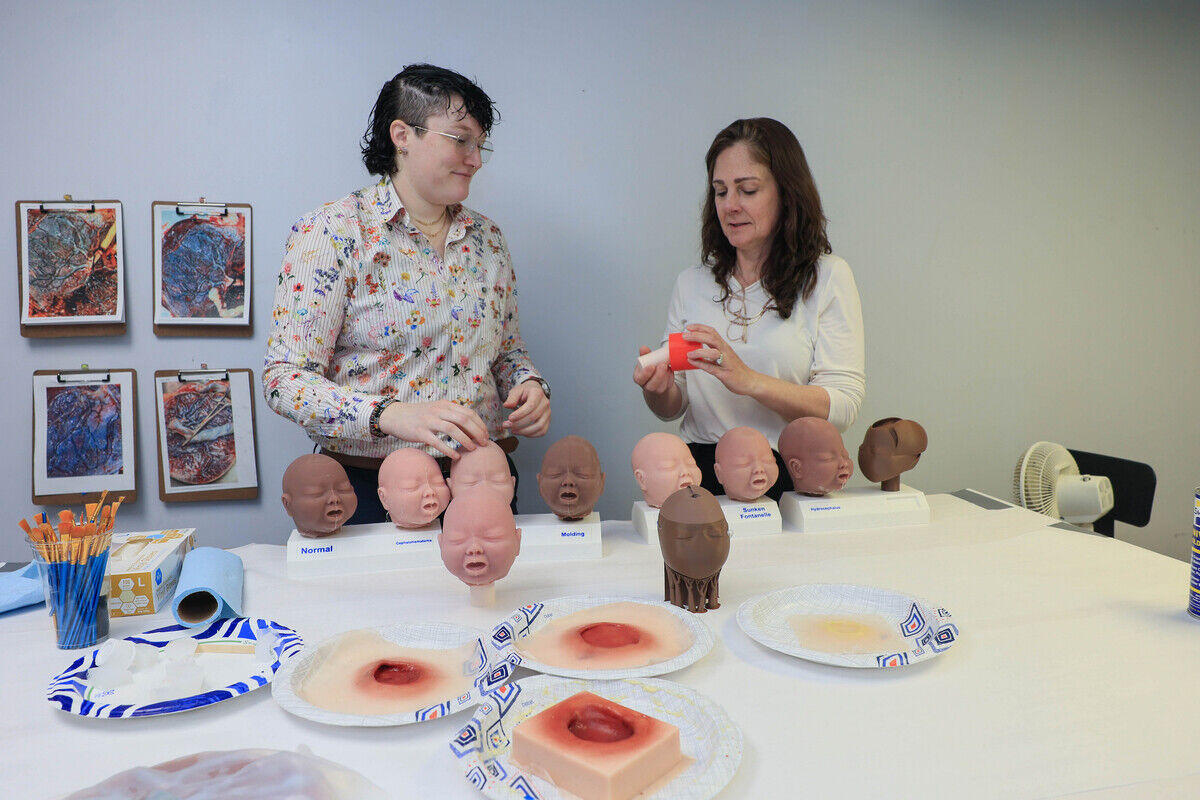
Delaney Enlow, left, a research engineer with the Model Exchange and Development of Nursing and Engineering Technologies (MEDNET) in the Systems Management and Production (SMAP) Center at The University of Alabama in Huntsville (UAH) shows a variety of anatomically correct infant head models to Megan Murphy Wolf, chief operating officer of the Zabara Foundation, during a center tour on April 15, 2026. Wolf holds a model joint that will be used to connect the heads to the body of the training simulator and enable realistic movement. SMAP has received a $50,000 grant from the Zabara Foundation to support the development of nursing training devices for the UAH College of Nursing.
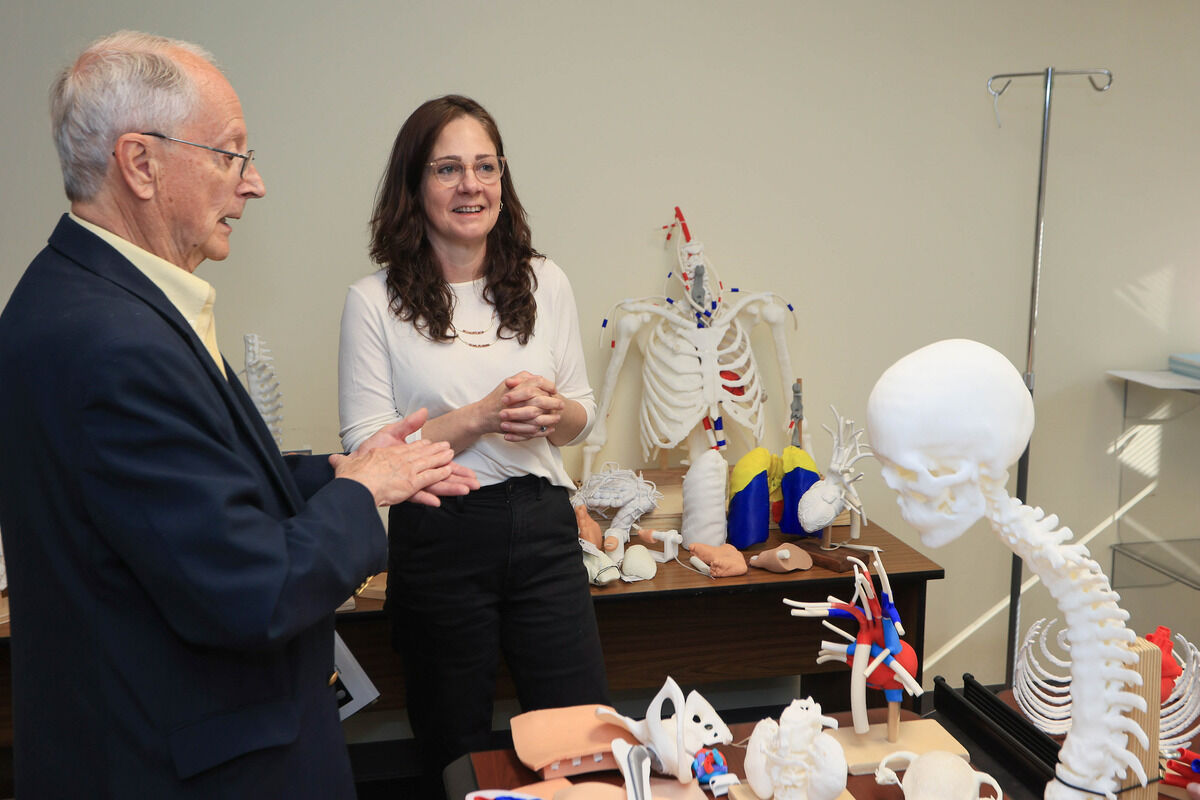
Dr. Bernard Schroer, left, professor emeritus in the UAH College of Engineering and a volunteer with SMAP's MEDNET program, describes some of the training models created in partnership with the UAH College of Nursing to Megan Murphy Wolf of the Zabara Foundation.
HUNTSVILLE, Ala. (JUN 29, 2026) – A long-running collaboration between engineers and nurses at The University of Alabama in Huntsville (UAH) is expanding into state-of-the-art infant training simulators with the support of a $50,000 grant from the Zabara Foundation. UAH is a part of The University of Alabama System.
"At the Zabara Foundation, we're focused on supporting smart, effective solutions that move the needle on patient outcomes," said Chief Operating Officer Megan Murphy Wolf.
She visited UAH in April and toured the Systems Management and Production (SMAP) Center and the College of Nursing to see the latest results of their cutting-edge partnership.
"What the SMAP Center is building isn't just innovative – it's the kind of work that drives best practices across the field," Wolf said. "When nursing students train on high-fidelity infant simulators, they graduate better prepared, and that preparation creates measurable, meaningful change for patients and families. That's exactly the impact we're glad to support."
Since 2020, SMAP, UAH's largest research center, has developed and manufactured a wide range of realistic training models to help nursing students practice essential skills for treating patients. Using 3D printers and silicone casting techniques, SMAP has created more than 40 models, including IV pads, catheterization trainers and biopsy pads, which offer higher quality at lower cost than models on the market.
The educational benefits flow both ways. When SMAP's engineering students communicate with nursing faculty and students to understand model requirements, take feedback and refine their products, they learn how to work effectively with customers.
The SMAP/Nursing collaboration has been so successful that it led to the creation of the Model Exchange and Development of Nursing and Engineering Technologies (MEDNET), which shares these resources with a network of county technical schools and other healthcare organizations. All models and casting instructions are available for free for non-commercial use.
"The Zabara Foundation grant has enabled us to transfer our developed training devices to other nursing programs," said Dr. Bernard Schroer, professor emeritus in the UAH College of Engineering. Before his retirement, he was UAH associate vice president of research; now he volunteers with MEDNET.
"Working with the Alabama Community College System, we have launched a pilot program with five community colleges in North Alabama," he said. "The baby will be one of the devices we have designed and fabricated that will be transferred in the pilot program. After the pilot program, we are hopeful to provide our technology to all nursing programs in Alabama."
Delaney Enlow was one of SMAP's engineering students before she graduated from UAH in 2025. Now a research engineer with MEDNET, she showed Wolf a sample of the different types of infant head models they've developed and explained why variety is so important.
"The first three heads that we did in phase one represent birth traumas that can happen when the baby comes out and a lot of the nurses have struggles recognizing," Enlow said. "The other three were intracranial pressure issues. Both of those can often lead to bigger problems. This is a more awareness, more intervention type of approach."
It's also important for nursing students to be able to recognize cranial variations that fall within the normal range.
"There are some variations associated with birth, and then there are some variations associated with maturity or prematurity," said Dr. Darlene Showalter, clinical associate professor and Doctor of Nursing Practice program coordinator in the College of Nursing. She's the primary customer for the infant simulators.
"We want to make sure that our students can differentiate those so that they can make solid and safe clinical decisions, so they can engage with the parents and be able to support them in their knowledge journey."
One head model has a cone shape. That might concern the parents, but it's in the normal range, and a well-trained nurse can reassure them.
Showalter appreciates the high level of accuracy in shape, color and feel achieved by MEDNET's engineers.
"Delaney has to be an artist to make this happen," Showalter said. "She comes here to check out colors and textures and makes sure the sheen is exactly right. Realism makes a lot of difference when doing a simulation and when practicing. It really breaks the train of thought when something doesn't look real."
Although UAH nursing students are exposed to real mothers and babies in a hospital setting, there's no guarantee of equal training.
"You might have seven births in one day and zero the next day," Showalter said. "However, we can level out that playing field and make sure that everybody gets the same experience in a controlled environment with simulation."
This combination of engineering innovation and nursing devotion impressed Wolf.
"Walking through the SMAP Center, you immediately understand why this work matters," she said. "The team has created an environment where nursing students can practice life-saving skills in realistic, low-stakes conditions – and that changes outcomes for real patients. The College of Nursing at UAH is doing vital work, and the dedication of the faculty and students there is evident in everything they do. We're proud to support a program that takes training this seriously."







Reader Comments(0)