
The people's voice of reason


The people's voice of reason

An employee finally decides to ask for help. Maybe their work has slowed. Maybe they have been missing sleep. Maybe they have been holding it together for months and can feel that changing.
For an HR or benefits leader, that moment matters. The first experience an employee has with a mental health benefit can determine whether they get routed to the right care, wait too long, disengage, or start over later.
That is why a mental health assessment deserves more attention than it often gets in vendor evaluations. It is more than a questionnaire. Done well, it is the clinical and operational front door to the entire mental health journey, Spring Health reports.
A mental health assessment is a structured way to understand a person's symptoms, goals, functioning, preferences, and level of need. It may include self-reported questions, validated screening tools, clinical interviews, or ongoing symptom measures used during care.
In a workplace mental health benefit, the assessment has a practical job: to help each employee find the right next step. That next step may be therapy, coaching, medication management, self-guided support, specialty care, crisis support, social-needs resources, or help from a trained navigator.
A strong assessment does not ask questions for their own sake. It uses the answers to guide care.
Employers are not responsible for diagnosing employees. They can be responsible for offering a benefit that identifies needs safely, route employees appropriately, and show whether the program is working.
That makes assessment quality a business issue as well as a clinical one. A weak assessment can create friction at the exact moment someone is ready to act. A stronger assessment can reduce trial and error, improve the first match, flag risk earlier, and measure progress over time.
For benefits leaders, the question is not only whether a vendor offers a mental health assessment online. The better question is what happens after someone completes it.
Assessment questions for mental health should help a care team understand both symptoms and context. A practical workplace assessment usually needs to cover:
The best questions are clinically grounded, easy to complete, and connected to a clear action. Employees should not have to answer a long questionnaire and then still figure out care on their own.
Many mental health assessment tools are validated screeners that help identify symptoms or severity. They do not replace a clinician's judgment, but they can support earlier identification and better routing when used appropriately.
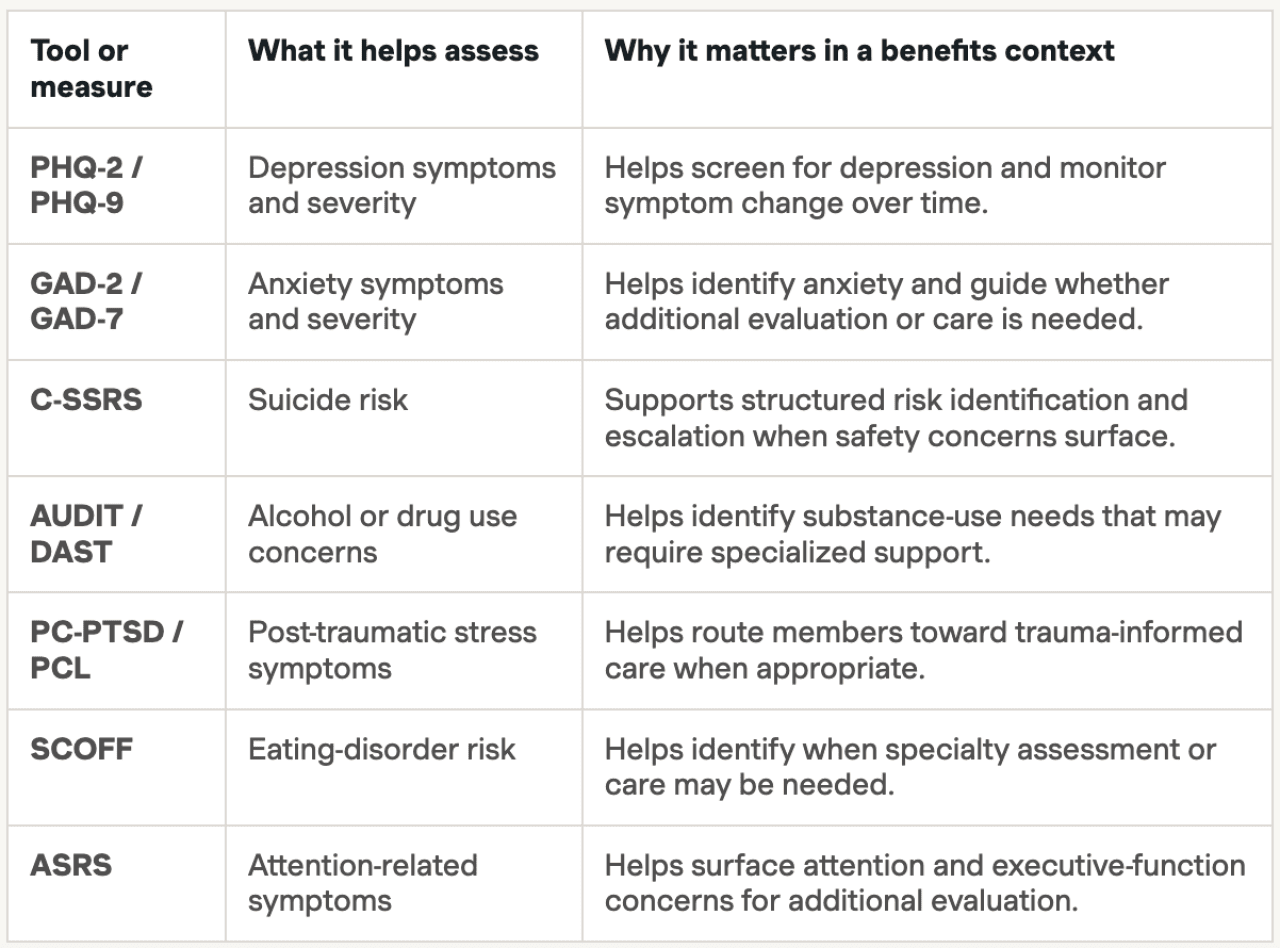
The value lies in using validated screeners intelligently, with dynamic branching that asks more when the member's answers suggest more support may be needed.
Digital access can make assessment easier, faster, and more private for employees. But an online form is not enough. HR leaders should evaluate whether the assessment is built into a care model that can act on the information it collects.
1. Clinical validation
Ask whether the assessment uses validated mental health assessment tools and whether those tools are appropriate for the population, geography, and care model. The assessment should screen for common needs without overclaiming a diagnosis.
2. Dynamic branching
A strong assessment should adapt based on the member's answers.
3. Safety protocols
If an assessment asks about suicide risk or other high-acuity needs, the vendor must have clear clinical escalation pathways.
4. Care routing
The assessment should inform the next step in care That can include therapy, coaching, medication management, crisis support, specialty programs, social-needs support, or navigator outreach.
5. Personalization and matching
Assessment data should improve the care match. The goal is a lasting care relationship, not just the first open appointment.
6. Ongoing measurement
Assessment should continue during care. Measurement-based care helps providers and care teams see whether symptoms are improving and adjust the care plan when they are not.
7. Reporting for employers
Employers should receive aggregate, de-identified insight into engagement, access, outcomes, and program opportunities through a reporting layer. They should not receive individual clinical details.
8. Privacy and employee trust
Employees are more likely to complete an assessment when they understand how their information is used and protected. A vendor should explain what is confidential, what is aggregated, and how assessment data supports care.
Spring Health's published outcomes show why that model matters.
Navigation also affects action. In a published PLOS One study, care navigation was associated with 7.1 times higher odds of starting therapy, 36%more sessions attended, and added symptom improvement for the highest-severity members.
Matching matters too. Members matched to an algorithm-recommended therapist improved up to 8.5% faster and recovered at higher rates than those who self-selected, at 11%-13% lower cost per improved member.
What is a mental health assessment?
A mental health assessment is a structured way to understand symptoms, goals, functioning, preferences, and level of need. In a workplace benefit, it should help route employees to the right care, not simply produce a score.
What are common mental health assessment tools?
Common tools include PHQ-2 and PHQ-9 for depression, GAD-2 and GAD-7 for anxiety, C-SSRS for suicide-risk screening, and other validated screeners for trauma, substance use, eating concerns, attention, and mood.
Can employees take a mental health assessment online?
Yes. Many workplace mental health benefits begin with an online assessment. The assessment should be clinically grounded, easy to complete, connected to a care plan, and supported by appropriate privacy and safety protocols.
What assessment questions for mental health should employers expect?
Assessment questions should cover goals, current symptoms, functioning, safety signals, care preferences, social needs, and progress over time. HR should not see individual answers, but employers should receive aggregate, de-identified program insights.
How do mental health assessments influence outcomes?
Assessments influence outcomes when they guide matching, navigation, measurement, and care-plan adjustments. They help members start with the right level of support and give care teams the information needed to adapt care over time.
This story was produced by Spring Health and reviewed and distributed by Stacker.





Reader Comments(0)