
The people's voice of reason


The people's voice of reason
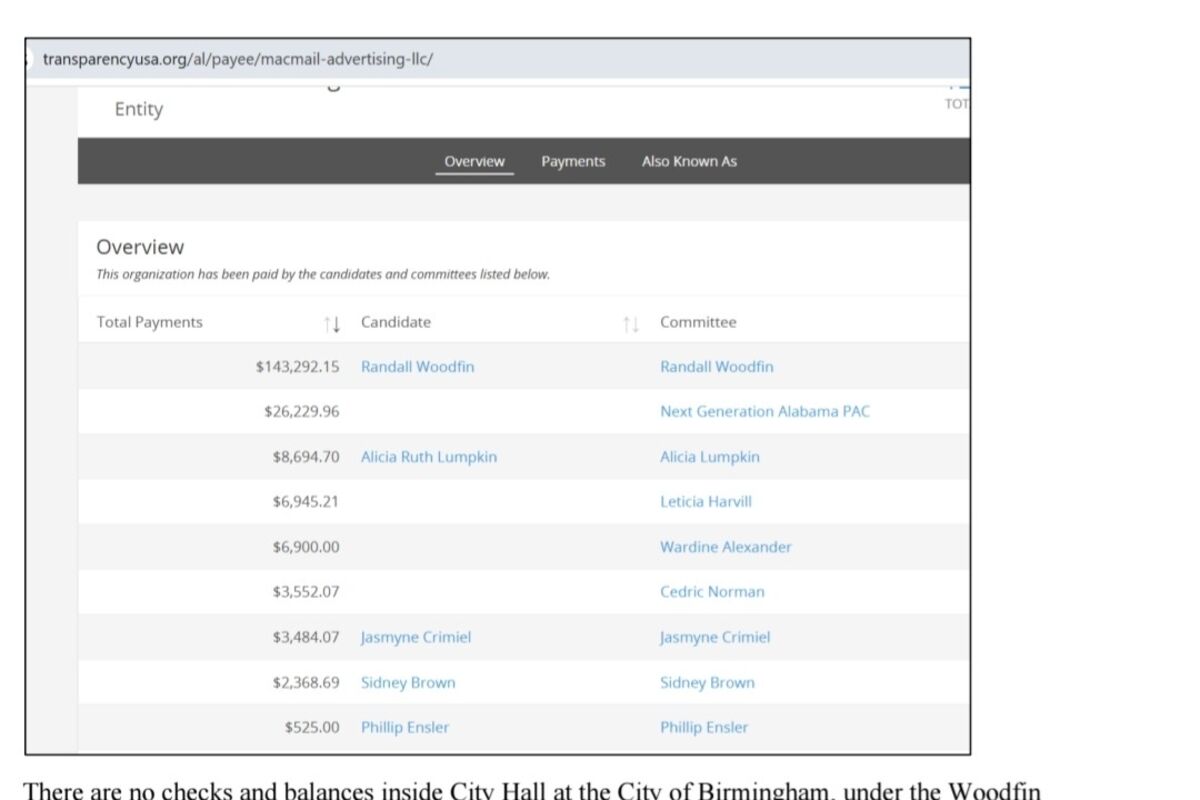
In my first report, I highlighted the foundation of a contracting pipeline through which the Magic City mayor's office funnels municipal revenue by outsourcing city projects to private firms. But how does this translate into political capital? The answer lies within a special-interest group called the North Alabama PAC.
The Circular System
We are not viewing isolated instances of mismanagement; we are watching a self-sustaining cycle that appears to circumvent several core protections in Alabama law:
• Public Sourcing: Government funds and city staff are directed toward strategic projects managed by outside companies.
• Private Capture: Those same entities-tied to the core figures within city hall-are effectively subsidized by the public.
• Political Output: Income generated from these government agreements flows into the Next Generation Alabama PAC, which then funds the partisan objectives and Woodfin's political machine.
The Legal Thresholds
The "firewall" the administration claims exists between private business and political expenditures invites intense scrutiny under three primary pillars of Alabama law:
• Alabama Ethics Act (Ala. Code § 36-25-5): This law prohibits public officials from using their position to obtain personal gain for any business with which they are associated. It further forbids the use of public time, labor, or property for the private or business benefit of an official or their campaign committee. By mapping common personnel between city contractors and the administration, this system raises questions regarding whether official influence is being used to secure private (and political) outcomes.
• Corrupt Influence (Ala. Code § 36-25-7): This statute makes it illegal to solicit or receive anything of value for the purpose of corruptly influencing official action-defined as acting voluntarily and dishonestly to accomplish an unlawful end or using unlawful means to reach a result. The cycle of contracts leading to political contributions suggests a system that may be operating outside these bounds.
• Competitive Bid Law (Ala. Code § 41-16-54): To ensure public funds are spent efficiently, the state requires competitive bidding for significant contracts. If the administration is utilizing "private" firms to bypass these thresholds or splitting projects to avoid oversight, it risks direct violation of state fiscal safeguards designed to prevent cronyism.
• Fair Campaign Practices Act (Ala. Code § 17-5-3): While PACs are distinct entities, they are subject to strict reporting and segregation requirements. If funds from municipal contractors are being funneled into these committees to obscure the true source of campaign financing, it challenges the transparency mandates of the FCPA.
The Reality for the Public
This system ensures that if a firm or organization wants to do business with the municipality, it must exist within the orbit of the mayor's office. This isn't just about procurement; it is a calculated grab for dominance. For the average resident, this means your tax contributions are being used to maintain a mechanism that actively works to keep current city leaders in office, regardless of the price paid by the public interest.
Christopher M Peeks
Reporter and Columnist
Alabama Political Contributor
First reported on the Alabama Political Contributor website








Reader Comments(0)