
The people's voice of reason


The people's voice of reason

The US job market is showing signs of stabilization after several years of uneven hiring and uncertainty, according to a new Q3 job forecast. Published in a job market report from professional services company Toptal, the forecast projects conditions for several key areas of the U.S. labor market: all nonfarm job openings, professional services job openings, and information services (i.e., technology) job openings.
Because the company’s talent network of 30,000 professionals is fully distributed and focused on experienced workers, the report also includes a dedicated forecast for this segment of workers.
Several factors may be contributing to the improving outlook. The report points to easing energy prices, relative resilience in the U.S economy, and the release of pent-up hiring demand after a period of elevated uncertainty.
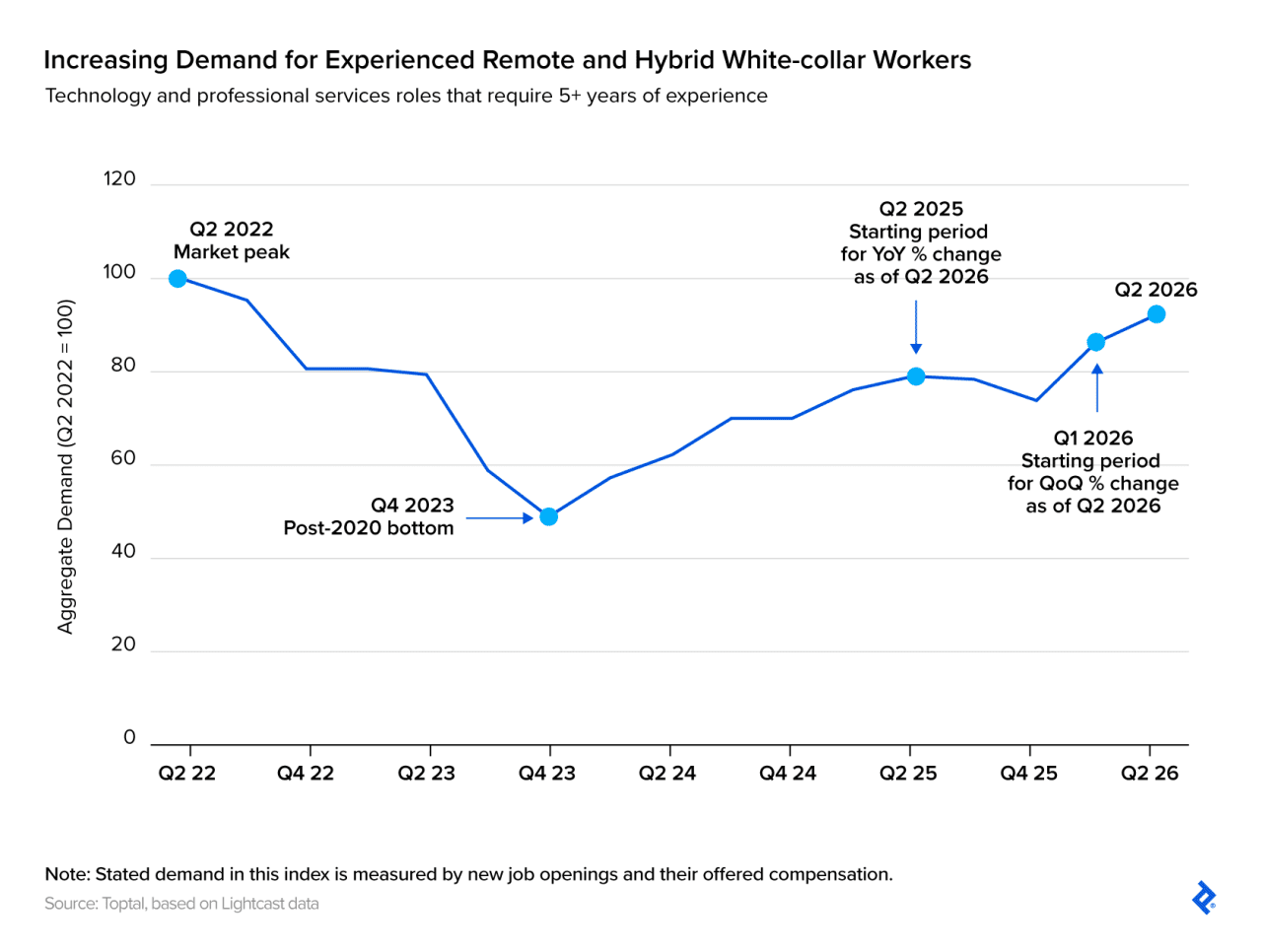
In technology, employers are also gaining a more practical understanding of where AI delivers value and where human expertise remains essential, leading to renewed hiring as organizations refine their workforce strategies.
Toptal’s predictive model draws on 16 years of remote and hybrid job posting data from Lightcast, alongside several macroeconomic indicators that have historically tracked labor market performance.
One of those indicators is the U-6 unemployment rate, which captures both unemployed and underemployed workers. Unlike the more widely cited U-3 unemployment rate, the U-6 includes people working part-time for economic reasons and those who have stopped actively searching for employment but still want work, providing a broader measure of labor market conditions.
The model also incorporates high-yield credit spreads, hiring rates, and inflation-adjusted GDP. Together, these indicators help capture shifts in business confidence, employer hiring behavior, and overall economic activity.
The resulting projections are then compared against several years of Toptal’s own client demand for experienced remote and hybrid professionals. According to the report, distributed hiring often serves as an early signal of broader labor market movements, because companies frequently use remote talent to address immediate needs or launch new initiatives before expanding to permanent hiring.
The report cautions that the projections should be viewed as directional rather than definitive. Although the model accounts for historical labor market relationships and current economic conditions, the U.S. job market remains uncertain, and hiring outcomes will continue to be influenced by factors not captured in the analysis. It also notes that while remote and hybrid hiring patterns have shown a strong correlation with broader market movements, additional research is needed to better understand the relationship between those trends.
The forecast uses an ordered logistic regression model, which takes a set of input variables and uses historical data to estimate the relationship between those inputs and a particular outcome. The model’s directional projections are then compared against Toptal’s own client demand data for remote and hybrid professionals, providing a cross-check between modeled signals and observed market activity. Inputs include 16 years of remote and hybrid job posting data from Lightcast, the U-6 unemployment rate, high-yield credit spreads, hiring rates, and inflation-adjusted GDP.
This story was produced by Toptal and reviewed and distributed by Stacker.







Reader Comments(0)