
The people's voice of reason


The people's voice of reason

Every summer, warm weather drives predictable shifts in consumer behavior: Families travel, airports fill up, and buildings crank up their cooling systems. The Motley Fool tested whether that seasonal pattern actually translates into stock market gains.
Thirty-six publicly traded companies with a genuine reason to do more business in the summer — spanning hotels, airlines, cruise lines, HVAC and cooling providers, and similar weather-dependent industries — were put through a proprietary 10-year screen, using data from the end of 2015 through the end of 2025. Each company had to clear four tests:
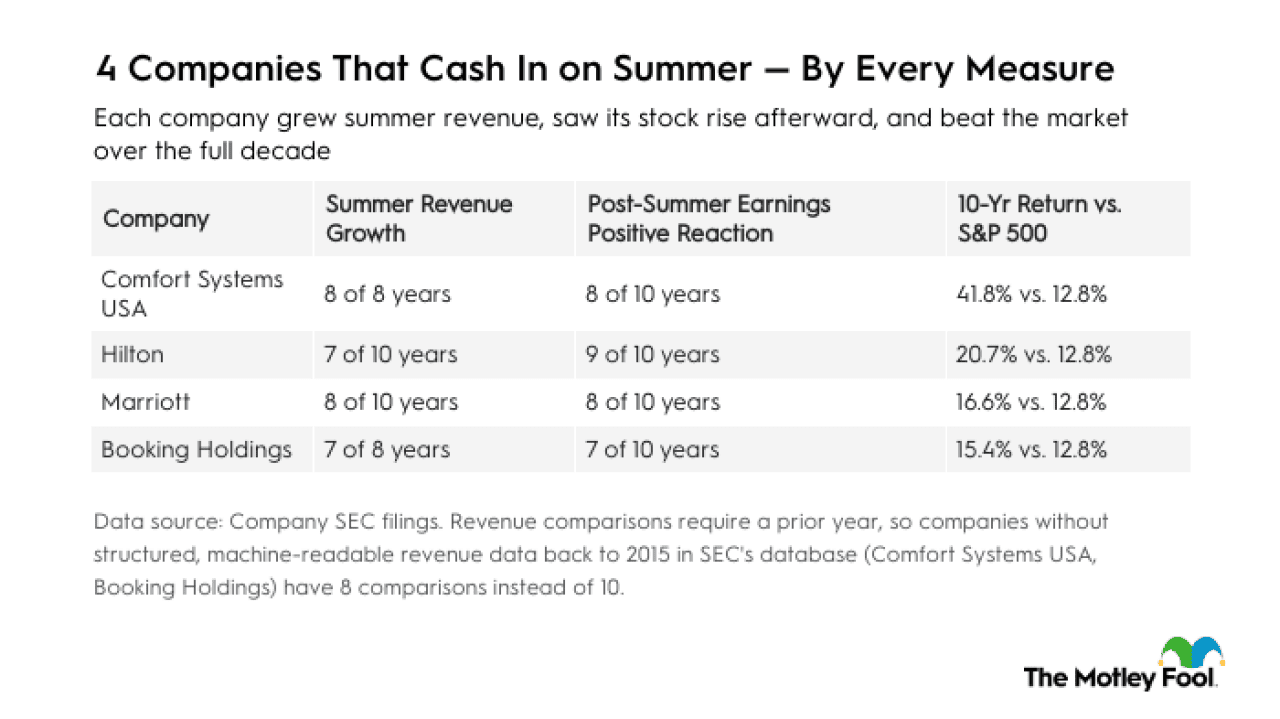
Only four stocks cleared all four requirements: Hilton Worldwide, Marriott International, Booking Holdings, and Comfort Systems USA.
The gap between 36 candidates and four winners points to a crucial truth for long-term investors: While seasonal growth is common across certain industries, converting that brief revenue bump into market-beating, long-term returns is quite rare. Treating seasonal patterns as a substitute for deep business research is a dangerous trap. For further research, The Motley Fool has a foundational guide on how to invest in summer stocks.
Key Points
Hilton Worldwide and Marriott International didn't just pass this screen; they outpaced the S&P 500 in at least eight of the last 10 summers. This success comes down to a core industry metric called revenue per available room (RevPAR). From June through August, hotels get a double win: Room occupancy climbs at the exact same time that management can raise nightly prices. This allows these giants to squeeze heightened profits out of the properties they already own.
The hard numbers show exactly how powerful this peak season can be.
Both converted that seasonal surge into real stock market gains:
This outpaced the historical average stock market return, proving that peak operational quarters can feed substantial long-term returns.
Both companies share identical pricing tailwinds, yet Hilton's post-earnings stock reaction is historically stronger. One likely reason: Hilton's asset-light, franchise-fee-driven model may let it convert summer demand into higher-margin earnings surprises that catch Wall Street off guard.
The same wave of leisure travel that fills Hilton and Marriott's properties also drives Booking Holdings, just from a different point in the transaction. As a digital travel platform, Booking captures the front-end planning and booking phase of the summer rush, collecting its toll before the traveler ever reaches a lobby or a plane.
Booking's 70% post-earnings hit rate is lower than the hotels' 80%-90%, despite tracking the same consumer travel dollar.
As an asset-light booking platform, Booking avoids the heavy capital costs of physical buildings, but also lacks a hotel chain's real-estate-backed defensive foundation.
Wall Street tends to price this asset-light volatility with more caution right after earnings are reported, showing that the exact same consumer tailwind can trigger very different stock market behaviors depending on the business model.
Comfort Systems USA, a commercial HVAC, heating, and cooling installation business, contrasts with the travel names on this list, and its numbers are the most airtight of all 36 companies screened:
Compared to the historical average stock market return, this run proves that the least intuitive name on the list was the group's biggest wealth compounder.
The secret is that Comfort Systems USA operates on a need-driven mechanism, not a want-driven one. Commercial cooling isn't an optional luxury.
While a family can easily defer a summer vacation when inflation bites, a hospital, factory, or hotel can't turn off its air conditioning in July without shutting down operations entirely. It's a great reminder that boring business models built on nondiscretionary corporate needs can be durable engines for long-term compounding.
The ultimate danger of seasonal investing becomes obvious when looking at the near misses. In other words, stocks that generated great short-term excitement but underperformed over the long haul.
Four of the five stocks that fell into this trap were the major domestic airlines: Delta Air Lines, American Airlines Group, United Airlines Holdings, and Southwest Airlines.
Each of these four airlines checked the boxes for real summer revenue growth and a positive post-earnings stock reaction in the immediate two-month window, yet all four ultimately lagged the S&P 500 over the 2015 to 2025 decade.
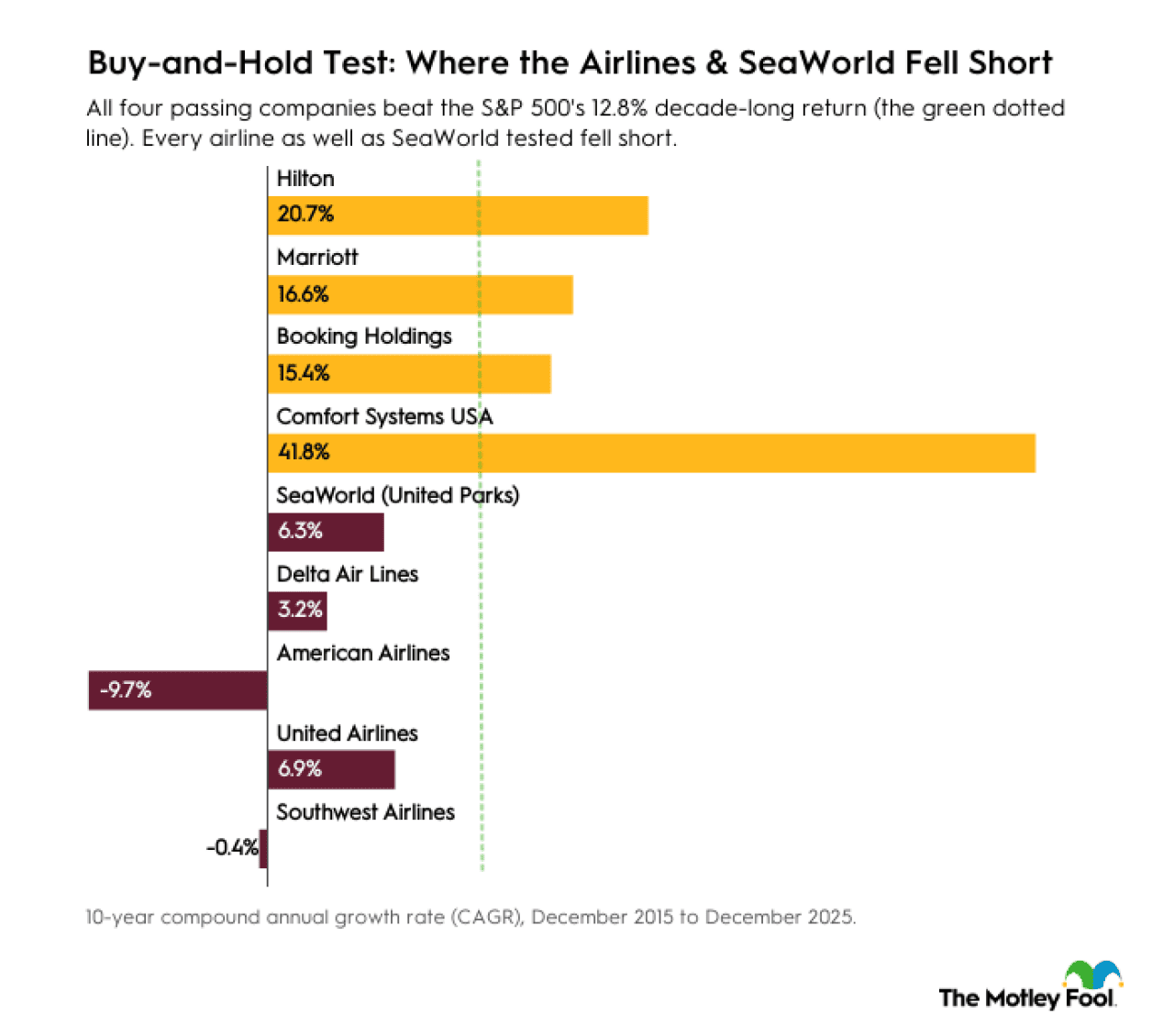
Airlines are notoriously capital-intensive businesses burdened by volatile fuel costs, heavy labor expenses, and intense price competition. The headwinds inherent to the airline business quietly eroded the wealth generated during their peak summer quarters, leaving long-term buy-and-hold investors grounded while their near-term trading peers celebrated temporary pops.
This underperformance also likely stems from a practical operational choke point. To capture lucrative summer travel surges, airlines must maintain capacity year-round. The heavy fleet and specialized flight crews required to handle peak July demand must still be paid for during low-demand winter quarters, creating an ongoing capital leakage that consistently eats away at peak seasonal wins.
The fifth near-miss was SeaWorld Entertainment (rebranded during this period to United Parks & Resorts, which represents a different kind of near-miss. Its stock reacted well in the two months after summer earnings were released, but it lacked the underlying revenue foundation that the airlines possessed.
Over the 10 years tested, its actual summer revenue growth hit rate was a shaky 30%. Because United Parks & Resorts never established the reliable revenue pattern that its post-earnings stock reactions suggested, it serves as a warning that short-term market enthusiasm can frequently mask volatile business fundamentals.
The data reveals a stark reality: Obvious seasonal plays don't automatically deliver market-beating returns over the long haul. It's incredibly easy for a temporary summer spike or a quick post-earnings pop to blind investors to heavy debt, bad industry economics, or other flaws.
The four winners on this list didn't win just because the sun came out. They won because their high-margin business models let them extract massive value from that demand. Hilton and Marriott used asset-light franchising to let partners shoulder the real estate risks while they collected steady fees. Booking Holdings dominated digital real estate to lock down global traffic, and Comfort Systems anchored itself to non-discretionary corporate infrastructure.
When you're screening businesses for the next decade, look past seasonal peaks and focus entirely on pricing power that consistently churns out cash and profits. Seasonality is a fine starting point for stock research, but true wealth compounding requires durable competitive advantages and financial health that can withstand all four seasons.
The Motley Fool's 2026 summer stocks screen was designed to measure whether companies with a documented reason to do more business in summer show that pattern in reported revenue, in stock performance after earnings, and in long-term returns.
The screen tested 36 publicly traded companies in industries with a genuine, documented summer-demand mechanism (hotels, airlines, cruise lines, HVAC and cooling, and similar warm-weather-dependent industries) against four questions using 10 years of data, 2016 through 2025. Revenue figures came directly from each company's SEC 10-Q and 10-K filings, not third-party estimates. Stock and S&P 500 price data came from S&P Global.
A company passed only if its revenue during summer months grew year over year in at least six of the 10 years tested, its stock beat the S&P 500 in at least six of the 10 years following its summer earnings report, the average size of that outperformance was positive, and its actual 10-year price growth from the end of 2015 to the end of 2025 beat the S&P 500's growth over the same period. Companies with fewer than eight years of usable public trading history were excluded.
Past performance does not predict future results, and a stock passing these tests describes a historical pattern over one specific 10-year period. It is not a guarantee that the pattern continues, and this article is not investment advice.
This story was produced by The Motley Fool and reviewed and distributed by Stacker.






Reader Comments(0)