
The people's voice of reason


The people's voice of reason
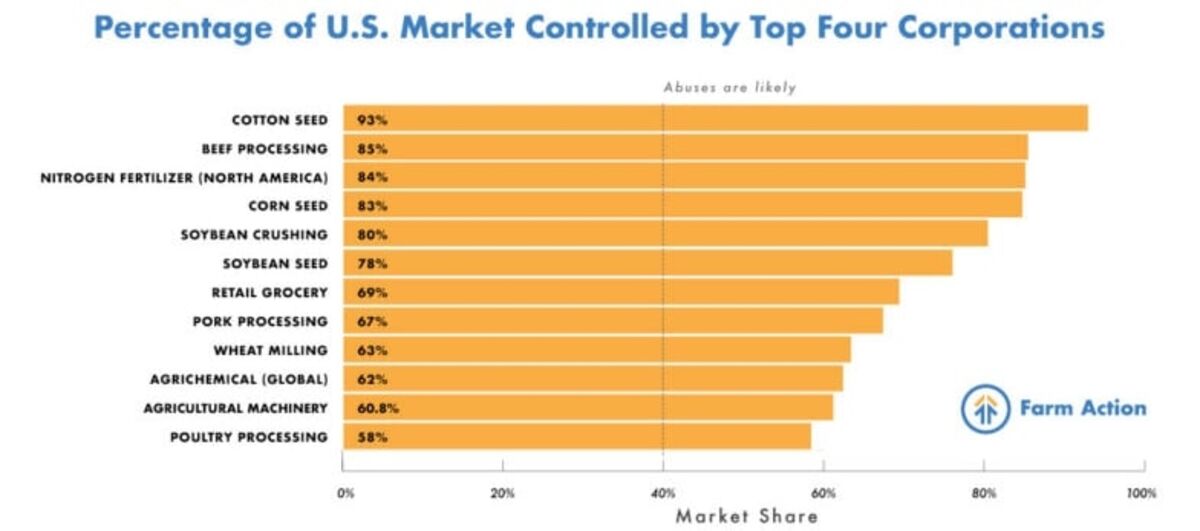
Everyday the average American is feeling their wallet get thinner and thinner as they purchase gasoline at over three dollars a gallon and the price of meat at the grocery store goes up every single week. However, the average American is not alone in experiencing higher meat prices, for even McDonald's reached the point of frustration in having to pay high prices for meat. With McDonald's filing suit in federal court in October of 2024 against the "Big Four". The "Big Four" being the industry term for Tyson, JBS, Cargill, and National Beef Packing Co. As those four companies control 85% of the beef market in the USA. With McDonald's alleging in their suit that the Big Four have become, "a monopoly in which direct purchasers were forced to buy at prices dictated by (the meat packers)."
While the McDonald's suit against the Big Four has yet to be decided, the Farm Action Fund is encouraging people to sign a petition to break up the Big Meat monopoly. As the Missouri based group stands with Missouri's state lawmakers to call the meatpackers to task. The nonpartisan, farmer-led organization states on its website that its purpose is to expose how monopoly power is shaping the food system in the USA and how it is time for rural America to hold the corporations and government accountable. With Farm Action Fund emphasizing that "This isn't about left or right. It's about whether our economy works for people - or for monopolies." With the Farm Action Fund further describing the Big Four as "Kings over the necessaries of life." For currently, the Big Four control 85% of the beef market in the USA, four corporations control 66% of the pork market in the USA, and four corporations dominate 50 to 60% of the poultry market in the USA.
The reason having the Big Four controlling 85% of the beef market in the USA is concerning is because with just the four main buyers for their cattle, ranchers have very little, if any at all, bargaining power. Rather than being able to bargain for a fair price for their livestock, the cattle ranchers are forced to "take-it-or-leave-it" with the Big Four. With some reports showing that while beef prices have steadily increased in the grocery stores over the past few years, up 30% since 2023, cattle ranchers now receive less than 30 cents of every retail beef dollar. Whereas, historically, cattle ranchers earned 60 cents of every retail beef dollar.
Interestingly, enough, the Big Four corporations that dominate 85% of the beef market in the USA aren't even all American based companies. JBS S. A. is the largest meat processing company in the world and one of the Big Four corporations dominating the beef market in the USA. It is a Brazilian multinational corporation that is headquartered globally in Brazil and the Netherlands. While the National Beef Packing Company LLC is a Big Four beef processor headquartered in Kansas City, Missouri, it is also dominated by Brazilian interests. As Marfrig Global Foods, a major Brazilian protein producer, owns 81.7% of the stock in National Beef. Marfrig Global Foods is the second-largest beef producer in the world.
The other two companies that comprise the Big Four are two companies that were founded in the U.S. and are still heavily influenced by the founding families. Tyson Foods maintains its headquarters in Springdale, Arkansas and was founded by John W. Tyson in 1935. While the company is publicly traded on the New York Stock Exchange, the Tyson family still owns roughly 70% of the voting stock of Tyson Foods. Cargill is a privately owned Big Four company that was founded by William Wallace Cargill. The company is still owned by the Cargill-MacMillan family.
Some advocates support investing in regional slaughterhouses and meat processors to give ranchers another place to take their cattle besides the ones dominated by the Big Four. With the regional slaughterhouses and meat processors providing consumers with another place to purchase their beef, as well. While some groups have identified seven policy priorities that they think can improve the meat situation in the USA. With those seven policy priorities being, use federal food purchasing to strengthen local markets, advance competition and fair markets, rebuild local and regional food supply chains, expand risk management for diversified and specialty crop farmers, support organic, regenerative, and soil health practices, oppose federal preemption and pesticide immunity provisions, and restore mandatory country of origin labeling for beef.
In the meantime, Farm Action Fund emphasizes that having, "A handful of corporations control our food system" is not just hurting farmers. But, it is "raising prices, impacting our health, and affecting every American who eats." Those who wish to sign the petition by Farm Action Fund to break up the Big Meat monopoly can do so here: https://farmactionfund.us/break-up-the-big-meat-monopoly.
Luisa Reyes is a Tuscaloosa attorney, poet, piano instructor, reporter, vocalist, and columnist who writes on current affairs, politics, and the arts.





Reader Comments(0)