
The people's voice of reason


The people's voice of reason

A mortgage refinance swaps out your old mortgage with a new one, including a fresh set of terms and interest rate. It may or may not come with financial benefits, depending on your goals and how a new loan quote stacks up against your existing home loan.
In this guide to refinancing a mortgage, SoFi shows how a mortgage refinance works and how you qualify for refinancing. It will walk you through what a refinance application is like and explain how much you can borrow when you refinance. Get the lowdown on the pros and cons of refinancing your mortgage.
Key Points
Refinancing a mortgage is when you get a new mortgage with different terms from the old one. The new lender pays off the original balance you owed, then begins to receive payments from you.
People refinance for a number of reasons, such as qualifying for a lower interest rate, changing the payment term, or cashing out some of their equity. In order to refinance your home loan, you need to submit a full application, get a home appraisal, and pay closing costs.
Consequently, you should have a clear financial goal in mind that makes up for the time and expense of mortgage refinancing.
If you meet these refinancing mortgage requirements, you’re ready to start the qualification process.
You’re ready to apply, but how does mortgage refinancing work? You can check your eligibility and request lender quotes before you get too far into the application. The mortgage preapproval process is an evaluation with a lender that looks at your credit and income to determine whether or not you meet the mortgage refinance requirements.
You can also look at different types of mortgages and cash-out options with estimated monthly payments before you go through underwriting. Once you have a loan quote you like and the loan officer is confident in your preapproval, your application moves to the underwriting process.
At this point, you may be asked to submit extra documentation and you’ll also need to pay for the appraisal. Home appraisal fees range from $200 to $600, and you usually must pay for it at the time the service is completed.
You understand the basic process, but how does refinancing a mortgage work in terms of updating your loan?
Here’s what happens. Depending on your financial situation and your existing mortgage, you may want to change the terms of your home loan (we’ll get to potential reasons to do this in a bit). You typically can’t negotiate those terms with the lender, so you can instead shop around for a new mortgage at different lenders (you can also include your original lender in your search).
Once you find new loan terms that fit your goals, you go through the refinancing application process. After closing, the new lender pays off your mortgage balance with the old lender. Then you start making payments on your new loan according to the updated terms.
Common loan terms that can be changed with a refinanced mortgage include:
On average, it takes 30 to 45 days to refinance a mortgage.
There are several types of mortgage refinancing options, whether you’re trying to lower your cost of living, change your loan term, or get a different rate. Each option depends on your goals and eligibility.
You can use a mortgage refinancing calculator to compare new loan terms to your existing ones. Here is the information you’ll need to see how your payments and overall costs stack up:
Once you enter in all of these details, you’ll see an estimate of your new monthly payment, along with a comparison of any potential savings (or extra costs) in interest over time. Finally, the calculator will show you how many months it will take to recoup the costs of refinancing so you can estimate whether or not you plan to live in the home that long.
With a rate and term refinance, you’ll borrow the same amount as your existing mortgage balance, unless you decide to roll in some closing costs or pay down a lump sum of your loan.
With a cash-out refinance, you can borrow up to 80% of your home’s value. That means you would subtract your outstanding mortgage balance from 80% of the appraised value, and that’s the amount you could borrow — assuming you meet the requirements to handle the new payments.
The cash-out funds can be used however you’d like. Many homeowners use the funds to pay off other debts, pay for home renovations, or cover education expenses. In recent years, the number of cash-out refinances has increased alongside the cost of living in the U.S.
Here are the steps for refinancing a mortgage explained.
After you complete your closing, the new lender pays off your old mortgage balance from the previous lender.
As you consider refinancing your mortgage, here are some benefits and drawbacks to consider.
As you consider refinancing your mortgage, here are some benefits and drawbacks to consider.
Pros:
Cons:
Is mortgage refinancing right for you? There are several scenarios when it makes sense (and some when it doesn’t).
You plan to stay in your home for a while: Make sure you plan to live in your home for at least the next few years. Even if a refinance saves you money, it takes time to recoup the closing costs.
You qualify for a better interest rate: Whether rates have dropped since you got your original mortgage or your credit score has increased since you qualified as a first-time home buyer, you could save money over time.
Your adjustable rate is about to change: Refinancing can help you switch from an adjustable rate to a fixed one. If your rate is about to adjust, compare fixed rate options to see what’s a better deal.
You have an FHA loan and 20% equity: Your annual FHA mortgage insurance premium may be permanent if you took out your original loan after 2013 and your down payment was less than 10%. In this scenario, the only way to stop paying the premium is to refinance.
In addition to the scenarios above, there are a few things you should track when choosing the best time to refinance.
Here are two examples of how it might look to refinance a mortgage:
1. Rate and term refinance: A homeowner with an FHA mortgage reaches 20% equity in his home. Average monthly expenses have increased, so he wants to cut costs in other areas. He pays 0.5% of his mortgage balance each year in FHA mortgage insurance premium, which is about $1,500 on his $300,000 balance. Refinancing to a conventional loan would save $125 per month, and even more if he can get a lower rate.
2. Cash-out refinance: A married couple has lived in their home for seven years. Over that time, their home value has increased from $250,000 to $500,000, leaving them with more than $250,000 in equity after making payments over the years. Their daughter is about to head to college and they want to tap into their equity to help pay for it. But since their mortgage rate is fixed at 3.99%, they end up opting for a home equity line of credit (HELOC) instead of a cash-out refinance in order to preserve that lower rate.
There are a number of costs involved with refinancing a mortgage, including:
Your original mortgage lender may also charge a prepayment penalty for closing the loan early. This fee is rare, but it’s still worth researching so you’re not surprised. If you have a jumbo loan, you may also have some extra-large costs associated with refinancing so carefully consider what you will spend on a refinance vs. what you will save.
To get the best rates and lowest overall cost in a refinance, compare at least three different lenders. Remember, even if a simple interest rate is lower, hefty lender fees could negate any savings.
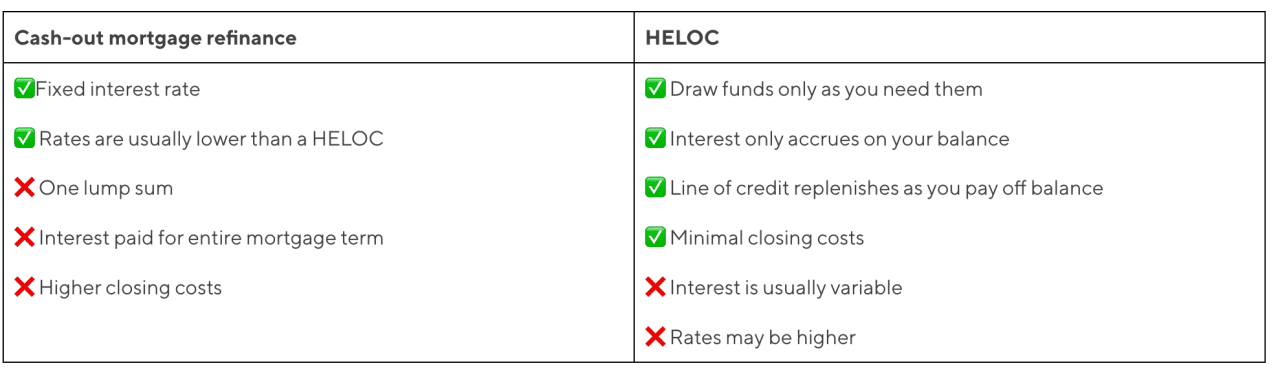
Both a cash-out refinance and a home equity line of credit (HELOC) allow you to tap into your home’s value, but there are different pros and cons to each option. One key difference is that a HELOC allows you to borrow only as much as you need at any given time, while a cash-out refi will deliver one lump sum payment. Here’s how the differences lineup:
There are a few other options to consider if refinancing doesn’t feel like a perfect fit.
Recasting: Instead of refinancing with a new loan, you could make a large payment to your existing lender in order to recast your loan. The lender then lowers the balance and re-amortizes your payments so they reflect the lower balance. This is a good solution if you’re looking to lower your monthly expenses and you have cash on hand.
Make extra payments: If you’re considering refinancing to shorten your loan term, you could simply pay more principal each month without getting a new mortgage. You’d still pay off your loan sooner and wouldn’t have to pay closing costs or lose a competitive interest rate if you have one.
Move to a new location: If you need to lower your monthly mortgage payments — or expenses generally — consider moving to a more affordable area where your money could go further.
Borrowers have two options for a mortgage refinance: a new loan with terms or rates that will ideally lower your monthly payment, or a cash-out refinance that won’t necessarily save you money but can free up funds to help you meet other financial goals. Refinancing is a similar process to applying for a home loan, so consider the decision carefully. Examine the costs associated and consider how long you expect to own your home before committing to a refinance with a lender you can trust.
What is the point of refinancing a mortgage?
Refinancing usually comes with a couple of different outcomes: changing your rate and term, cashing out some of your equity, or paying off a large chunk of your mortgage to lower your payments.
What are the risks of refinancing a home?
There are risks if the costs of refinancing don’t outweigh the benefits, so you could end up paying more than with your original mortgage. If you choose a cash-out refinance, you use your home as collateral for borrowing a lump sum of money.
Is it ever a good idea to refinance your house?
Yes, it could be a good idea to refinance your house if you can reduce your payment, save on interest, or pay off your loan faster.
Do you get money when you refinance your home?
You only get money when you refinance if you choose a cash-out refinance. With this option, you take out a larger mortgage than your current balance and receive the difference as cash.
Does refinancing hurt your credit?
You may see a slight dip when you first apply to refinance your mortgage, simply because of the new inquiry on your credit report. Be sure to keep up with on-time payments when you transition between loans; otherwise you could hurt your score with a late payment.
Is it good or bad to refinance a loan?
It depends on your goals and your loan terms. If you can save money with a lower interest rate, it could be a good thing. But you could end up paying more, especially if you cash out some of your equity.
This story was produced by SoFi and reviewed and distributed by Stacker.





Reader Comments(0)