
The people's voice of reason


The people's voice of reason
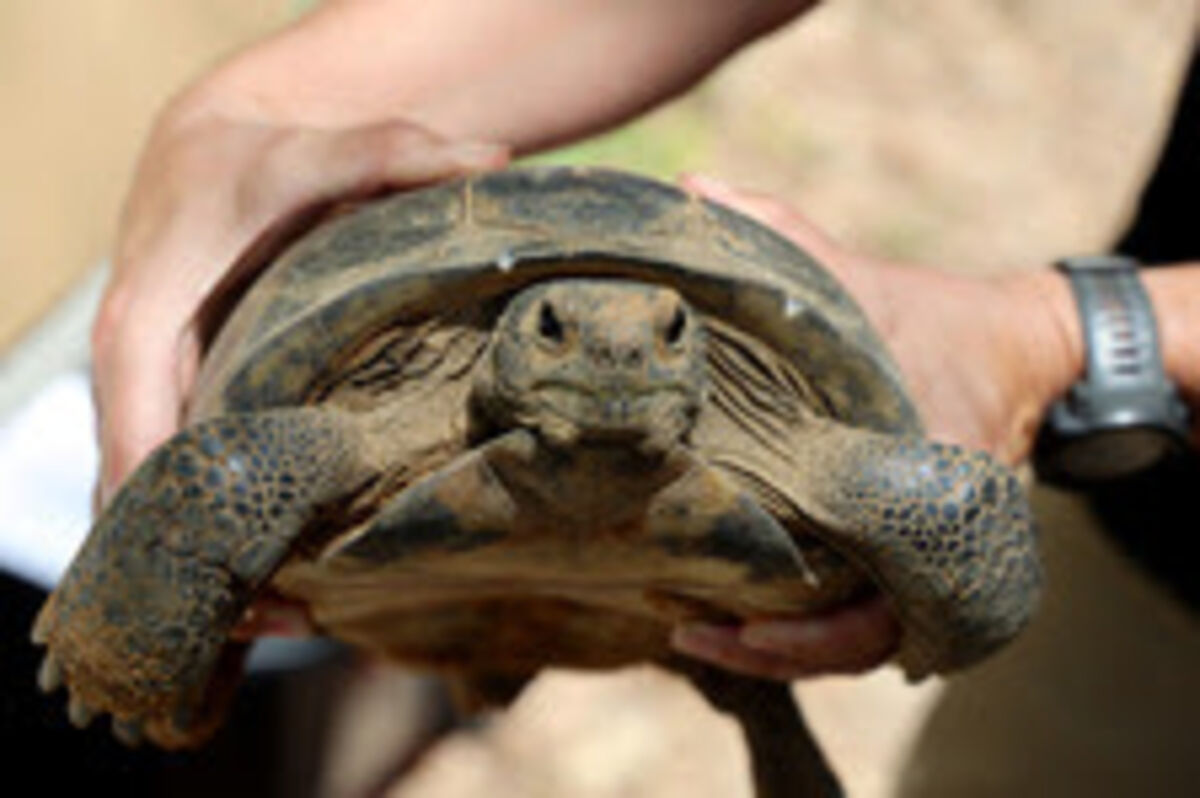
The gopher tortoise is considered a keystone species in Alabama's coastal plain.
With about 95 percent of land in Alabama in private ownership, partnerships with landowners and developers are crucial for the conservation of threatened species like the gopher tortoise. That type of collaboration happened recently in Baldwin County when development company 68 Ventures contacted the Alabama Department of Conservation and Natural Resources' (ADCNR) Wildlife and Freshwater Fisheries (WFF) Division about the discovery of gopher tortoise burrows.
Chloe Kelly, Director of Entitlements with 68 Ventures, is at the forefront of the company's extensive efforts to ensure environmental compliance, including determining if any sensitive species of animals need attention.
Recently Kelly and team found suspected gopher tortoise burrows at The Reserve, a residential development in Daphne. Kelly said 90 days prior to construction, the environmental team went in, and the burrow site was secured to be sure it was not disturbed. They established a 25-foot buffer to erect a silt fence to encircle the area. WFF was notified and the burrows were surveyed to see if they were occupied. Of the seven burrows discovered, six were occupied by gopher tortoises.
Charlanna Skaggs, ADCNR's Deputy Commissioner, was invited by WFF's Amy Silvano, Chief of Nongame Resources and Wildlife Health Section, to witness the relocation of the gopher tortoises from The Reserve to the Perdido River Wildlife Management Area (WMA) in east Baldwin County. She came away with a lasting impression.
"I had never joined any of our relocation activities with tortoises before," Skaggs said. "I was able to watch the environmental team and their contractor do their work. When I learned that it was a local contractor, 68 Ventures, I contacted them through a mutual friend to compliment the great job they did.
"It was fascinating to watch the equipment operator carefully remove the dirt. The gopher tortoise burrows were 8 feet deep. For them to be able to trace those all the way down and carefully remove the dirt from the top of the burrow was impressive. When the tortoises came out, they were perfectly fine and healthy."
Silvano and team weighed and measured each tortoise and prepared them for transfer.
Considered a keystone species of the longleaf pine ecosystem, the gopher tortoise is crucial for the survival and health of a variety of animal species, including the federally threatened Eastern Indigo Snake. In fact, more than 360 species of mammals, birds, reptiles, amphibians and invertebrates are known to spend all or a portion of their lives in either active or abandoned gopher tortoise burrows. Therefore, preserving gopher tortoises receives high priority for WFF's Nongame Section.
"It was great to see this group responsibly collect and preserve them," Skaggs said. "This is what (ADCNR) Commissioner (Chris) Blankenship talks about all the time – being able to balance our work with economic development, to balance conservation with business. This neighborhood was able to go in, but we were also able to conserve and protect those threatened species."
Silvano said the gopher tortoise has two ranges in Alabama; the western population is federally listed as threatened, and the eastern population is state protected.
"These tortoises are located on the very edge of the eastern range," Silvano said. "So, they (68 Ventures) are doing this for the benefit of the gopher tortoise. They reached out to us and wanted to work with us on a plan for relocation. We work with developers frequently to find a cooperative solution for them to move forward while still protecting the animals. Relocation is often the best recourse for protecting the animals when an area is targeted for development.
"They (68 Ventures) were willing to provide funds to build a waif pen where the gopher tortoises were relocated to. Gopher tortoises have a high homing instinct. If you move them out of an area, they are going to try to make it back to where they came from regardless of how far it is away. So, we build a multiple acre pen with silt fencing that is dug into the ground, and we will relocate gopher tortoises into that pen."
Ideally, after about a year, the gopher tortoise then considers the pen as its home. WFF then takes down the fence, and the gopher tortoises are free to roam. Silvano said 68 Ventures provided the funds for the silt fence and a contractor with a ditch-digging machine to bury the fence to make sure the gopher tortoises did not burrow out under the fencing.
"When we are looking for a site on one of our WMAs, it has to be within the gopher tortoise's range," she said. "If the animals come from the federal range, we relocate to a property within the federal range. What we're looking for is an open pine – in specific longleaf pine – forest with sandy soils. Geneva WMA, Blackwater SOA (Special Opportunity Area) and Perdido WMA are all within their range and have the appropriate soils for the gopher tortoise.
"This relocation to state-protected lands is a prime example of how development and conservation can go hand-in-hand. Developers in our state want to do the right thing."
The gopher tortoises thrive in dry, upland sandhill habitat with an open canopy in the pine forest with an array of ground cover. The animals feed on a variety of grasses and forbs, and a regular prescribed burning regimen promotes the growth of the preferred vegetation.
Although the gopher tortoise garners a great deal of attention, Silvano said WFF's job is to create habitat that benefits the entire ecosystem for numerous native species.
"Our goal with our wildlife agency is to manage for ecosystem function," she said. "Some people think we are managing for only deer and turkey. That's not the case. We manage for habitat to support all the animals that would naturally occur in those habitat types."
This gopher tortoise relocation wasn't the only relocation that 68 Ventures has been involved in. Another tract that is being developed in Daphne at Plantation Hills has a gopher tortoise burrow network. The company and its contractors successfully relocated those gopher tortoises to a tract of land the company donated to the City of Daphne north of Highway 64.
"We do an endangered and threatened species study on every site we evaluate," Kelly said. "Depending on the site, there could be species that are endangered or threatened and we want to be considerate of their habitat. Typically, on the Gulf Coast we're looking for gopher tortoises, Eastern indigo snakes, black bear, eagles, red-cockaded woodpeckers and certain salamanders that are protected."
Conservation Commissioner Blankenship added, "This is one example of why it is so important for ADCNR and Forever Wild to have property where we can house and protect those species. Having publicly owned property set aside allows private property owners to develop their property while, at the same time, allowing us to be able to protect, conserve and increase valuable species like gopher tortoises. 68 Ventures reached out to us. I think that is absolutely awesome. We hope more developers will read this and do the same. This partnership shows it can work and work well."





Reader Comments(0)