
The people's voice of reason


The people's voice of reason

AI-written content is everywhere today, from news sites to social media to classrooms. And it's not always easy to tell what's written by AI and what's written by humans. AI-generated content can be dangerous when it's used to spread misinformation, like hyperrealistic videos of events that didn't happen or social media posts presenting false information as real news.
To understand how often people say they can tell the difference between AI-generated and human-made content, Pangram Labs partnered with YouGov PLC to poll 2,557 people on if they think they can spot misleading content online. The survey showed that 67% of people who consume online content say they've seen AI-generated content that they believe provided false, misleading, or incorrect information.
AI has made it possible for bad actors to spread more misinformation online than ever. The survey found that 67% of people who consume online content — everything from online news articles to streaming and podcasts — say they've spotted AI-generated content that was false, misleading, or otherwise incorrect. Meanwhile, 16% of online users say they have not seen misleading AI-generated content, and 17% aren’t sure.
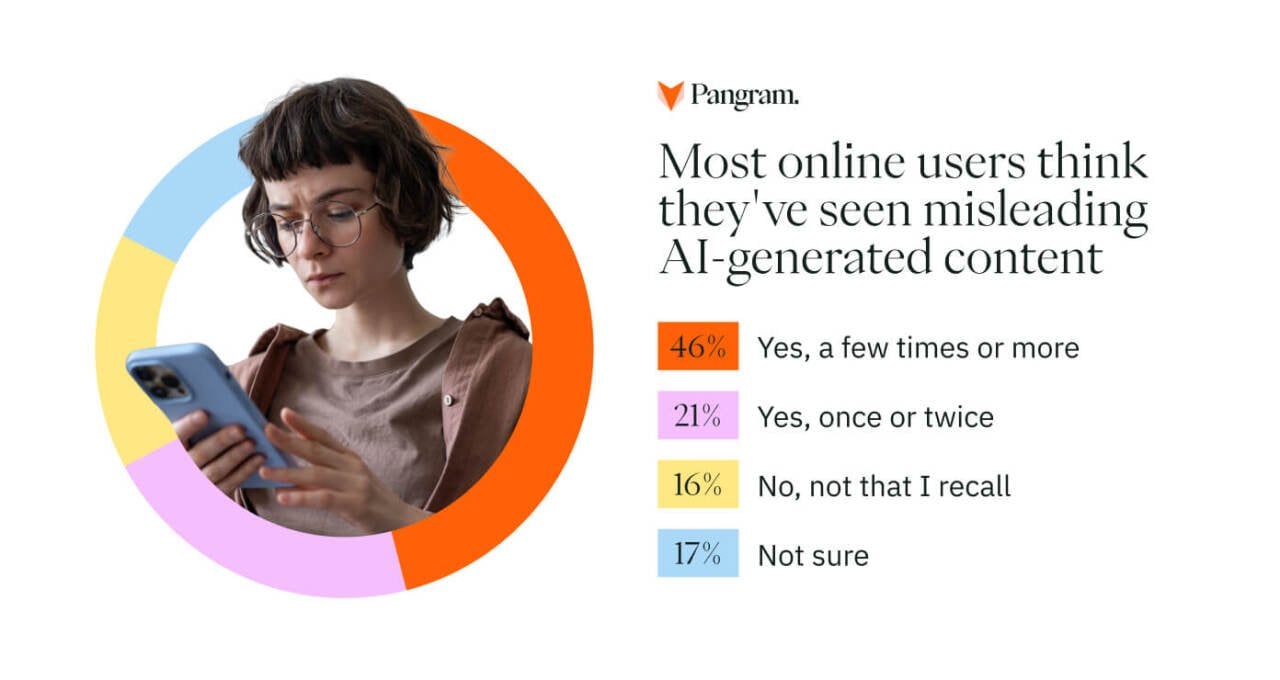
Online Gen Zers (ages 18-28) are the likeliest generation to say they've seen false or misleading AI-generated content. More than half (55%) of Gen Z respondents say they frequently see misleading AI-generated content online, compared to 47% of millennials (ages 29-44), 43% of Gen Xers (ages 45-60), and 43% baby boomers (ages 61-79).
Looking at the social media platforms themselves, the vast majority of Reddit users (84%) and Discord users (87%) say they come across misleading AI-generated content. Meanwhile, even though misinformation (AI-generated or not) is very common on TikTok, only 68% of TikTok users say they've spotted misleading AI-generated content.
Users who report seeing AI-generated content by platform:
Many people who use the web now know AI is being weaponized for malicious uses, like creating political misinformation or deepfakes. And it's likely there's more misleading content people aren't catching. This can be especially harmful when AI-generated content is used at school and work, and when people mistake AI-generated content for actual news and opinion articles, political messaging, or health and legal advice.
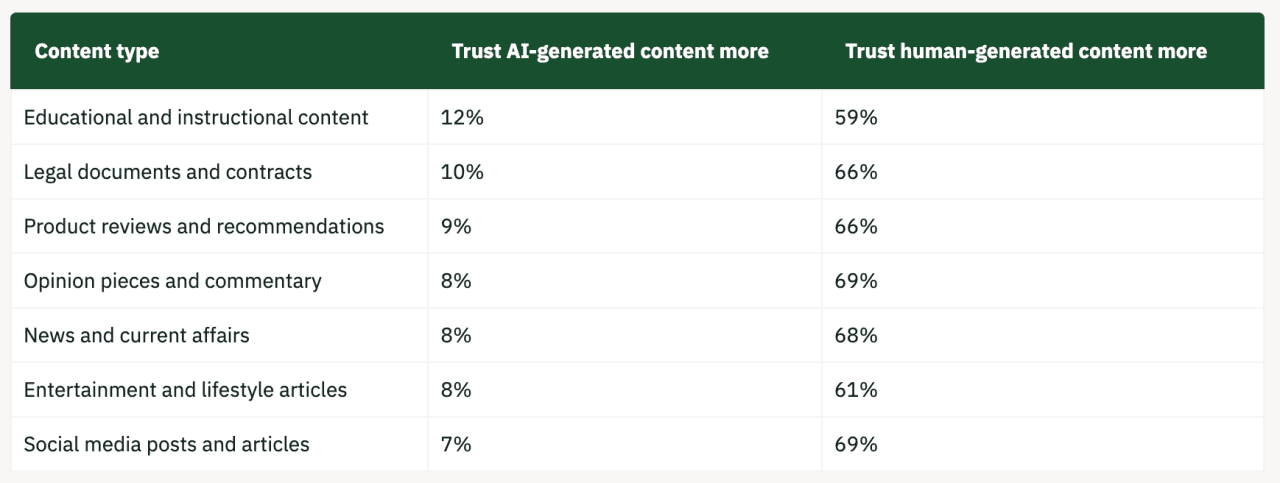
AI-generated content can be frequently misleading or contain more errors than content made by humans. Now, two-thirds (69%) of online users say they trust AI-generated content less than they do human-generated content. Only 8% trust AI-generated content more than human-made content.
Generally, people trust AI-generated content less, no matter the actual type of content, but more people tend to distrust AI-generated news, product reviews, and opinion pieces. People are most likely to trust AI-generated educational or instructional content (12%), but only by a very slim margin.
People trust human-made content more, regardless of the content type
Because many people don't trust AI content, 61% of people who use online content say they're unlikely to read or engage with content if they think it's AI. Only 31% say they're likely to engage with it. In theory, this may help people avoid misinformation. But if someone can't tell the difference between AI-generated and human-made content, they may dismiss real news and important information as AI. Even worse, AI deception can enable fraud, manipulation, and other harmful effects.
Undisclosed AI content is flooding social media feeds with spammy, low-effort content. Even worse, it's often fraudulently presented as human-made, even if it doesn't contain misinformation.
Around one-third (35%) of people don't believe they can definitively tell the difference between AI-generated content and content created by humans. More than half (56%) do believe they can spot it, however.
Gen Zers are much more likely than older people to say they can spot undisclosed AI-generated content, with only 22% of Gen Zers saying they can't tell. In comparison, baby boomers are more split; 46% think they can't tell the difference, and 41% think they can. People who use AI frequently are better at detecting AI-generated text than people who don't use AI much. If Gen Zers use AI more frequently than older people, that could make them better at spotting it.
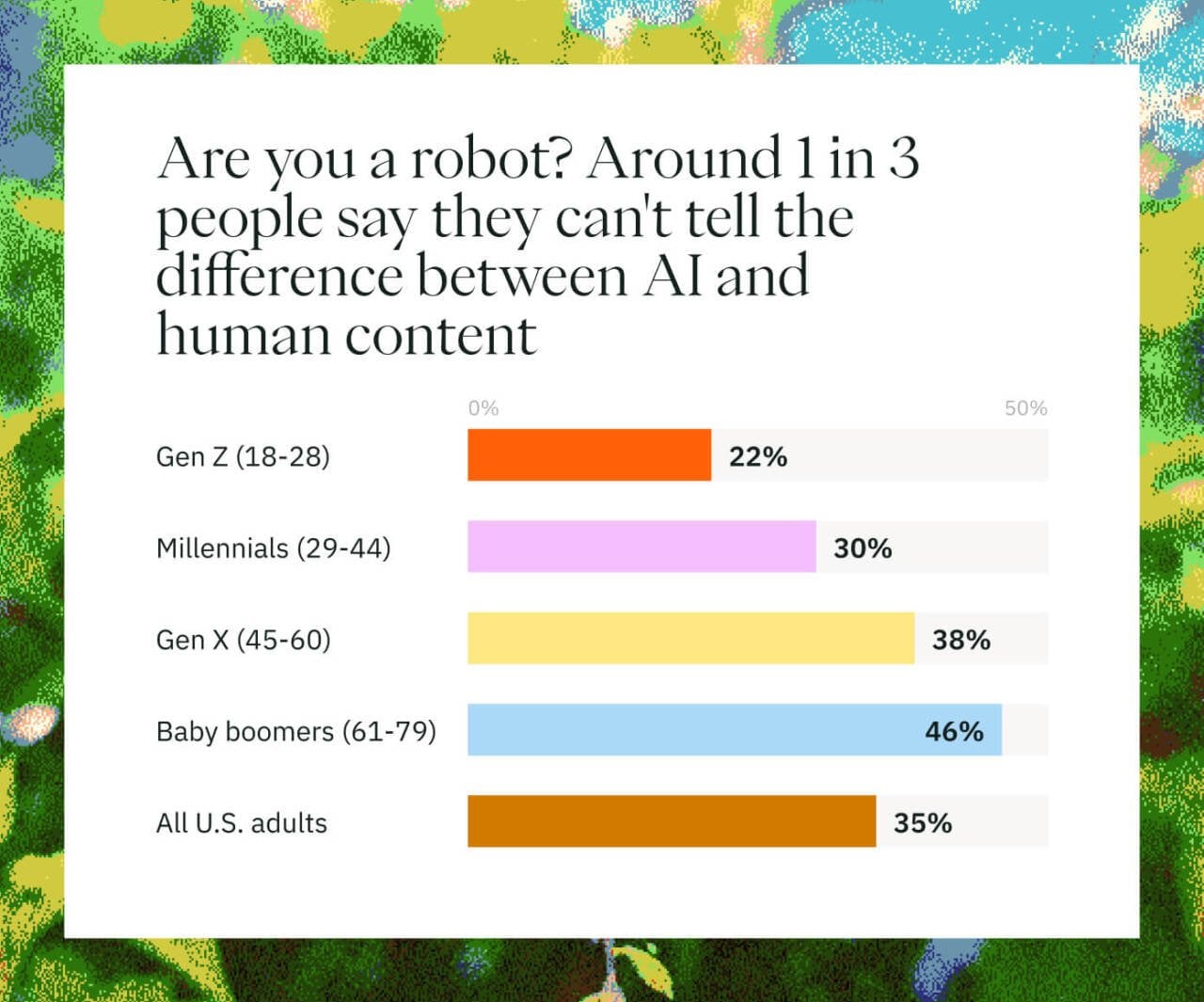
Gen Z and millennials are more likely than Gen X and boomers to say they can tell AI-generated content from human-written content.
Overall, nearly three-quarters (71%) of people who consume online content believe they're seeing AI-generated social media posts or online articles at least several times a week, with 41% seeing it daily.
Interestingly, 10% see it a few times a month or less, and 7% don't know if what they're seeing is AI-generated. The number of AI-written articles and other content is growing, and it's very unlikely that regular social media users never see AI content. Many people may just be unable to tell the difference.
Despite the high percentage of baby boomers who say they can't tell the difference between AI and human content, 48% believe they see AI content daily, the highest percentage of any generation. In comparison, only 37% of Gen Zers and 37% of millennials say they see it daily.
Many companies do not currently disclose when their content is AI-generated, even though there are a few nationwide regulations requiring them to do so. Three-quarters (75%) of online users say they're interested in a tool, app, or browser extension that alerts them when they're experiencing AI-generated content online or on social media.
Knowing the difference between AI-generated and human-made content is a crucial skill to use the internet safely.
This survey was conducted by YouGov PLC on behalf of Pangram. All figures, unless otherwise stated, are from YouGov PLC. The total sample size was 2,557 U.S. adults. Fieldwork was undertaken from April 9-13, 2026. The survey was carried out online. The figures have been weighted and are representative of all U.S. adults (aged 18+).
This story was produced by Pangram Labs and reviewed and distributed by Stacker.







Reader Comments(0)