
The people's voice of reason


The people's voice of reason
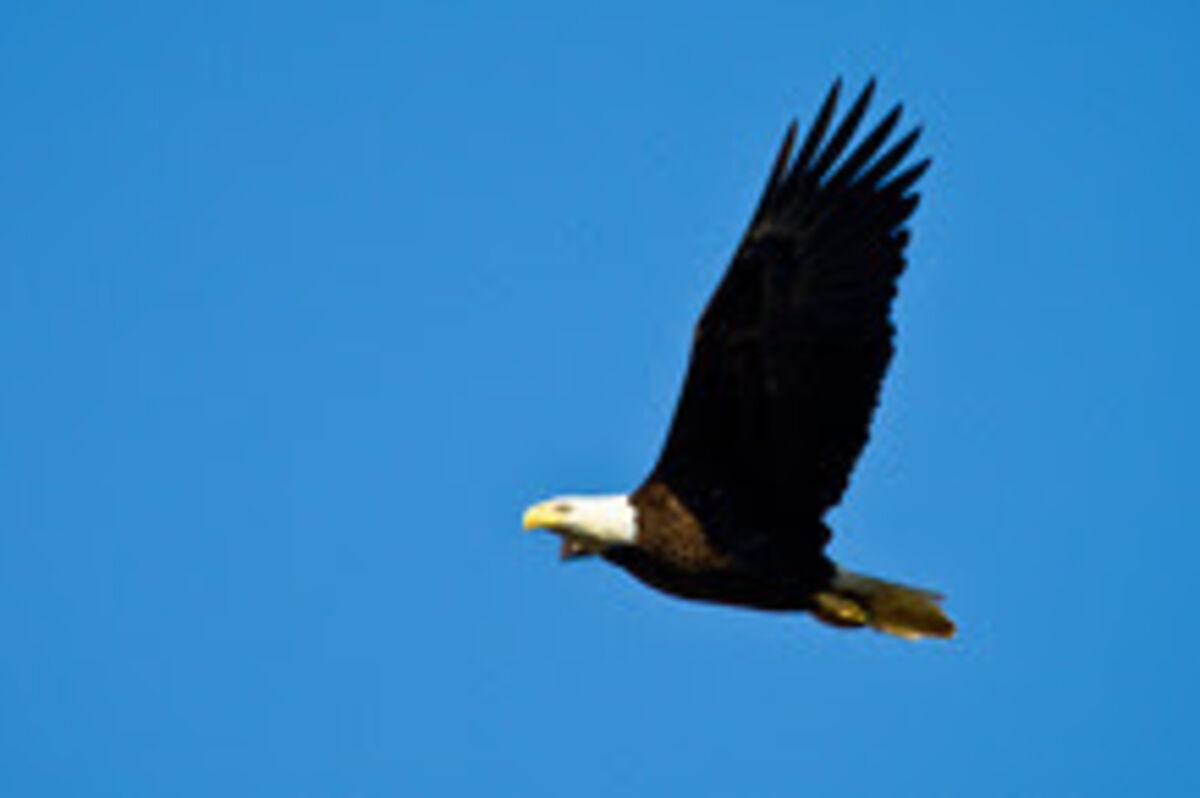
Soaring bald eagles will be flying over Lake Guntersville State Park during Eagle Awareness Weekends.
An overflow crowd is expected to celebrate the 40th anniversary of Eagle Awareness Weekends at Lake Guntersville State Park in January, and no one will be more excited about this achievement than Linda Reynolds and Renee Raney.
Reynolds was the first naturalist at Lake Guntersville State Park and a trailblazer who, with the help of volunteers, organized the first Eagle Awareness Weekend in 1985. That inaugural event was a life-changing experience for Raney, who attended as a college student from Jacksonville State University.
The Eagle Awareness Weekends are set for January 23-25, 2026, and January 30-February 1, 2026, at Lake Guntersville. Visit http://www.alapark.com/EagleAwarenessWeekends and click on the link to reserve a spot for a package holder, which includes lodging, several meals, all of the presentations and all of the guided tours during the event. Space is limited. Check back online in December for the availability of day passes.
Raney, Alabama State Parks' Chief Naturalist, said she came to an Eagle Awareness Weekend when she was 18; it was one of the first conservation education programs she engaged with as a university student.
"It was part of the reason I chose a career in environmental education and conservation," Raney said. "I have literally been involved in Eagle Awareness for 40 years, either as an ornithology tour guide, a presenter or, now, as a coordinator. It's really exciting for me to see this 40th year of existence. Alabama has had a great success story with this endangered species. Not only did Alabama State Parks care, but basically the entire country cared to send representatives and guests to Lake Guntersville State Park to support this program."
Alabama State Parks Director Matthew Capps provided praise for the State Parks staff, the naturalist team and volunteers who have made it possible for Eagle Awareness Weekends to continue to thrive into their 40th year.
"It's a great achievement that our Eagle Awareness Weekends will reach a milestone like this and celebrate our national bird, the bald eagle," Capps said. "Alabama State Parks thanks all those who contributed to making these weekends such a success."
The history of eagles in Alabama, especially bald eagles, is truly a remarkable recovery story. Conflicts with humans in the late 1800s and early 1900s left the eagle population decimated. The Bald Eagle Protection Act of 1940 provided civil penalties for those who "take, possess, sell, purchase, barter, offer to sell, purchase or barter, transport, export or import, at any time or any manner, any bald eagle ... [or any golden eagle], alive or dead, or any part (including feathers), nest, or egg thereof."
Another setback for the eagles occurred with the introduction of DDT insecticide, which caused damage to eagle nesting success. DDT was finally banned in 1972, but by that time, the eagle population had plummeted to about 1,000 birds. The U.S. Fish and Wildlife Service listed bald eagles as endangered in 1967.
The Alabama Department of Conservation and Natural Resources' (ADCNR) Wildlife and Freshwater Fisheries Division created its Nongame Wildlife Program in 1982, and it became a part of a multi-state effort in the Bald Eagle Restoration Program in 1984. Mercedes Maddox, WFF Nongame Biologist, who is one of the presenters during the Eagle Awareness Weekends, said Alabama used a technique called hacking to help the population rebound. Hacking is where the biologists force an immature bird to take its first flight in a desired area. Eaglets from Florida and Alaska were released at specific locations with depleted populations. The goal was for the eagles to imprint on those areas and return when they became sexually mature.
The first eagle to take flight from one of the hacking towers occurred in 1985 at Lake Guntersville. The first documented nest success occurred in 1991, and the efforts have been so successful that Alabama has eagles in all 67 counties in the state.
Raney said enthusiasm for Eagle Awareness Weekends has never waned, attracting people from all over the world.
"This year is just as exciting as ever with the energy of Eagle Awareness Weekends stronger than ever," she said. "Under the guidance of our first Park Naturalist, Linda Reynolds, the series originally spanned the entire month of January. Since then, the park has transformed the program into two concentrated weekends, packed with engaging programs, thrilling eagle sightings and unforgettable experiences. This focused format lets us deliver all the magic of the event in a more immersive, high-energy way, proving that even after four decades, the wonder of our eagles continues to captivate and inspire, now carried forward by our incredible interpretive team: Park Naturalist Anna Crow, District Naturalist Eric Cline and myself."
Before Eagle Awareness Weekends started, Reynolds was a housewife rearing four kids, but she and her late husband, Richard, always found time to enjoy and explore the outdoors, especially around Lake Guntersville. Becoming the naturalist at the State Park was the result of an encounter with a snake.
"My husband and I volunteered a lot in the park," Reynolds said. "They had hired a girl, and I took her on a hike because I knew the park. We were on a narrow trail with a little drop-off down to a creek, and the other side of the trail had a little cliff. Well, there was a snake on the trail, and she climbed the cliff. It took me 20 minutes to talk her back down."
The new hire decided to take another direction in her career, and Reynolds was offered the job in 1985.
Reynolds and her husband had been taking people to see migratory eagles at an overlook accessible by a paved road. The eagles were roosting on a shoreline opposite the road, and those sighting trips became increasingly popular. Those sightings occurred in the winter when Lake Guntersville State Park had its lowest occupancy of the year and needed something to spur visits.
"I advertised in Atlanta and all the big cities around," she said. "We had a one-day event with a field trip, and 500 people showed up."
On that first field trip, 89 eagles were documented.
"That's a lot of eagles," Reynolds said.
The Eagle Awareness Weekends started with spartan conditions with no dedicated funding. The event depended on volunteers. Presenters with live birds of prey came from Auburn University, the Wildlife Center in Atlanta and Montgomery Zoo.
"It was a success from the very beginning," Reynolds said. "And we filled the lodge every weekend. People love eagles."
The upcoming Eagle Awareness Weekends will include live bird demonstrations by Raptor Ridge Wildlife Education, Wings to SOAR, Alabama Wildlife Center and Auburn University Raptor Center. Numerous field trips are included in the package. On Saturday, January 31, State Parks will present the Eagle Awards to a group of people who have served Alabama State Parks in exemplary fashion.
"Eagle Awareness Weekends are extremely special because it's not just a gathering of scientific minds; it's a gathering of friends and family and a tribe of like-minded people, some who have been to every Eagle Awareness Weekend for the past 40 years and some newcomers," Raney said. "Whether you're an established attendee or a new visitor, you're going to step into an atmosphere of comfort and coziness. You're going to see some of the most extraordinary nature images imaginable with wild eagles, wild birds of prey, migrating waterfowl and the presenters who bring their passions and talents to the program. You will meet live bald eagles up close, and you will see live bald eagles, even nesting bald eagles, during these weekends.
"As a university student, I was very fortunate to be invited to participate in the first Eagle Awareness Weekend, where one of my mentors, Linda Reynolds, stood on that stage and talked about how important the species is to Alabama and to the planet Earth. It has been an honor to work beside her and numerous others to see this program be successful for four decades."
Raney said the pre-dawn Early Bird Coffee feature of the weekends is truly special as well.
"Before sunrise, standing on the edge of a chilly mountain lake, you can behold 75 participants looking up at the gray sky, watching for these eagles to come off of their roosts and make a magnificent flight past us, heading out into the park to forage," she said. "Last year, we saw between 20 and 30 eagles at each of our morning watches. It makes getting up early worth it, and cold fingers are forgotten.
"Eagle Awareness Weekends are truly special because they offer more than just an event; they're an experience. From the thrill of live bird demonstrations to captivating programs led by expert speakers, every moment is an invitation to marvel. Guided eagle safaris transform the sky into a theater of awe-inspiring sightings, while the landscapes of Lake Guntersville come alive with the call of wild creatures and the silent grace of birds of prey. It's a chance to reconnect with nature, create unforgettable memories, make forever friends and witness the power and spirit of America's most iconic bird."
For more information about Lake Guntersville State Park or any of the 20 other Alabama State Parks, visit http://www.alapark.com.






Reader Comments(0)