
The people's voice of reason


The people's voice of reason
NASA pushes moon landing back to 2028
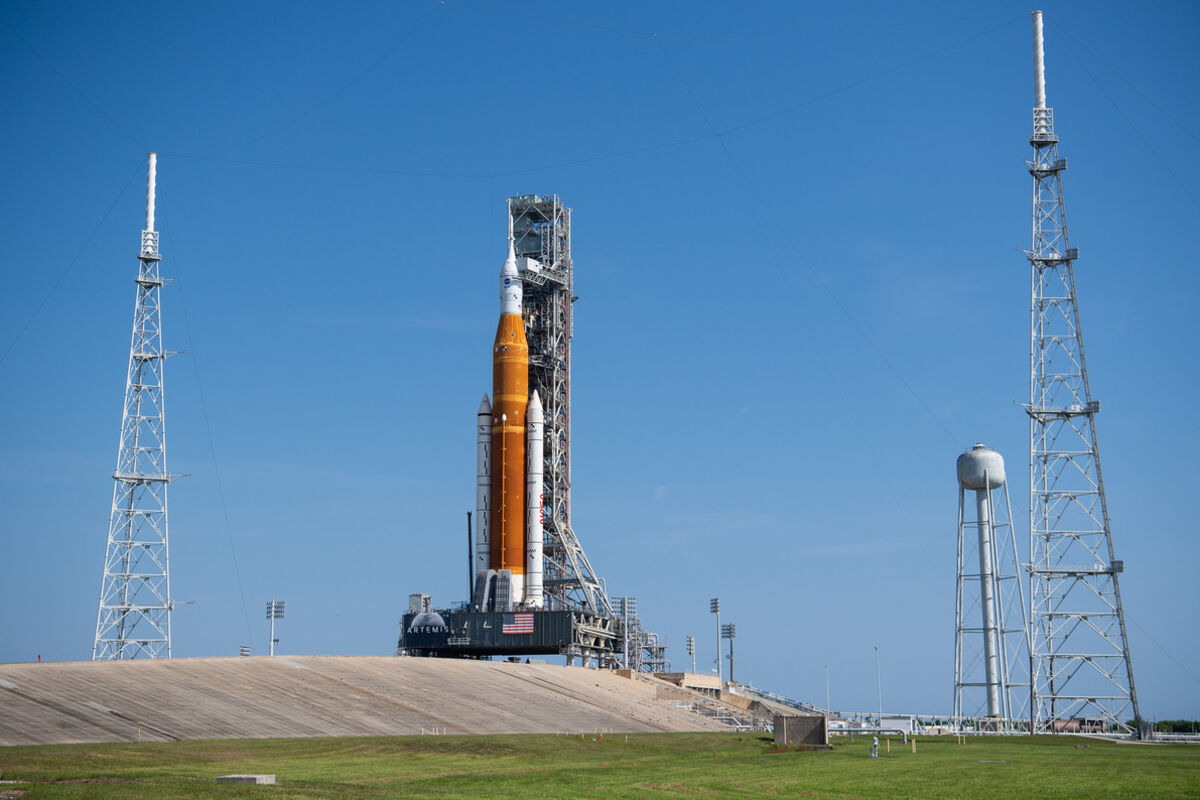
The Space Launch System on the launchpad
NASA has formally entered what leaders are calling a new Golden Age of exploration, unveiling a sweeping acceleration of the Artemis program that will reshape the United States' return to the Moon and redefine the pace of human deep‑space missions. In a major announcement Friday, the agency confirmed it will increase its flight cadence, standardize its launch architecture, add a new mission in 2027, and conduct at least one lunar surface landing every year thereafter.
The decision marks the most significant structural shift in Artemis since the program's inception and reflects growing geopolitical urgency, technological maturation, and a renewed national commitment to sustained lunar presence.
A Strategic Shift Toward Speed, Reliability, and Annual Landings
NASA Administrator Jared Isaacman framed the announcement as both a strategic necessity and a return to the disciplined, iterative approach that defined the Apollo era. With China accelerating its own lunar program, Isaacman emphasized that the United States must move faster, reduce delays, and adopt a more standardized architecture to maintain leadership.
"NASA must standardize its approach, increase flight rate safely, and execute on the President's national space policy," Isaacman said. "With credible competition from our greatest geopolitical adversary increasing by the day, we need to move faster, eliminate delays, and achieve our objectives."
The new plan calls for:
- A standardized SLS Block 1 configuration for upcoming missions
- An added Artemis mission in 2027
- A minimum of one lunar landing per year beginning in 2028
- A step‑by‑step capability build‑up modeled after Mercury, Gemini, and Apollo
This approach mirrors the cadence of the 1960s, when NASA launched crewed missions roughly every three months-far faster than the multi‑year gaps between Artemis flights today.
Artemis II: Final Preparations for the First Crewed Flight
The announcement comes as NASA teams work intensively to prepare Artemis II, the first crewed mission of the program. On Feb. 25, the SLS rocket and Orion spacecraft were rolled back into the Vehicle Assembly Building (VAB) at Kennedy Space Center to address a helium‑flow issue in the Interim Cryogenic Propulsion Stage.
Once inside the VAB, engineers immediately began:
- Replacing flight termination system batteries
- Conducting end‑to‑end range safety tests
- Troubleshooting the helium leak
- Preparing the vehicle for a launch window expected no earlier than April
Artemis II will send four astronauts on a lunar flyby, testing life‑support systems, navigation, and deep‑space communications in preparation for later landings.
Artemis III Reimagined: A New 2027 Mission Focused on Earth‑Orbit Testing
Under the updated architecture, Artemis III-originally planned as the first crewed lunar landing-will now launch in 2027 as a low Earth orbit systems‑test mission.
This redesigned mission will:
- Conduct rendezvous and docking with one or both commercial landers from SpaceX and Blue Origin
- Perform in‑space tests of docked systems
- Complete integrated checkouts of life support, propulsion, and communications
- Test the new xEVA lunar surface suits
NASA officials said the mission's detailed objectives will be finalized after additional reviews with industry partners.
This shift reflects a broader strategic philosophy: test in space before committing to a landing, reducing risk and ensuring reliability. It also mirrors the Apollo sequence, where missions like Apollo 7, 8, 9, and 10 each built incrementally toward Apollo 11.
Artemis IV: The First Landing of the New Cadence
With Artemis III redefined, Artemis IV-scheduled for 2028-becomes the first lunar landing mission under the new plan. NASA expects to conduct at least one landing per year beginning with Artemis IV, with the possibility of two landings in 2028 depending on lander readiness.
This annual cadence is designed to:
- Establish a sustained human presence on the Moon
- Support construction of the Artemis Base Camp
- Enable regular deployment of scientific instruments
- Prepare for eventual crewed Mars missions
Standardizing the SLS and Orion Stack
A major component of NASA's acceleration strategy is the decision to standardize the SLS and Orion configuration, avoiding the costly and time‑consuming transition to the more complex Block 1B variant.
NASA Associate Administrator Amit Kshatriya explained that altering the configuration between missions would introduce unnecessary risk and slow the program's momentum.
"There is too much learning left on the table and too much development and production risk in front of us," Kshatriya said. "We want to keep testing like we fly and have flown."
Instead, NASA will:
- Continue using the Block 1 upper stage
- Maintain consistent pad systems
- Apply an Apollo‑style incremental approach to mission design
This consistency allows engineers to refine systems across multiple flights, improving reliability and reducing turnaround time.
Workforce Rebuilding: A Return to In‑House Expertise
NASA's recently announced workforce directive is central to enabling the faster cadence. The agency plans to rebuild core competencies within its civil‑service workforce, increasing the amount of in‑house development and side‑by‑side engineering with commercial partners.
This shift reflects lessons learned from Artemis I and II, where hydrogen and helium leaks caused months‑long delays. NASA leaders believe that deeper internal expertise will help identify and resolve such issues more quickly.
Industry Partners Respond: Boeing Signals Readiness
Industry partners welcomed NASA's announcement, with Boeing-the prime contractor for the SLS core stage-emphasizing its readiness to support a higher flight rate.
"The SLS core stage remains the world's most powerful rocket stage, and the only one that can carry American astronauts directly to the moon and beyond in a single launch," said Steve Parker, president and CEO of Boeing Defense, Space & Security. "Our workforce and supply chain are prepared to meet the increased production needs."
Parker highlighted the national footprint of the SLS program, designed at Marshall Space Flight Center in Huntsville, built at Michoud Assembly Facility in New Orleans, and integrated at Kennedy Space Center-a point of pride for Alabama's aerospace community.
A Race Against Time-and Against China
NASA's acceleration is driven in part by concerns that China's lunar program could outpace the United States. Analysts warn that China may attempt a crewed lunar landing before the end of the decade, raising the stakes for Artemis.
Isaacman acknowledged this geopolitical pressure directly, noting that the U.S. cannot afford multi‑year gaps between missions.
"Launching SLS every three and a half years or so is not a recipe for success," one senior NASA official said, contrasting the slow Artemis cadence with the rapid tempo of Apollo.
A Program Entering Its Most Ambitious Phase
With Artemis II nearing launch, Artemis III redefined as a critical systems‑test mission, and Artemis IV positioned as the first landing of a new annual cadence, NASA is entering the most ambitious phase of its modern exploration program.
Acting associate administrator Lori Glaze praised the agency's direction: "Our team is up to the challenge of a successful Artemis II mission, and soon thereafter, enabling a more frequent cadence of Moon missions."
The coming years will test NASA's ability to sustain momentum, manage complex partnerships, and execute a long‑term lunar strategy. But if successful, the Artemis program will not only return Americans to the Moon-it will establish a permanent foothold for science, exploration, and future missions to Mars.





Reader Comments(0)